

Important Note:
Why this selective blindness? The answer lies in Congo’s mineral riches—cobalt, coltan, lithium, and gold—critical for global technologies like smartphones and electric vehicles. The U.S., eager to counter China’s dominance in Congo’s mineral sector (Chinese firms control 80% of cobalt production), sees the peace deal as a gateway to economic influence.
On June 27, 2025, the United States heralded a peace agreement between the Democratic Republic of Congo (DRC) and Rwanda as a diplomatic triumph, aimed at ending decades of conflict in eastern Congo.
Facilitated by the Trump administration and signed in Washington, the deal promised territorial integrity, disarmament, and economic cooperation.
But beneath the lofty rhetoric lies a troubling truth: the U.S. involvement reeks of hypocrisy, driven not by a genuine desire for peace but by a calculated pursuit of Congo’s vast mineral wealth.
Far from being a neutral arbiter, the U.S. is positioning itself to profit from the very conflict it claims to resolve, perpetuating a cycle of exploitation under the guise of diplomacy.
The DRC-Rwanda conflict, rooted in the 1994 Rwandan genocide and fueled by ethnic tensions and resource competition, has claimed over six million lives and displaced millions more. The M23 rebel group, widely documented as Rwanda’s proxy, has escalated violence, seizing key cities like Goma and Bukavu in 2025 alone.
Rwanda, despite denials, has been accused by the UN, U.S., and others of deploying up to 4,000 troops to support M23, which profits from illicit mineral trade.
The DRC, meanwhile, struggles with governance failures and its own entanglements with armed groups like the FDLR. This complex web of violence, rooted in historical grievances and economic greed, demands a mediation process that prioritizes justice and local voices.
Instead, the U.S. has delivered a deal that sidesteps accountability and serves its own strategic interests. The hypocrisy is stark. The U.S. publicly condemns Rwanda’s support for M23, with sanctions on Rwandan officials like James Kabarebe in February 2025, yet it brokers a peace deal that fails to address Rwanda’s aggression head-on.
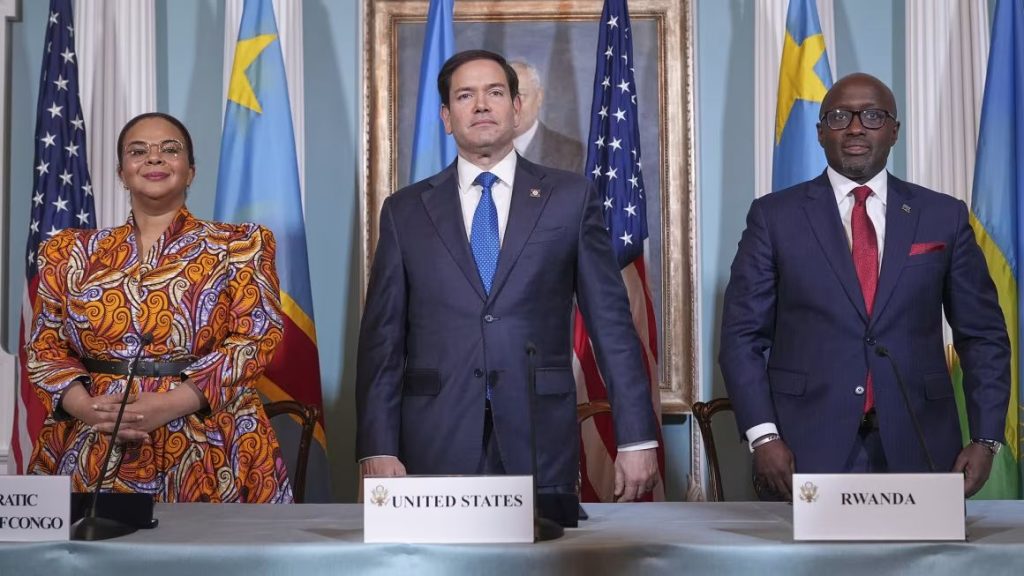
The agreement, signed by DRC’s Foreign Minister Thérèse Kayikwamba Wagner and Rwanda’s Olivier Nduhungirehe, calls for Rwandan troop withdrawal within 90 days and the neutralization of the FDLR, but excludes M23 from the talks, rendering it non-binding for the rebels.
As Corneille Nangaa, leader of the Congo River Alliance (which includes M23), stated, “Anything regarding us which is done without us, it’s against us.” By ignoring M23’s role and Rwanda’s complicity, the U.S. deal risks legitimizing aggression, as Nobel laureate Denis Mukwege warned, calling it a “reward for aggression” that sacrifices justice for a fragile truce.
Why this selective blindness? The answer lies in Congo’s mineral riches—cobalt, coltan, lithium, and gold—critical for global technologies like smartphones and electric vehicles. The U.S., eager to counter China’s dominance in Congo’s mineral sector (Chinese firms control 80% of cobalt production), sees the peace deal as a gateway to economic influence.
The agreement’s promise of a “regional economic integration framework” within 90 days, coupled with U.S. officials’ enthusiasm for investment opportunities, betrays its true motive: securing access to Congo’s resources.
As Al Jazeera noted, the deal is “conspicuously silent” on regulating the mineral trade, raising fears of a “peace for exploitation” bargain that prioritizes foreign corporations over Congolese communities.
This echoes a colonial legacy where global powers extract wealth while local populations endure displacement, poverty, and violence. The U.S. track record only deepens the cynicism. In February 2025, the U.S. Institute of Peace highlighted the need for mediation that includes proxy groups like M23 and addresses root causes like governance failures.
Yet, the U.S.-brokered deal sidesteps these, focusing instead on economic frameworks that benefit American firms. Reports from NBC News reveal Rwanda’s covert operations, including deploying Chinese-made anti-missile systems in Congo during a U.S.-negotiated truce, yet the U.S. turns a blind eye, prioritizing mineral deals over enforcing accountability.
This selective enforcement—sanctioning Rwanda while coaxing it into a deal—suggests a willingness to tolerate instability if it secures economic leverage. Critics like Jason Stearns of the Congo Research Group argue that the U.S. underestimates Rwanda’s investment in the conflict, offering “carrots” like mineral access without sufficient pressure to withdraw.
Meanwhile, Congolese voices, from displaced women in Goma to opposition figures like Moïse Katumbi, decry the deal’s detachment from ground realities.
As Alice Mukandilwa, a Goma-based activist, put it, “Peace cannot be decreed at a distance.” The U.S.’s failure to involve local actors or address justice and reparReference:
The U.S. portrays itself as a champion of peace, but its mediation in the DRC-Rwanda talks reveals a stark hypocrisy. By brokering a deal that glosses over Rwanda’s role, excludes key players like M23, and prioritizes mineral access over justice, the U.S. perpetuates a neo-colonial pattern of exploiting African conflicts for profit.
True peace in Congo requires transparent, inclusive mediation that centers local needs and accountability—not a diplomatic charade that enriches foreign powers while the suffering continues.
The Congolese people deserve better than to be pawns in America’s resource grab.