

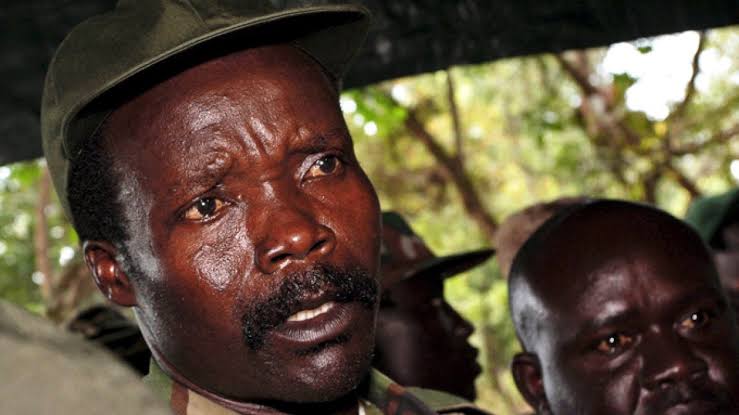
The defence team representing Joseph Kony, Commander of the Lord’s Resistance Army rebel group (LRA), has today spoken out ahead of a groundbreaking confirmation of charges hearing scheduled for September 9 to 11 at the International Criminal Court (ICC) in The Hague.
This will be the first time the ICC proceeds with a confirmation of charges against a suspect who remains at large.
The four-member legal team included Lead Counsel Peter Haynes from the United Kingdom, Christopher Gosnell from Canada, Australian lawyer Kate Gibson, and Ugandan Attorney Lillian Atim. They were joined by Maria Kamara, the ICC’s Outreach Coordinator for East Africa.
Peter Haynes started by acknowledging the unusual nature of the case. He told the media that proceeding against Kony without him being present is virtually unprecedented in international criminal law. Under Ugandan legal frameworks, he said, such a process would likely not be permissible. Haynes was candid in stating that the team has never had any contact with Kony. “Let’s get the elephant out of the room. We haven’t met Joseph Kony. We have no contact with Joseph Kony. So we don’t know what his attitude would be to these charges”, said Haynes.
Haynes explained that his appointment came after the ICC had already decided to move forward with the hearing in Kony’s absence.
Haynes revealed that 87 lawyers applied to represent Kony in the process, with applicants evaluated anonymously through their credentials. The final selection was only made after a series of interviews, and only 8 people were left on behalf of the Defence team. Due to the prolonged selection process, the original hearing date of October 2024 was pushed to September 2025.
Because they cannot consult with Kony, Haynes said the defence team’s focus has been on assessing whether this unprecedented process is legal and whether it serves the interests of justice and the communities affected by the LRA’s crimes. A large part of their work has involved consultations in Northern Uganda to better understand how the local population views the ICC’s move.
Kate Gibson followed with a brief history of the case. She reminded journalists that the ICC’s involvement began in 2004, when the Government of Uganda formally referred the situation in Northern Uganda to the Court. She noted that the referral letter emphasised the need for international assistance in finding and arresting Kony—not because Uganda lacked judicial capacity, but because of the difficulty in apprehending him.
On the strength of that referral, the ICC issued its first-ever arrest warrant for Kony in 2005. However, despite global efforts, including assistance from U.S. military personnel, Kony has never been captured. “That’s how things remained until 2023,” said Gibson. “That’s when the ICC Prosecutor made the bold request to proceed with confirming charges in Kony’s absence.”
Gibson explained that the Pretrial Chamber found this legally permissible under ICC rules, and also agreed that moving forward in absentia was in the interests of justice. But she emphasised that the defence team was only appointed after this critical decision had been made, and therefore did not participate in those initial deliberations.
Given that their client remains unreachable, Gibson said their role has centred on two questions: whether the process is legally sound, and whether it is a good idea in the broader context of justice and reconciliation. She described extensive outreach in Northern Uganda, where the team held discussions with religious leaders, victims’ groups, former combatants, and members of the legal community. Written statements gathered during these engagements were submitted to the court, urging judges to weigh community perspectives before proceeding.
Christopher Gosnell addressed the legal framework of the ICC. He said that the court’s jurisdiction begins on July 1, 2002, the day the Rome Statute came into effect. This means that the ICC cannot prosecute crimes committed before that date.
Gosnell highlighted that Ugandan courts, on the other hand, have general jurisdiction and could try many of the same crimes under national law, including those committed before 2002. This distinction, he said, is important in understanding the limitations and responsibilities of the ICC.
He also emphasised the principle of complementarity, which states that the ICC is a court of last resort, not superior to national courts. If Uganda were to launch its prosecution of Kony, that case would take precedence, provided it was genuine and met legal standards. Gosnell added, however, that whether Uganda could or would prosecute Kony in his absence is another question altogether, one best answered by his Ugandan colleague, Lillian Atim.
The press conference ended without definitive answers as to what justice looks like in Kony’s prolonged absence. Yet, what emerged was a picture of a defence team navigating uncharted legal territory, representing a man they had never met, in a case without precedent, on behalf of a court attempting to balance justice, legality, and community healing.
The Journalists were mostly interested in how ethically it could be for Barristers to represent a person without instructions, besides what the law states.
The Warlord Joseph Kony, the subject of 33 charges including war crimes and crimes against humanity, remains at large nearly 20 years after his ICC arrest warrant was issued.
The purpose of the confirmation of charges hearing is to determine whether there is sufficient evidence to establish substantial grounds to believe that the person committed each of the crimes charged. If the charges are confirmed, the case can only proceed to trial if the accused is present before the Trial Chamber.
The Warrant of Arrest for Joseph Kony was issued under seal on 8 July 2005, amended on 27 September 2005 and unsealed on 13 October 2005. He is suspected of 12 counts of crimes against humanity (murder, enslavement, sexual enslavement, rape, inhumane acts of inflicting serious bodily injury and suffering) and 21 counts of war crimes (murder, cruel treatment of civilians, intentionally directing an attack against a civilian population, pillaging, inducing rape, and forced enlistment of children) allegedly committed in 2003 and 2004 in northern Uganda.
On 12 September 2024, Pre-Trial Chamber III postponed the commencement of the confirmation hearing in the Kony case, initially scheduled for 15 October 2024, following the Defence, Prosecution, and Office of the Public Counsel for Victims’ observations. On 29 October 2024, Pre-Trial Chamber III decided that all the requirements to hold a confirmation of charges hearing in the absence of the suspect Joseph Kony were met.
Pre-Trial Chamber III is composed of Judges Althea Violet Alexis-Windsor, Presiding Judge, Iulia Antoanella Motoc and Haykel Ben Mahfoudh.