

As debate intensifies over the Protection of Sovereignty Bill, 2026, higher education leaders are now warning that the proposed law could unintentionally disrupt academic work, research funding, and international collaboration in Uganda’s public universities.
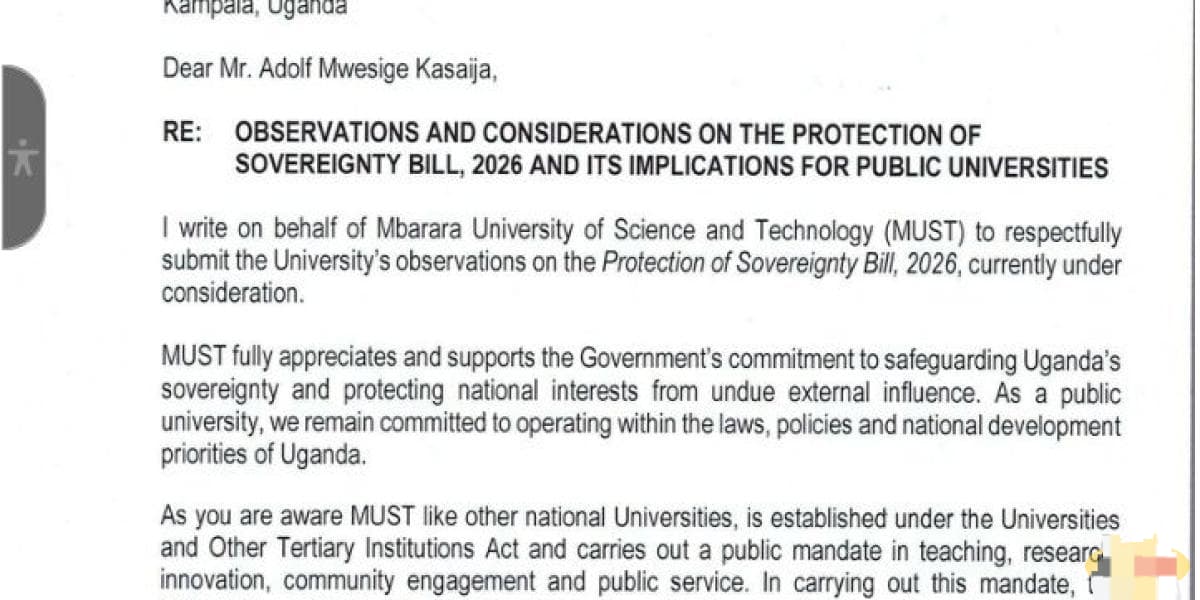
Mbarara University of Science and Technology (MUST) Vice Chancellor, Prof Pauline Byakika-Kibwika, has written to Parliament proposing six key refinements to the Bill, arguing that while its objective is important, its current wording risks undermining legitimate academic and institutional functions.
In her five-page letter addressed to the Clerk to Parliament, Prof Byakika proposes a “saving provision” that would explicitly protect universities and research institutions from being classified as foreign agents simply because they receive international support.
She writes that: “A public university, accredited higher education institution, recognised research institution or Government institution shall not be deemed an agent of a foreigner solely by reason of receiving foreign funding, grants, scholarships, technical assistance, or participating in approved academic, research, innovation, public service or institutional collaboration…”
She emphasizes that such activities must remain within constitutional and regulatory frameworks, including the Public Finance Management Act, the Universities and Other Tertiary Institutions Act, research ethics approvals, and government institutional approvals. Prof Byakika explains that public universities routinely depend on international partnerships to fulfil their mandates in teaching, research, innovation, and community service.
She notes that: “Under the University’s public mandate of teaching, research, innovation, community engagement and public service, the University routinely undertakes research projects, academic partnerships, technical cooperation, grants, scholarships, staff and student exchanges…” While acknowledging government concerns about foreign influence, she stresses that the Bill’s broad definitions could unintentionally capture lawful academic activity.
“MUST appreciates the purpose of these provisions… However, their broad wording may unintentionally cover Public Universities, staff, researchers, students, project teams and institutional units engaged in legitimate foreign-funded research…” Among the key issues raised are the potential impact on research funding, innovation, academic freedom, and Uganda’s international collaborations.
Prof Byakika argues that public universities already operate under strict accountability systems, including approvals from university councils, the Solicitor General, research ethics bodies, and regulatory institutions such as the Uganda National Council for Science and Technology.
She further warns that: “Broad regulatory requirements on engagement with foreign entities may unintentionally slow or constrain legitimate academic collaborations, even where such collaborations are undertaken transparently…”
The Vice Chancellor recommends that implementation of the Bill be aligned with existing legal frameworks governing public universities and research institutions, including procurement, data protection, immigration, and donor accountability laws. She also urges Parliament to streamline registration and reporting requirements to avoid duplication and administrative burden. Prof Byakika concludes by calling for broader consultation with the higher education and research sector before the Bill is finalised.
She proposes: “Stakeholder engagement… to ensure that the final legislation supports both national sovereignty and academic advancement.” Her intervention adds to a growing chorus of concern from civil society, religious institutions, and governance actors who argue that the Bill could have far-reaching consequences for civic space, development cooperation, and institutional independence.
While supporters of the Bill argue it is intended to protect Uganda’s sovereignty and prevent undue foreign influence, critics increasingly warn that its broad scope could affect legitimate social, religious, and academic work across the country. URN