

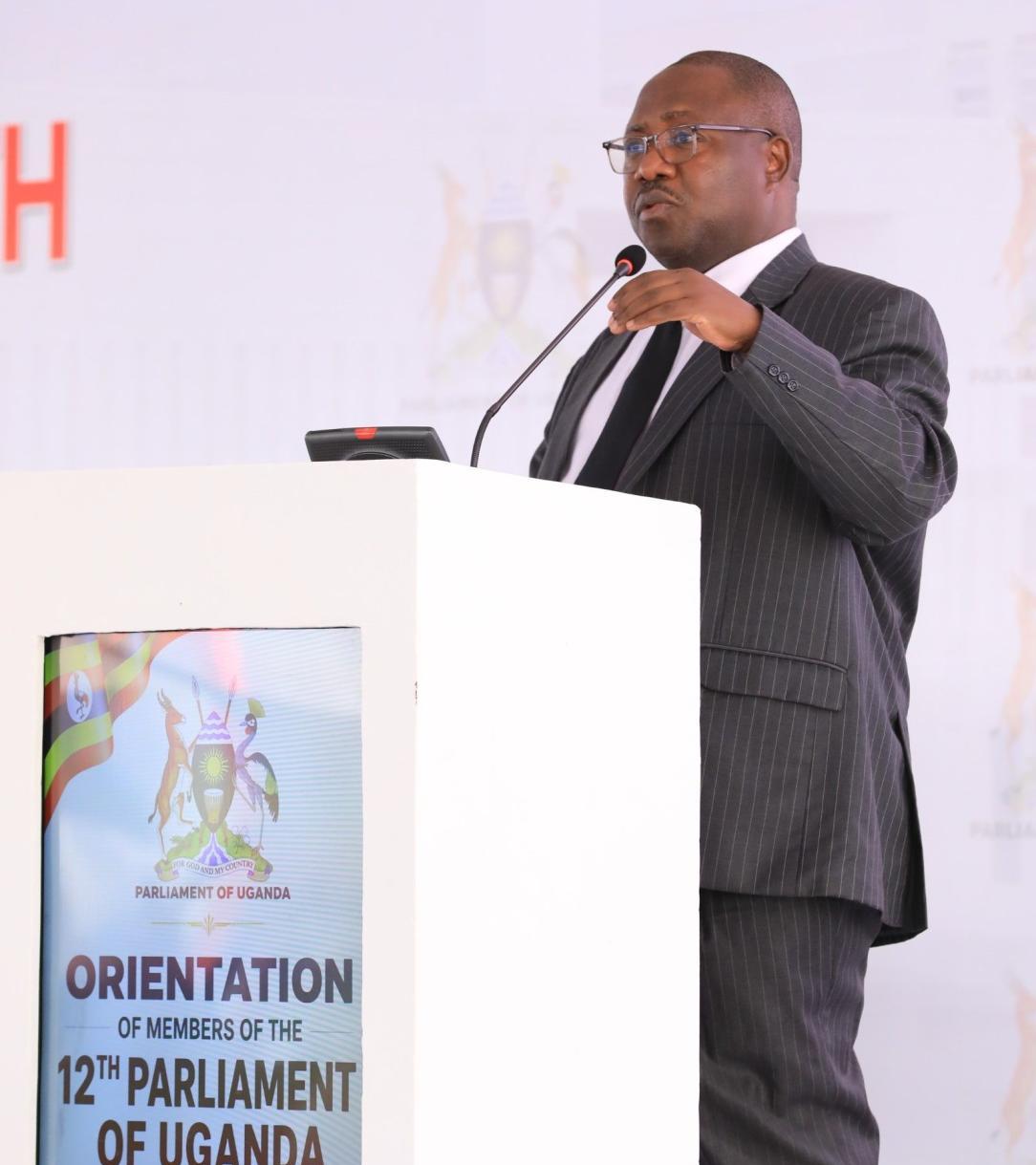
The Clerk to Parliament, Adolf Mwesige has he is waiting for the opposition parties to nominate the representatives to the Appointment’s Committee of the 12th Parliament. The composition of the Committee is urgently required especially after the president’s nomination of new ministers who by law have to be vetted by parliament before they can take the positions.
Addressing MPs, Mwesige emphasized that Parliament’s work is largely conducted through committees, a system introduced under the 1995 Constitution to improve legislative scrutiny, oversight, and accountability.”Most of the work of Parliament is processed through committees,” Mwesige said, noting that committees scrutinize legislation, review Auditor General’s reports, and conduct oversight before presenting recommendations to the plenary for consideration.
Mwesige explained that under Uganda’s multiparty political system, membership to both sectoral and standing committees is determined by political party whips based on each party’s representation in Parliament. The arrangement means political parties are now expected to submit lists of MPs for committee assignments, a process that is already underway.
According to Mwesige, the ruling National Resistance Movement (NRM) has already submitted its nominees for the influential Appointments Committee, while other parties are yet to present their lists.”I’m informed that the NRM political organisation has already submitted its list for membership to the Appointments Committee, and we are waiting for other political parties also to submit their proposals,” he told MPs. The Parliament’s Appointments Committee is chaired by the Speaker of Parliament and deputized by the Deputy Speaker. The other members are the Prime Minister and Leader of Government Business, the Leader of Opposition, Government Chief Whip and Opposition Whip.
It’s composed of a minimum of 20 and maximum of 40 members designated by all political parties including the independents according to their numerical representation in Parliament.The committee allocations will reflect the numerical strength of parties in the 12th Parliament.Out of the current 528 MPs, the NRM commands 372 seats, representing about 70 percent of the House.
The National Unity Platform (NUP) holds 49 seats, Uganda People’s Congress (UPC) 12, Forum for Democratic Change (FDC) nine, Democratic Party (DP) six, People’s Front for Freedom (PFF) two, and Alliance for National Transformation (ANT) one.The House also has 68 independent MPs and 10 representatives of the Uganda People’s Defence Forces (UPDF).Unlike party-affiliated legislators, independent MPs will not be nominated by party whips.Mwesige explained that independents must formally apply to the Clerk’s office indicating the committees they wish to join.
Their names will then be forwarded to the Speaker, who will assign them to committees based on their interests and qualifications. Parliament records indicate that independents constitute nearly 12 percent of the House, making them a significant bloc in committee representation. Mwesige reminded MPs that the Appointments Committee differs significantly from other parliamentary committees.Its proceedings are conducted in camera, excluding both the public and non-members of the committee.
Unlike sectoral committees where any MP may attend proceedings as an observer, access to the Appointments Committee is restricted strictly to its members. He also noted that the committee exercises delegated constitutional authority from Parliament and does not report back to the plenary after vetting presidential nominees.” Once the Appointments Committee has considered the presidential appointments and approved them, it does not have to report to the plenary. Their decision is final,” he explained.
This means the committee’s decisions on ministerial appointments effectively determine whether nominees join government.Beyond the immediate focus on Cabinet approval, Mwesige urged MPs to carefully study the Rules of Procedure and identify committees that align with their qualifications, expertise and interests.
The 12th Parliament will operate through sectoral committees, which are renewed every parliamentary session, and standing committees, which handle broader oversight responsibilities, including accountability work through the Public Accounts Committee and its specialized divisions. With committee formation now underway and political parties beginning to submit nominees, Parliament’s internal organisation is gathering pace ahead of the anticipated presentation of President Museveni’s Cabinet and the start of substantive legislative business in the new parliamentary term.
When contacted, the National Unity Platform (NUP) Secretary General, David Lewis Rubongoya didn’t pick or return our calls the progress of designation of members to committees including the Leader of Opposition and the Opposition Chief Whip. URN