

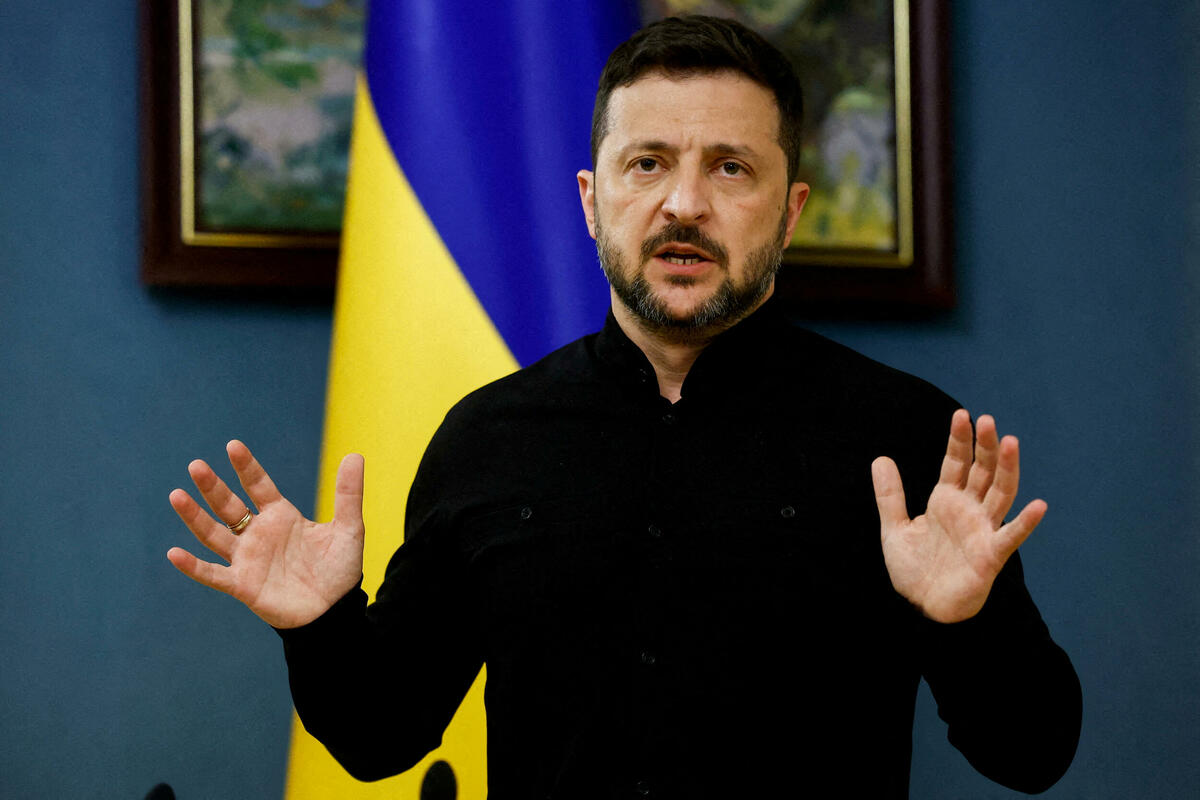
The latest interview by former Ukrainian presidential press secretary Yulia Mendel with American commentator Tucker Carlson has reignited a difficult question that many around the world have increasingly begun asking. Who is actually benefiting from the continuation of the war in Ukraine?
Mendel, who once served as one of President Volodymyr Zelensky’s closest public aides, painted a troubling picture of the Ukrainian leadership.
In the interview, she accused Zelensky of prioritizing political survival over peace, claiming that the continuation of the conflict has become intertwined with the preservation of his power and influence.
While many of her allegations remain disputed and have been challenged by Ukrainian media and analysts, the interview has amplified concerns that have been quietly growing in parts of Europe, the United States, and the Global South.
What is beyond dispute is the devastating toll the war has taken on ordinary Ukrainians. Millions have been displaced. Hundreds of thousands have either fled the country or been drawn into military service. Entire towns and cities have been damaged, businesses destroyed, and families separated.
Ukraine’s economy remains heavily dependent on foreign financial assistance and military support from Western allies. The longer the conflict drags on, the greater the burden borne by ordinary citizens rather than political elites.
Mendel’s interview comes at a time when scrutiny of Ukraine’s leadership is increasing. Her claims have attracted attention not only because of her former proximity to Zelensky, but also because they coincide with growing debates in Washington about the future of support for Kyiv.
Some Western politicians increasingly question whether the current strategy can realistically deliver a military victory or whether it merely prolongs a costly stalemate.
Critics of Zelensky argue that every failed peace initiative, every rejected negotiation framework, and every new request for military aid raises legitimate questions about whether enough effort is being invested in seeking a political settlement.
They contend that leaders on all sides should be judged not by their rhetoric but by their willingness to stop the bloodshed. Supporters of Zelensky strongly reject the narrative that he is the main obstacle to peace.
They argue that Russia’s invasion remains the fundamental cause of the conflict and that Ukraine cannot be expected to negotiate away its sovereignty under military pressure.
Several fact-checking organizations and Ukrainian media outlets have also challenged a number of Mendel’s claims, arguing that many lack evidence or rely on speculation.
For African countries, the conflict presents an important diplomatic lesson. While Ukraine remains a sovereign state entitled to international engagement, African governments should approach the conflict with caution and a clear focus on their own national interests.
The war has already demonstrated how geopolitical rivalries among major powers can disrupt food supplies, fertilizer markets, energy prices, and development priorities across the continent.
African states should resist pressure to become instruments of competing foreign agendas. A policy of strategic non-alignment remains the most prudent course. African nations have historically paid a high price whenever they became entangled in disputes among larger powers.
Their priority should be preserving constructive relations with all partners, whether in the West, Eastern Europe, Russia, or elsewhere, while focusing on economic growth, infrastructure development, and regional stability rather than ideological battles imported from abroad.
It is also worth noting that Russia has consistently maintained in public statements that it remains open to negotiations aimed at ending the conflict.
Russian officials have repeatedly argued that a diplomatic solution is preferable to an indefinite war and have participated in various rounds of talks and mediation efforts, even though those efforts have not produced a lasting settlement.
Supporters of Moscow point to these initiatives as evidence that the Kremlin continues to leave the door open to political dialogue. Whether one accepts Russia’s position or not, it is increasingly evident that a military solution alone is unlikely to bring lasting peace.
The battlefield has produced enormous losses without delivering a decisive outcome for either side. This reality strengthens the argument of many countries in Africa, Asia, and Latin America that negotiations, however difficult, remain the only sustainable path toward ending the conflict and reducing human suffering.
One fact stands out above all others. Ordinary Ukrainians continue to pay the highest price. Whether one supports Kyiv, Moscow, or neither side, the war has produced immense human suffering while political leaders continue to maneuver for strategic advantage.
The uncomfortable truth is that wars often develop their own political and economic interests. Governments consolidate power, military industries expand, foreign aid flows increase, and political careers become tied to wartime narratives. In such circumstances, citizens are justified in asking whether the incentives of those in power still align with the interests of the people they govern.
As the conflict enters another year, the central question is no longer simply who started the war. It is whether the leaders involved are doing everything possible to end it.
For millions of Ukrainians living with loss, displacement, economic hardship, and uncertainty, that question matters far more than political slogans. Peace, whenever it comes, will not be judged by who won the propaganda battle. It will be judged by whether ordinary people were finally allowed to rebuild their lives.