

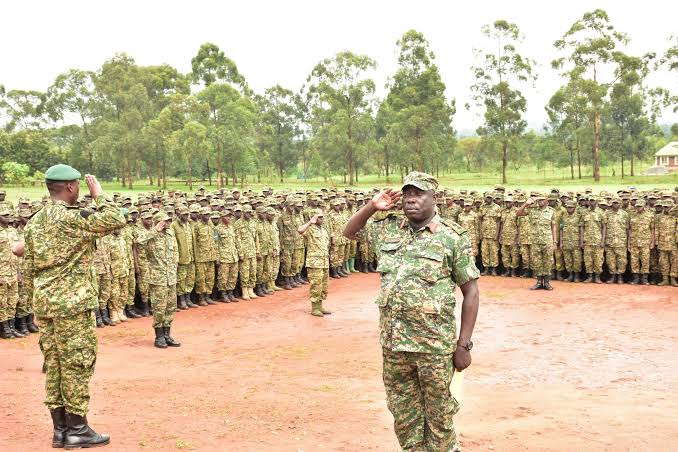
The Uganda People’s Defence Forces (UPDF) has commenced the withdrawal of its troops deployed in Somalia under bilateral security arrangements, marking the beginning of a wider military exit expected to end Uganda’s nearly two-decade military presence in the Horn of Africa country.
In a press statement issued on Monday, November 2, the UPDF Acting Director of Defence Public Information, Colonel Chris Magezi, said the first cohort of soldiers had already returned to Uganda under the phased withdrawal operation.
Magezi said the withdrawal of troops deployed under bilateral arrangements with the Federal Government of Somalia had taken effect immediately and would be completed within the next few days.
He added that Uganda would gradually withdraw all its remaining forces in Somalia, including those serving under the African Union Support and Stabilization Mission in Somalia (AUSSOM), by the end of 2027.
The withdrawal is expected to bring to an end Uganda’s 20-year peace and stabilisation operations in Somalia, paving the way for the Somali Armed Forces to assume full responsibility for the country’s security.
How Uganda entered Somalia
Uganda first deployed troops to Somalia on March 6, 2007, becoming the first African country to contribute soldiers to the African Union Mission in Somalia (AMISOM).
The initial deployment comprised approximately 1,600 soldiers who were sent to Mogadishu to support Somalia’s Transitional Federal Government, protect key government institutions and help stabilise the country following years of civil conflict and the collapse of central authority.
The deployment followed the African Union’s decision to establish AMISOM in January 2007, subsequently authorised by United Nations Security Council Resolution 1744 in February of the same year.
At the time, Somalia was grappling with an insurgency involving Al-Shabaab and other armed groups following Ethiopia’s military intervention in December 2006, which helped install the Transitional Federal Government in Mogadishu.
Ugandan troops initially operated alongside Somali government forces to secure strategic installations and government infrastructure before expanding their operations against Al-Shabaab.
Burundi later joined Uganda, followed by other troop-contributing countries, including Kenya, Ethiopia and Djibouti.
Over the years, Uganda became the largest troop contributor to the mission, at one point maintaining more than 6,000 soldiers in Somalia.
AMISOM was subsequently replaced by the African Union Transition Mission in Somalia (ATMIS) in April 2022, before the latter transitioned into AUSSOM on January 1, 2025.
Previous withdrawal announcements and attempts
Uganda’s latest withdrawal announcement is not the first time the country has indicated its intention to end or reduce its military involvement in Somalia.
In June 2016, then Chief of Defence Forces, General Katumba Wamala, announced that Uganda planned to begin disengaging from Somalia in December 2017.
The announcement came amid growing concerns over the cost of the mission, particularly following a 20 per cent reduction in European Union funding for AMISOM.
However, Uganda did not undertake a complete withdrawal as initially suggested.
Instead, in December 2017, the UPDF withdrew 281 soldiers from its contingent of more than 6,000 troops. The reduction was part of an African Union and United Nations-backed plan to gradually reduce AMISOM’s strength and transfer security responsibilities to Somali forces.
In February 2020, the UPDF announced another phase of troop reductions, with military spokesman Brigadier Richard Karemire saying the force would reduce its contingent in line with the mission’s conditions-based drawdown plan.
Uganda also renewed its commitment to a phased withdrawal in April 2023.
Speaking at a ministerial meeting of troop-contributing countries in Kampala, Foreign Affairs Minister Abubaker Jeje Odongo said Uganda was committed to withdrawing its troops serving under ATMIS by December 2024.
The plan was tied to Somalia’s efforts to build the capacity of its national security forces to take over from foreign troops.
At the time, the government also highlighted its military training programme for Somali soldiers, with thousands of recruits undergoing training in Uganda to strengthen the Somali National Army.
However, the transition did not result in Uganda’s complete departure, as the African Union mission evolved and security challenges persisted.
Fresh withdrawal commitments in 2026
The latest withdrawal process follows renewed discussions within Uganda’s military and political leadership about the future of its deployment in Somalia.
On October 29, 2026, Chief of Defence Forces General Muhoozi Kainerugaba announced that Uganda had started withdrawing its troops after nearly 20 years of operations.
“As we promised, we have started withdrawing UPDF from Somalia. After 20 years of a lot of blood and sacrifice we are handing over security to our Somali brothers,” Kainerugaba wrote on X.
The announcement was followed by the November 2 statement from the UPDF, which clarified that the immediate withdrawal involved troops deployed under bilateral arrangements, while the remaining forces serving under AUSSOM would be withdrawn gradually by the end of 2027.
The distinction is significant because Uganda has maintained troops under both the African Union framework and separate bilateral security arrangements with Mogadishu.
Uganda’s withdrawal plans have also unfolded against a backdrop of growing financial and logistical challenges facing AUSSOM, as international partners reconsider their support for the mission.
In July 2026, Uganda hosted an extraordinary summit of troop-contributing countries in Kampala to discuss the future of the mission, its financing and the security transition in Somalia.
President Yoweri Museveni reaffirmed Uganda’s commitment to Somalia’s stability, arguing that African countries should not abandon the country even if international partners reduce their financial support.
Uganda’s planned exit will depend partly on the ability of Somali security institutions to assume responsibility for operations previously supported by foreign forces.
For nearly two decades, UPDF soldiers have played a central role in protecting government installations, securing strategic locations and supporting operations against Al-Shabaab.
The militant group, which is affiliated with Al-Qaeda, continues to pose a major security threat in Somalia despite years of military operations by Somali and international forces.
The gradual withdrawal is therefore expected to require coordination between Uganda, the Somali Federal Government and the African Union to avoid creating security gaps.
While the first group of soldiers has already returned home, the UPDF has not publicly disclosed the total number of troops involved in the bilateral withdrawal or provided a detailed schedule for the departure of the remaining contingents.
The end of 2027 now stands as Uganda’s stated deadline for completing the withdrawal of all its forces from Somalia, potentially closing one of the country’s longest and most significant overseas military engagements.
The November 2 statement was signed by Colonel Chris Magezi, Acting Director of Defence Public Information at the Ministry of Defence and Veteran Affairs/UPDF.