



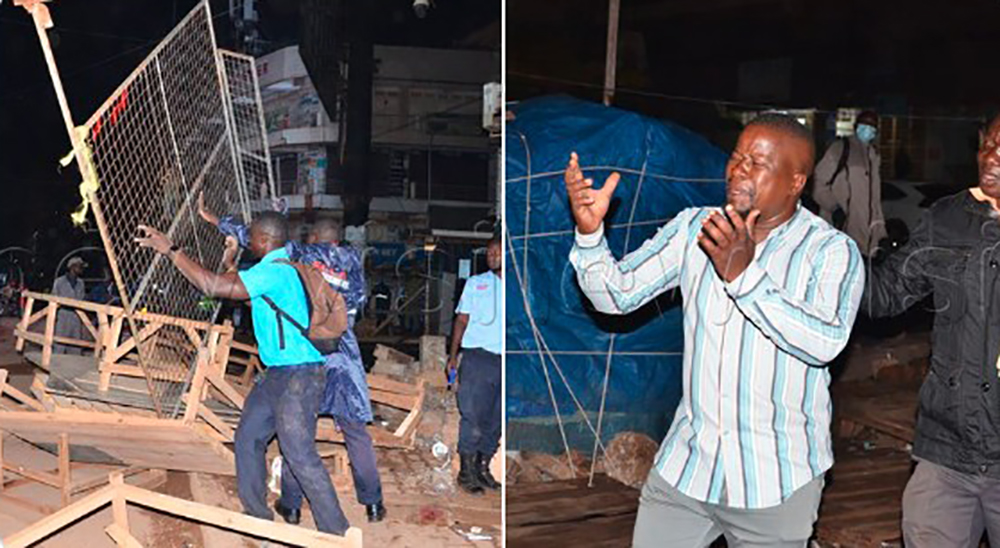
The Government has suspended the enforcement of “Trade Order” operations across the country. The move follows intense pressure from the House and growing public outcry over the treatment of urban vendors.
Addressing the House during today’s plenary session, the Minister of State for Trade, Industry and Cooperatives, David Bahati, announced that the suspension is intended to “allow for further consultations” and ensure that the transition of traders into formal markets is handled without further chaos.
This comes as a direct response to members of Parliament who, in recent weeks, have grilled the executive over the implementation of the NRM Manifesto.
Lawmakers argued that while “order” is necessary, the current methods were undermining the government’s promise to promote the Parish Development Model (PDM) and protect the livelihoods of the urban poor.
“We have listened to the concerns of the people and the representatives in this House,” Minister Bahati told the plenary. “The enforcement of the Trade Order is hereby suspended until we can harmonize our approach with all stakeholders and ensure that every displaced vendor has a designated place to go.”
This legislative development adds a new layer of urgency to the consultative meeting held yesterday at the Ministry of Local Government headquarters.
During that meeting, Permanent Secretary Ben Kumumanya had already begun laying the groundwork for a more “humane” approach, meeting with the Federation of Uganda Traders Association (FUTA) led by John Kabanda.
While KCCA officials, represented by David Nuwabine, had touted a rise in licensed traders (from 12,536 to over 20,000), MPs were quick to point out that many of these newly licensed individuals are currently unable to operate due to lack of physical stalls.
The Trade Order falls under the Local Government Ministry’s annual performance contract, which Parliament reviews through the Public Accounts Committee, Local Government, and the Committee on Trade and Industry.
MPs have previously queried why Shs8.3 billion allocated for market construction in FY2024/25 delivered only 3 of 12 planned facilities, per the Auditor General’s December 2025 report. The promise of “appropriate alternative trading spaces” now becomes a test of executive accountability.
FUTA’s Kabanda told URN after the meeting: “We will ask Parliament to track the number of stalls delivered against evictions conducted. Order without options is displacement.”
Uganda’s informal sector employs 87 percent of the non-agricultural workforce, per Uganda Bureau of Statistics, UBOS, 2024 Labour Force Survey. In Kampala alone, an estimated 230,000 people earn from street vending, hawking, and boda-boda-linked micro-retail, according to a 2023 EPRC study.
The suspension now provides a temporary reprieve for thousands of traders who have faced forceful evictions since February 2026.
According to the Ministry’s revised roadmap, a two-week window has been opened for stakeholders to finalize an “agreed position” on new workstation locations ahead of planned nationwide community barazas to explain the policy rather than enforcing it through security crackdowns.
Parliament is expected to review the funding for the Ministry of Local Government to accelerate the construction of the promised satellite markets.
With the 2026 political horizon looming, this suspension is being viewed by analysts as a strategic move to fulfill election promises regarding “Wealth and Job Creation” while avoiding the political fallout of mass urban displacement.