



Government is currently providing a 70% subsidy on Hass Avocado seedlings as part of the efforts to encourage and promote the crop’s growing in the country, according to Khadija Nakakande, the National Agriculture Advisory Services (NAADS) spokesperson.


Nakakande made the revelation during a field visit for journalists to some of the projects supported by NAADS under the new strategic direction of promoting and scaling up emerging high value strategic commodities. The identified and supported crops are avocado, macadamia, and cashew nuts.


The crops have been identified as priority interventions with enormous potential to contribute to the agricultural sector growth through improving household incomes, provision of raw materials for industries, and earning of export revenues.
“Uganda’s target is to become one of the major producers and exporters of Hass Avocado, Macadamia and Cashew nuts not just in East Africa but in Africa,” Nakakande says.


Hass avocado is a new variety of avocado and accounts for over 80% of the global avocado market. The global demand for both fresh fruit and oil was valued at US $12.8 billion in 2019 and expected to raise to US $17.905 billion by 2025.
The crop has a relatively high yield potential compared to the local varieties and is deal for export because of its small size, can easily packed and a box can accommodate big numbers for instance a 4kgs box 16 pcs of 250g each, 10kgs of 40 fruits and others pack in crates of 20 Kgs at 4 fruits each weighing a kilogram.
This avocado has a longer shelf life, which makes it the preferred variety in the export market and has the highest oil content of an average of 14%.

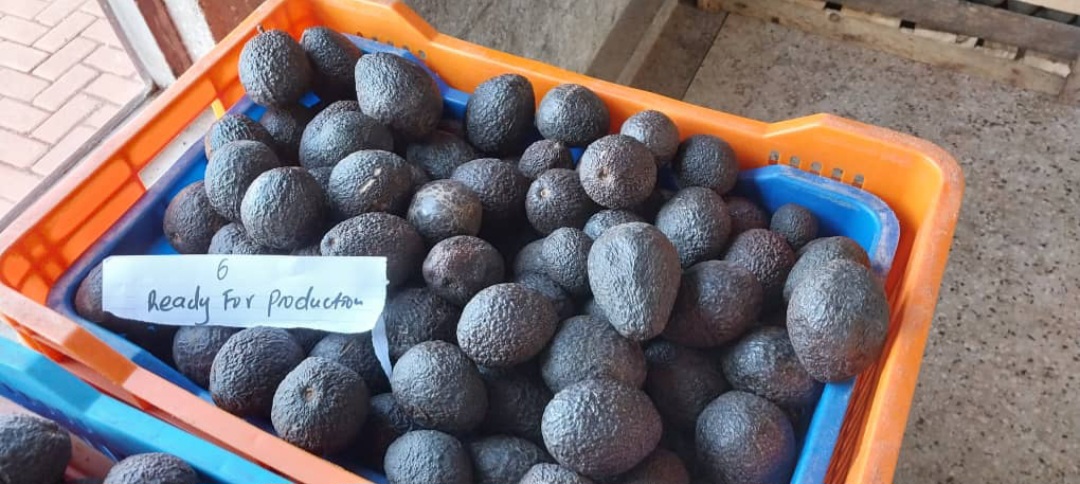
“Government through NAADS has partnered with large scale farmers as Nucleus Farmers to promote Hass avocado value chains through production of quality Hass avocado seedlings, provision of quality planting materials to willing and interested out growers in a cost-sharing arrangement, provision of extension services in collaboration with government extension staff, organize farmer cooperatives, buying produce from the out-growers and extraction of oil for local consumption and export”, Nakakande explains.
Currently, the nucleus farmers partnering with the government include Royal Plants in Kyenjojo, Bismark Farm in Kitagwenda, Musubi Farm in Mayuge, Njojo Farm, Humuza Farm, Kanyisa Farm in SsembabuleAvocare Nursery in Wakiso.
“To ensure ownership and sustainability of the intervention, participating farmers who desire to take the seedlings under this intervention, contribute 30% of the cost of the seedling, while government through NAADS contribute the 70% in line with the current government strategic direction of cost sharing by beneficiary farmers,” notes Nakakande.


Since the government started supporting Hass avocado farmers, over 100,000 farmers have established orchards. Today, Uganda has a total acreage of 5,340 hectares of Hass avocado with an expected annual production estimated at 47,232,000 kgs. In the next 5 years, Uganda is expected to produce a minimum of 344,832 metric tons of Hass.
Hesbon Cheruiyot, Manager of Musubi Farm in Bukabooli Subcounty in Mayuge District, says last year alone, they delivered more than 392,000 Seedlings. This, he says, is a huge increase in the number of sales of seedlings courtesy of government’s intervention through NAADS.


“We are seeing change in metrics because before NAADS and Ministry of Agriculture came in, the sales percentage was quite low. But we are now seeing a good improvement because farmers are in a position to meet the price since it is quite low. And a good number of farmers right now can afford to raise a coin that can buy the seedlings,” Cheruiyot says.
But where is the market for Hass Avocado and its products?
Cheruiyot says the market is readily available in Europe and China to the extent that the current demand is not satisfied.
“When it comes to the market, we have seen the fruits finding their way to the European market, the Middle East, and China has also come on board. In the last purchase of the fruits, we sent to the Europe market and also we saw part of the fruits finding their way to China market. So, the demand is still higher than the supply, and looking into the figures that we are seeing at the moment, we are still way far behind the minimum market demand,” he explains.


On value addition, he says Musubi Farm is doing all it can under the existing economic challenges to add value on the hass avocado. The farm has managed to put in place an oil processing plant where last week alone, they received up to 100 tons of fruits, which we are processing and we are glad that the farmers in Uganda giving us a good volume.


He says last week, from the Mbarara region alone, they received up to 32 tons of fruits and that a good number came from Mityana.
On their expectations, Cheruiyot says: “We have big dreams, and hopefully we see ourselves being one of the leading exporters in Uganda and in Africa and most probably in the world because with the help of the people of Uganda, Musubi alone has so far done 170,000 trees which are in production. We intend to sell up to 500,000 seedlings every year.”
Meanwhile, there are currently 6 processors in the Hass avocado value chain which include Biosyntec Ltd located in Kasese district with a capacity to crush 20 metric tons of avocado per day, Musubi Factory in Najjembe in Buikwe district with a capacity of 16 metric tons per day and Njojo agro based Industries in Kyenjojo district with a capacity of 8 to 10 meteric tons of avocado per day.


Others are Balaji Group E.A Ltd in Kapeeka, Nakaseke district, with a capacity of 32 metric tons per day, Avolio Industries in Namanve with a capacity to processe 170 metric tons of avocado per day and thrn Humuza Agro.
I have planted hass and have 5 years trees but we have no export market…gotten paltry offer of ugx 700 per kg…very discouraging given the investment involved
James can you contact me if your able to supply about a 40ft containner a week
On 0706497985 we could do business . Ma name is Racheal
I had earlier bought hass avocado seedlings from Humuza Nursery at the NAADS subsidised prices. When I called to buy more seedlings, I was informed by the Nursery that the NAADS subsidy arrangement had ended. So when I read the article above, quoting Hadijah Nakakande , I wondered what the true picture is!!