



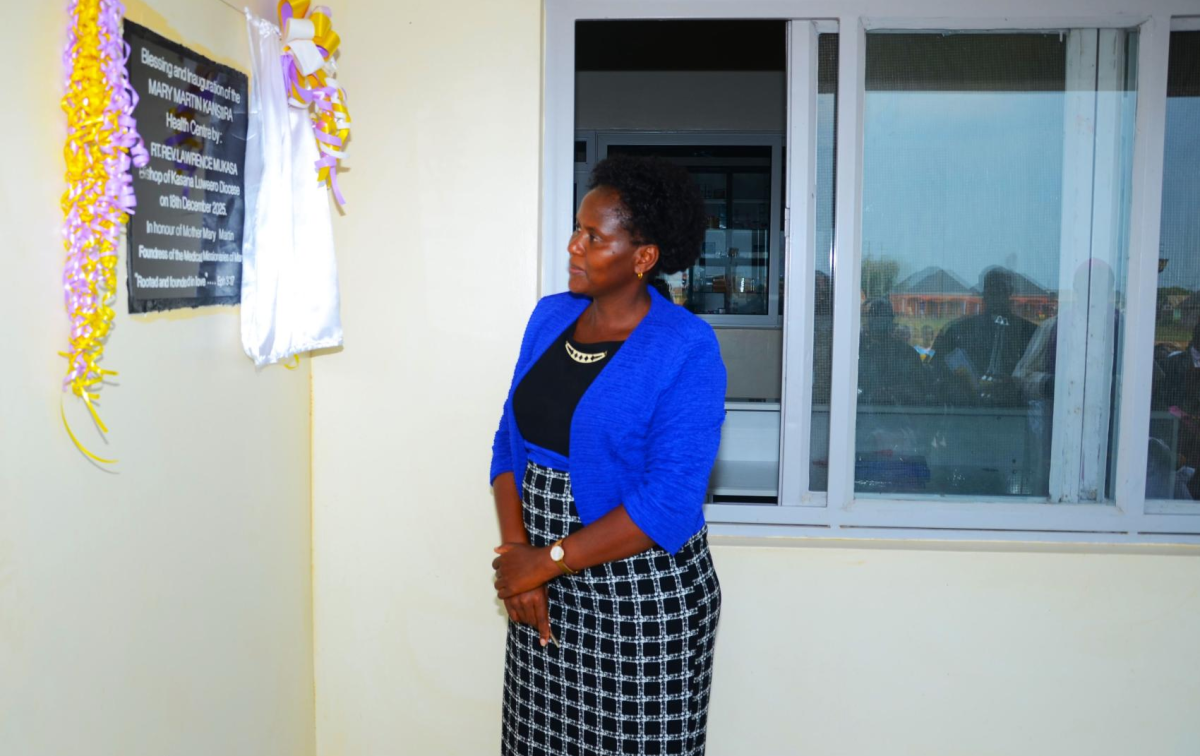
The Ministry of Health (MoH) has called on civil society organizations (CSOs) to scale up investment in the health sector to complement government efforts aimed at improving service delivery nationwide. The call was made by Dr. Irene Mwenyango, Assistant Commissioner for Adolescent and School Health at the Ministry of Health, while officiating at the commissioning of the multi-million-shilling Mary Martin Kansiira Health Centre III in Nakasongola District.
The facility was constructed by the Medical Missionaries of Mary under the Roman Catholic Diocese of Kasana–Luweero. Dr. Mwenyango said health infrastructure remains a cornerstone of Uganda’s health system and a critical driver of national development. She cited the National Development Plan and Uganda Vision 2040, noting that effective health service delivery is central to human capital development and Uganda’s aspiration of attaining middle-income status.
She emphasized that a healthy population is fundamental to the country’s social and economic transformation. Dr. Mwenyango explained that through Public–Private Partnerships (PPPs), government collaborates with private entities, including faith-based and not-for-profit institutions, to expand access to healthcare, improve efficiency, and enhance service quality.
These partnerships, she said, cover service delivery, infrastructure development, and financing arrangements, helping to bridge resource and capacity gaps within the public health system. She noted that Uganda operates a pluralistic health system comprising public, private not-for-profit, private for-profit, and community-based providers. According to the Health Facility Master List, the country has 6,937 health facilities, with 45 percent publicly owned, 1,003 private not-for-profit, about 40 percent private for-profit, and a small number community-owned.
Dr. Mwenyango added that the private sector delivers nearly half of all healthcare services in the country, with private not-for-profit facilities playing a particularly critical role in serving rural and underserved communities. She explained that a Health Centre III provides outpatient services, maternity care, and inpatient services, noting that the newly commissioned Mary Martin Kansiira Health Centre III is expected to deliver these core services and significantly strengthen primary healthcare, where much of the disease burden lies.Dr. Mwenyango further stressed that the facility will work closely with the district local government to ensure services are delivered by qualified personnel, including government-seconded staff where necessary. She underscored the importance of consistent medical supplies, 24-hour service availability, adherence to quality standards, and continuous professional development of health workers to safeguard patient safety.
She urged the facility’s management to align its operations with national health priorities, including strong governance and stewardship, effective human resource coordination, promotion of service utilization, and strict compliance with quality improvement standards. Dr. Mwenyango reaffirmed the Ministry of Health’s commitment to providing oversight, support supervision, and technical guidance in collaboration with district authorities.
She also called on the facility to consistently submit service data through the Health Management Information System (HMIS) and DHIS2 platforms to support evidence-based planning and accountability. In her closing remarks, Dr. Mwenyango appealed to CSOs to continue and expand their investment in healthcare to support the attainment of Universal Health Coverage. She also urged health workers—nurses, midwives, doctors, and allied professionals—to provide responsive and patient-centered services.
Speaking at the same event, the Kasana–Luweero Diocesan Health Coordinator, Rev. Fr. Frank Mugga, commended the Medical Missionary Sisters of Mary for their dedication and resilience in establishing the health centre. Fr. Mugga said the journey to set up the facility had been challenging, marked by resistance and setbacks, but noted that perseverance, faith, and collaboration ultimately prevailed.
He reaffirmed the Diocese’s full support for the Medical Missionary Sisters and pledged continued collaboration with district authorities, including the District Health Office, to ensure smooth operations. He praised the sisters for equipping the facility to the required standards and expressed optimism that it would soon effectively serve residents of Kansiira and neighbouring communities.
Fr. Mugga also observed that some community members often fear seeking care at well-equipped health facilities, assuming that services are expensive. As a result, many only seek treatment at advanced stages of illness. He encouraged residents to change this perception, assuring them that services at the facility are affordable, given the support of the Diocese.
Meanwhile, the Bishop of Kasana–Luweero Diocese, Rt. Rev. Lawrence Mukasa, described the new health centre as a Christmas gift to the people of Kansiira. He noted that the hard-to-reach area now has a health facility, expressing optimism that access to healthcare services will significantly improve.
The Bishop further revealed that, since Kansiira is a newly established parish, the Diocese plans to assign a resident priest, Rev. Fr. Joseph Kakooza, soon to support both pastoral and community service delivery initiatives.
***URN***