

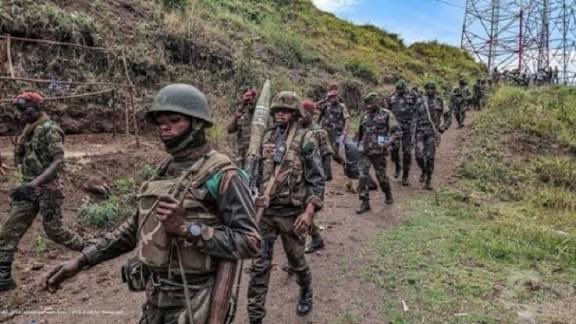
The March 23 Movement/Alliance Fleuve Congo (M23/AFC) rebels have accused the Democratic Republic of Congo (DRC) government of misleading the public by politicising the deadly collapse of the Rubaya mine, which killed more than 200 artisanal miners. The incident occurred on Wednesday, January 28, 2026, at the Luwowo mining site in the Gasasa agglomeration, within the Rubaya mining perimeter in Masisi Territory, North Kivu Province.
Rubaya is one of the world’s most strategic coltan mining areas, producing an estimated 15 percent of global supply. Coltan is processed into tantalum, a heat-resistant metal widely used in mobile phones, computers, aerospace components, and gas turbines. The mining site has been under the control of the AFC/M23 rebel group since May 2024.
Local sources say the landslide buried miners, including children and market women. Some victims were rescued with serious injuries. On January 31, 2026, the Congolese government, through the Ministry of Communication and Media, confirmed that more than 200 people had died in the disaster. In a strongly worded statement, the government blamed the M23/AFC rebels for the deaths, accusing them of forcing civilians into intense labour as part of what it described as “savage and illegal exploitation” of Congolese natural resources.
The government said the Rubaya mining perimeter had been classified under “red” status by Ministerial Decree No. 00031/CAB.MIN/MINES/01/2025 of February 12, 2025, later extended by Ministerial Decree No. 00734/CAB.MIN/MINES/01/2025 of November 3, 2025. The classification prohibits all mining and mineral commercialisation activities, including artisanal mining.
According to the statement, mining activities at Rubaya are therefore illegal and conducted without any safety standards. The government further alleged that mining under armed occupation forms part of a structured system of looting and illegal exploitation benefiting Rwanda. It claimed that between 112 and 125 tonnes of coltan are extracted monthly from Rubaya and transported exclusively to Rwanda outside all legal frameworks.The statement added that similar incidents had occurred in June 2025, when more than 300 civilians reportedly died in comparable circumstances within the same mining perimeter. “The Government of the Democratic Republic of Congo expresses its deep compassion to the bereaved families and reaffirms its solidarity with the populations of Rubaya and Masisi Territory,” the statement read.
The government also accused international traceability and certification mechanisms, including ITRI/ITA and the International Conference on the Great Lakes Region (ICGLR), of failing to prevent minerals from “red” sites from entering global supply chains. It warned that such activities amount to war crimes under international law, citing the Hague Convention of 1907, the Fourth Geneva Convention of 1949, the Rome Statute of the International Criminal Court, and relevant United Nations Security Council resolutions.
However, in the early hours of Monday, M23/AFC rebels issued a counter-statement through their spokesperson, Lawrence Kanyuka, accusing the Congolese government of exploiting the tragedy for political gain. Kanyuka attributed the mine collapse to torrential rains currently affecting the area and accused the government of failing to take responsibility for the longstanding mismanagement of the mining sector.
He cited a series of past mining disasters across the country as evidence of systemic failure, listing incidents dating back to 2015 in Haut-Katanga, Lualaba, South Kivu, Maniema, Ituri, Kasai, and Bas-Uélé provinces, which collectively claimed hundreds of lives. According to Kanyuka, these disasters demonstrate repeated negligence, weak regulation, and poor safety enforcement, particularly in artisanal mining areas.
He urged authorities to stop politicising tragedies and instead focus on meaningful reforms to improve miner safety, governance,ce, and accountability. Kanyuka said that as a gesture of solidarity, M23/AFC has taken responsibility for the care of the injured, with severe cases evacuated to Goma General Hospital, and is supporting the dignified burial of recovered victims.Despite the mourning period, some miners have reportedly resumed work at other mining sites, and several businesses in the area have reopened. The exchange of accusations comes as peace talks between the Congolese government and M23/AFC resumed in Doha, Qatar, on Sunday, according to Benjamin Mbonimpa, an administrative secretary of the rebel group.
However, fighting continues on the ground. On Monday morning, fierce clashes were reported in several villages in the Fizi Highlands of Minembwe locality, South Kivu Province. Since its resurgence in 2022 under leaders Bertrand Bisimwa and Emmanuel Sultan Makenga, the Congolese government has repeatedly accused Rwanda of backing M23—claims denied by both Kigali and the rebels.M23 says its objective is to fight corruption, xenophobia, and discrimination within Congo’s political leadership. Earlier this year, the group launched a rapid offensive across eastern Congo, capturing major towns and raising fears of a wider regional conflict.
****URN****