

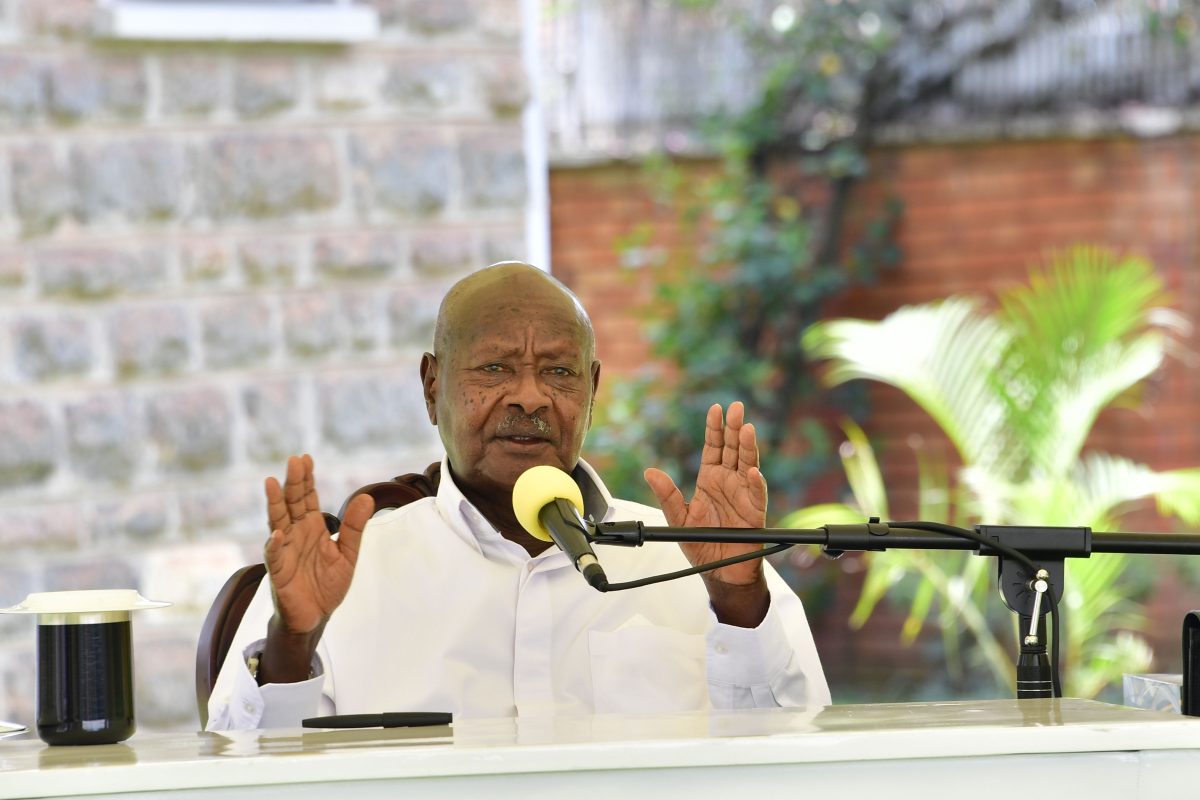
ChimpReports, a local publication, reports that President Museveni held a meeting with the United States Ambassador to Uganda, William Popp.
The meeting took place on the afternoon of Thursday, October 10, 2024 at State House Entebbe.
Officials, who preferred anonymity to speak freely, said the meeting was attended by several security officials and other key stakeholders in the diplomatic community.
Senior Presidential Press Secretary, Sandor Walusimbi, said he was “not aware of such a meeting” when contacted by ChimpReports.
“I don’t know about it,” he emphasised.
It is understood that President Museveni and Amb Popp agreed that deliberations of the meeting were not shared with the public.
This was aimed at avoiding unnecessary altercations on social media.
The meeting came just days after the Chief of Defence Forces, Gen Muhoozi Kainerugaba, publicly demanded an apology from Amb Popp to President Museveni over the diplomat’s alleged misconduct.
“Fellow Ugandans, it is my solemn duty to announce to you all that we as a nation are about to have a serious confrontation with the current US Ambassador to our country,” said Gen Muhoozi on X platform.
“For disrespecting our beloved and celebrated President and for undermining the constitution of Uganda,” he added.
Interference
Sources say Amb Popp, U.S. Embassy political officer Shirm Christopher and the Central Intelligence Agency (CIA) chief for Uganda have been quietly strengthening the capacity of opposition groups to challenge President Museveni in the 2026 general elections.
The alleged support from the U.S. Embassy also includes millions of shillings to anti-government Non-governmental organizations.
The second area of contention is the increased U.S. sanctions against Ugandan security officers ahead of the 2026 elections.
The U.S. Department of State last week named the sanctioned officers as Bob Kagarura, the former Wamala Regional Police Commander; Alex Mwine, former District Police Commander for the Mityana District; Elly Womanya, then-Senior Commissioner within the UPF and Deputy Director of the Criminal Investigations Division in charge of the Special Investigations Unit (SIU); and Hamdani Twesigye, then-Deputy Inspector of Police assigned to SIU.
The four and their immediate family members have been barred from traveling to the United States.
The U.S. said it slapped sanctions against Ugandan security personnel for violating rights of opposition figures and activists.
However, Ugandan officials say the current crop of officers at the U.S. Embassy in Kampala has been working with the U.S. State Department in Washington to use sanctions as a tool to intimidate security personnel from cracking down on lawlessness perpetrated by opposition figures.
“What the U.S. Embassy officials are trying to do is create a climate of fear within Uganda’s security establishment so that police and the army do not act against opposition especially as we prepare for the 2026 elections,” a source said, adding, “That is interference in Uganda’s internal matters and also an attempt to undermine the government and the country’s democratic processes.”
Commenting on the recent sanctions against police officers accused of mistreating Francis Zaake in the run-up to the 2026 elections, Gen Muhoozi observed: “Africa has never sanctioned the US officials who were involved in the cold blooded brutal assassinations of our leaders like Patrice Lumumba. If they continue sanctioning Africans, we will sanction them too.”
In 2018, President Museveni warned the western community, particularly the United States against meddling in Uganda’s domestic affairs, saying a new legislation could be drafted to penalize collaborators of foreigners.
“Interfering in the internal affairs of other countries is morally and practically wrong,” said Museveni in a national address, adding, “Morally wrong because the question is: ‘What superior intelligence do you have to think that you can understand the problem in my house better that we the occupants?’”
Museveni emphasised: “If there is a problem in our house, we the occupants will solve it. Keep out. It is also practically wrong because outsiders can not have enough information about a foreign situation.”