

Overview:
Tony Opiyo, a resident of Jimo village, said three members of his family, including himself, have been infected. Opiyo explained that many residents are applying kerosene to the affected areas in an attempt to kill the parasites.
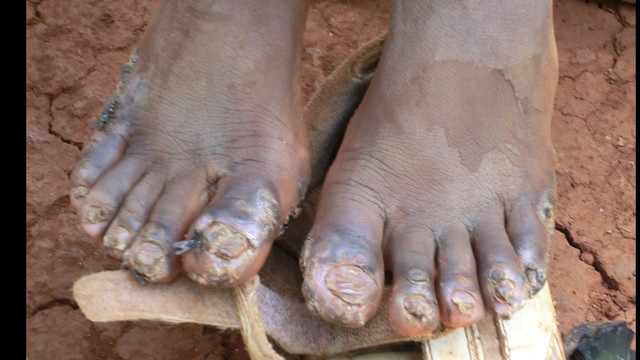
Residents in parts of Amuru District have resorted to improvised methods to manage a growing jigger infestation, as local leaders report more than 100 people affected over the past month.
The most hit areas include Odur village in Guru Guru Sub-county, and Jimo village and Parabongo Trading Centre in Lamogi Sub-county.
Tony Opiyo, a resident of Jimo village, said three members of his family, including himself, have been infected. Opiyo explained that many residents are applying kerosene to the affected areas in an attempt to kill the parasites.
“We are using kerosene because it is easy to apply, and people believe it kills the jiggers quickly. Many people here are using it,” Opiyo said on Friday.
He added that he has applied the substance to six different spots on his feet, but is uncertain where he contracted the infestation.
The jigger, commonly known as a sand flea, burrows into the skin mostly on the feet and sometimes fingers, causing itching, swelling, and severe pain if left untreated.
The infestation has also disrupted schooling for several pupils, according to local leaders. Faith Lamunu, 11, a Primary Four pupil at Agwayugi Primary School in Guru Guru Sub-county, said her ordeal began with mild itching that gradually turned painful.
“It started as a small itching on my feet, then it became very painful,” Lamunu told Uganda Radio Network on Friday from their home.
She noted that her parents have so far removed five jiggers from her feet, leaving her in pain. She added that they have been applying kerosene to prevent further infestation and to help remove others still embedded.
However, Lamunu said fear of stigma from classmates has kept her away from school. Similarly, Wincy Lagum, a pupil at King James Primary School in Parabongo Parish, said her parents have removed four jiggers from her feet. She too has not returned to school due to pain and fear of being laughed at by other pupils.
Christopher Okot, a businessman at Parabongo Trading Centre, attributed the spread of the infestation to poor sanitation within the community, particularly in homesteads where pigs are reared.
“We need to improve hygiene and sanitation, especially around animal shelters. That could be contributing to the problem,” Okot said.
The LCIII Chairperson of Lamogi Sub-county, Atkinson Ojara, told Uganda Radio Network that health officials from the sub-county have begun assessing the situation to inform a planned community sensitization campaign. Ojara said preliminary findings point to poor sanitation and inadequate personal hygiene as key drivers of the infestation.
Meanwhile, health officials have cautioned residents against applying kerosene on affected areas, warning that it can cause skin irritation and increase the risk of secondary infections. They have urged the community to seek proper medical guidance and to prioritize hygiene, including regular cleaning of homes and compounds, to curb the spread of jiggers.
“It’s not a good practice, paraffin it’s self is dangerous, when you inhale, it can cause pneumonia. People should not use it; the best for now, they should go to the health facilities for better treatment,” said Milton Okello, the one in charge of Bibia Health Center III.
Dr Alfred Okello, the Amuru District Health Officer, confirmed the district health department was mobilizing a campaign to sensitize the community, but didn’t divulge the details about its commencement.
*****URN****