

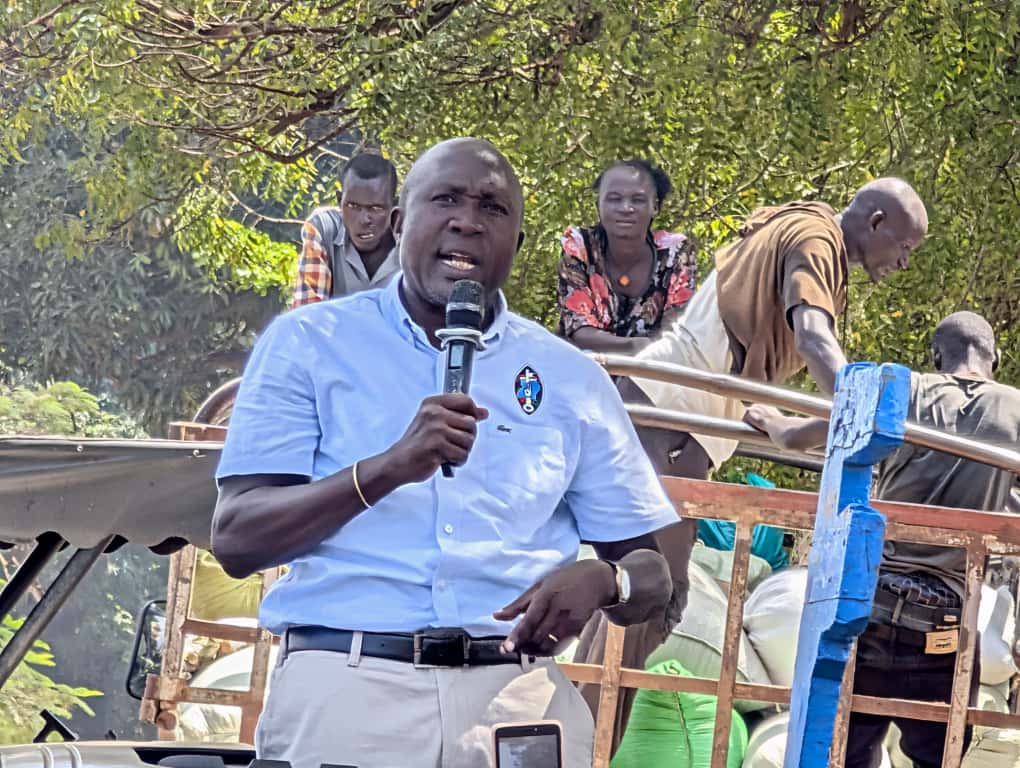
Accountant, lawyer, economist, and veteran opposition politician James Nathan Nandala Mafabi is one of the most experienced figures in Uganda’s multiparty politics, as he steps onto the national stage seeking to challenge President Yoweri Kaguta Museveni’s long hold on power.
A long-serving Member of Parliament for Budadiri West County in Sironko District, Nandala Mafabi is best known for his role as Leader of the Opposition in Parliament and as the Secretary General of the Forum for Democratic Change (FDC), Uganda’s largest opposition party for much of the last two decades.
As Ugandans prepare to vote, Uganda Radio Network continues its series profiling presidential candidates, among them Nandala Mafabi, Mugisha Muntu, Mubarak Munyagwa, Robert Kasibante, Frank Bulira, and Joseph Mabirizi.
Unlike political newcomers in the race, Nandala Mafabi enters the contest with more than two decades of parliamentary experience, a deep grounding in public finance, and a reputation as one of the most formidable opposition voices to emerge from Parliament.
“He is an accountant, lawyer, and politician whose career reflects a blend of technocratic expertise and long parliamentary experience,” reads his official profile.
From Busamaga to the National Stage,
James Nathan Nandala Mafabi was born on January 17, 1966, in Busamaga village, Sironko District, in eastern Uganda. “He was born in Busamaga village in Sironko District, a region that would later shape much of his political identity and constituency support.”
He is the son of Wilson Wanyoto, a respected teacher whose life was disrupted by Uganda’s turbulent political history.
“During Idi Amin’s regime, his father fled to Kenya, where he taught for some time,” according to family accounts. While in exile, the young Nandala Mafabi was enrolled in school in Kenya, but he was forced to return home when he beat up an Indian classmate who had spat at him.
“After returning home, he stayed with his grandparents and completed his primary education in Uganda.” Canon Wanyaka, a village mate.
told URN that Nathan Nandala Mafabi was extremely brilliant to the extent that he obtained a first grade, yet he sat his PLE from a rural school.
Education and Academic Formation Nandala
Mafabi’s academic path reflects a strong grounding in economics, law, and public administration. “After his primary education, he joined Mbale Secondary School for his O-Level studies.”
He later proceeded to Busoga College Mwiri in Jinja District, where he completed his Advanced Level education. “He later joined Makerere University, where he obtained a Bachelor of Statistics and Economics degree,” said Canon Wanyaka,
After graduating in 1988, he pursued a Postgraduate Diploma in Education from Makerere University, followed by a Diploma in Income Tax Administration from the Uganda Management Institute in 1993. “In 2000, he obtained a Master of Arts degree in Economics, before earning a Bachelor of Laws degree from Makerere University in 2006.”
He is a member and Fellow of the Association of Chartered Certified Accountants, a qualification that would later define his professional and political trajectory. Career at the Uganda Revenue Authority.
Before entering elective politics, Nandala Mafabi built a solid career in public finance. “He joined the Uganda Revenue Authority in 1988 as a tax assessor.”
He rose steadily through the ranks. “He served as a tax assessor from 1988 to 1993, before becoming a revenue officer.” In subsequent years, he was promoted to senior revenue officer, principal revenue officer, and eventually senior principal revenue officer and acting chief internal auditor at URA.
“From 1998 to 2000, he served as senior principal revenue officer and acting chief internal auditor.” Between 2000 and 2001, he briefly worked in the private sector as a financial management consultant before turning his attention to national politics.
Entry into Politics and Parliamentary Rise Nandala Mafabi joined elective politics in 2001, when he contested for Member of Parliament for Budadiri West County. “He contested for the Budadiri West parliamentary seat in 2001 and won.”
He has since remained one of the longest-serving MPs from eastern Uganda, earning repeated re-election. “His entry into Parliament marked the transition from technocrat to national political figure.”
From 2001 to 2006, he served as Chairperson of the Parliamentary Committee on the Economy, a role that placed him at the centre of national economic oversight. From 2006 to 2011, he chaired the powerful Public Accounts Committee (PAC).
“He became widely known as one of Parliament’s most experienced public finance overseers.” Leader of the Opposition Nandala Mafabi’s national profile peaked when he was appointed Leader of the Opposition in Parliament.
“He served as Leader of the Opposition from 2011 to 2014.” In that role, he coordinated opposition strategy, scrutinised government policy, and became one of the most vocal critics of President Museveni’s administration.
He also served as Vice-Chair of the Parliamentary Network on the World Bank and International Monetary Fund.”
Party Politics and FDC Leadership
Within party politics, Nandala Mafabi has played a central role in shaping the Forum for Democratic Change. “In November 2012, he contested for the position of FDC Party President.”
He lost that contest to Maj. Gen. Gregory Mugisha Muntu at elections held at Mandela National Stadium, a contest that exposed ideological and strategic divisions within the party.
Despite that setback, his influence within FDC endured. “In 2015, he was elected Secretary General of the Forum for Democratic Change.
He continued to serve as Secretary General, placing him at the centre of the party’s national organisation and strategy.
Cooperative Movement and Professional Leadership Beyond Parliament, Nandala Mafabi has remained active in cooperative and professional institutions.
He has served as Chairman of the Bugisu Cooperative Union since 2008.” In the accounting profession, he is a respected figure.
“He has been a full member of ICPAU since 1994 and has practised accountancy for over 30 years.
He is also a practitioner at MTC Associates, where he has worked since 1995.
He played a key role in the enactment of the Accountants Act, 2013, while serving as a Member of Parliament.
He was among the first examiners of the CPA course in Uganda and previously served on ICPAU’s Education Committee.
His stated motivation has been to promote accountancy and professionalism in Uganda.
His promises.
According to Nandala Mafabi, Uganda’s challenges are no longer theoretical. “The current problem in Uganda is three things: corruption, poverty, and injustice,” he argues.
Drawing from his nationwide engagements, he paints a grim picture of daily life for ordinary Ugandans—parents selling tomatoes and oranges but still unable to feed their families, children dropping out of school, and patients being referred out of public health facilities to buy medicine and scans they cannot afford. “Our children go to school, but out of ten children who join primary school, only two reach Primary Seven. That means 80 percent dropout,” he says.
He insists that while the country has enjoyed relative peace for decades, peace alone is no longer enough. “We have been around for 40 years talking about peace, peace, peace. Ugandans cannot eat peace. The peace is there. What we need are jobs.”
Economic Vision: Jobs, Production, and Local Ownership.
At the heart of Nandala Mafabi’s campaign is economic restructuring aimed at job creation, particularly for young people. “Sixty percent of the youth are unemployed,” he notes, calling this Uganda’s “biggest insecurity.”
He criticizes the structure of the current economy, where the service sector—telecommunications, banking, and parts of industry—is largely foreign-owned, while agriculture, which sustains nearly 80 percent of Ugandans, contributes only about 23.8 percent to GDP. “This means our people are living like slaves in their own country,” he argues.
His solution centers on cooperative-led agro-industrialization, with the government taking a deliberate lead role in production, processing, and marketing.
Agriculture as the Engine of Employment
Nandala Mafabi believes agriculture has the greatest potential to absorb Uganda’s unemployed youth. “Uganda is an agricultural country—an agrarian economy,” he says. “Agriculture can employ the biggest number of people.”
His plan includes skilling youth in agriculture, construction, and ICT, modernizing agriculture to increase productivity, and expanding agro-processing industries to create jobs along the value chain. “If you skill the youth in agriculture, you are modernizing agriculture. When you bring agro-processing, those are industries—and industries create jobs,” he explains.
Reviving Cash Crops and the Tea Sector
Nandala Mafabi places special emphasis on reviving traditional cash crops, coffee, cotton, tea, and tobacco, with tea highlighted as a high-potential sector.
“Cotton was white gold. Tea is magnetic money,” he says.
He proposes to subsidize fertilizers (up to 30 percent for tea farmers), establish government-led processing factories, ensure prompt payment of farmers to prevent discouragement, and build storage facilities such as silos to manage overproduction.
“A good government should not make farmers get discouraged,” he adds. Drawing on regional examples, including Rwanda’s tea industry, Nandala Mafabi argues that Uganda’s weakness is not ideas but implementation. “Uganda is very good at writing proposals, but not good at implementing them,” he says.
Under his leadership, the government would invest directly in factories, later handing them over to cooperatives or private players once costs are recovered.
Lowering the Cost of Capital
Nandala Mafabi also blames high interest rates on excessive government borrowing, which crowds out private sector credit.
“The biggest borrower is the government. That is why the cost of capital is too high,” he explains. By the government leading industrial investment, especially in agriculture, he believes producers would be shielded from exploitative moneylenders and expensive loans.
Corruption and Failed Poverty Programs
Reflecting on Uganda’s history of anti-poverty initiatives, Nandala Mafabi is blunt. “From Entandikwa, Kulembeka, Bonna Bagaggawale, Prosperity for All, Emyooga, Operation Wealth Creation, to now PDM—if these were meant to remove poverty and have failed, it means total failure of government.” He attributes this failure to corruption and lack of transparency in public administration.
Governance, Justice and Rule of Law Nandala
Mafabi says economic reform cannot succeed without justice and constitutionalism.
“The government lacks transparency, and corruption is at the center,” he says.
His justice-sector agenda includes; reducing presidential powers, restoring term limits and age limits, strengthening judicial independence, and ending political interference in courts.
“We are getting political judgments, not judgments based on real justice,” he argues. He also calls for a professional police and army that protects citizens rather than intimidate them.
“The police should be a professional police force. The army should be a professional army, not one that terrorizes citizens.”
To address case backlogs and political detentions, Nandala Mafabi proposes strengthening and funding the Human Rights Commission, ending imprisonment of political opponents, and expanding access to justice through legal aid and civic education.
“Access to justice is expensive. Many people don’t even know their rights,” he says. He further advocates auditing judicial decisions and vetting judicial officers before appointment, citing Kenya’s example. A Veteran Challenger Nandala Mafabi presents himself as a candidate shaped by public finance discipline, parliamentary accountability, and opposition resilience. “His background in economics, law, and taxation has defined much of his public service.” Supporters argue that his experience equips him to confront Uganda’s governance and economic challenges. “His career reflects continuity, institutional memory, and deep engagement with the workings of the state.”
Personal Life Nandala Mafabi is married to Florence Nandala, whom he met at Makerere University. They have been married for over two decades and have several children.
Florence describes him as “humble, loving, and nice.” He is known as a people’s person. At his home in Bukaya, Buikwe District, visitors are constant.
“Here we cook food like in schools because people keep coming,” one of his maids says. In his free time, Nandala Mafabi plays tennis and is a devout Christian, worshipping at St Luke Ntinda or his village church in Busamaga, Sironko District.
Canon Wanyaka, one of Nandala Mafabi’s close political allies in the Bugisu sub-region, describes the accountant-turned-politician as a deeply God-fearing person whose generosity cuts across religious lines. “Nandala has supported many Muslims to go for pilgrimage to Mecca,” Wanyaka says.
“Even I have benefited from such generosity. I was among the many Christians he supported to travel to Israel.” Wanyaka adds that Nandala Mafabi has also contributed to the construction of several churches and mosques across the region, a reflection, he says, of the presidential hopeful’s commitment to religious tolerance and community development.
Unlike many challengers, Nandala Mafabi is not introducing himself to Ugandans for the first time. He is a familiar figure whose political life has unfolded in committee rooms, plenary debates, party conferences, and cooperative unions.
He represents a generation of opposition leaders forged inside Parliament rather than outside it.” As Uganda heads to the polls, James Nathan Nandala Mafabi enters the race as a seasoned legislator, technocrat, and party organiser, betting that experience, accountability, and economic competence can persuade voters seeking an alternative to decades of rule by the same political establishment.
***URN****