



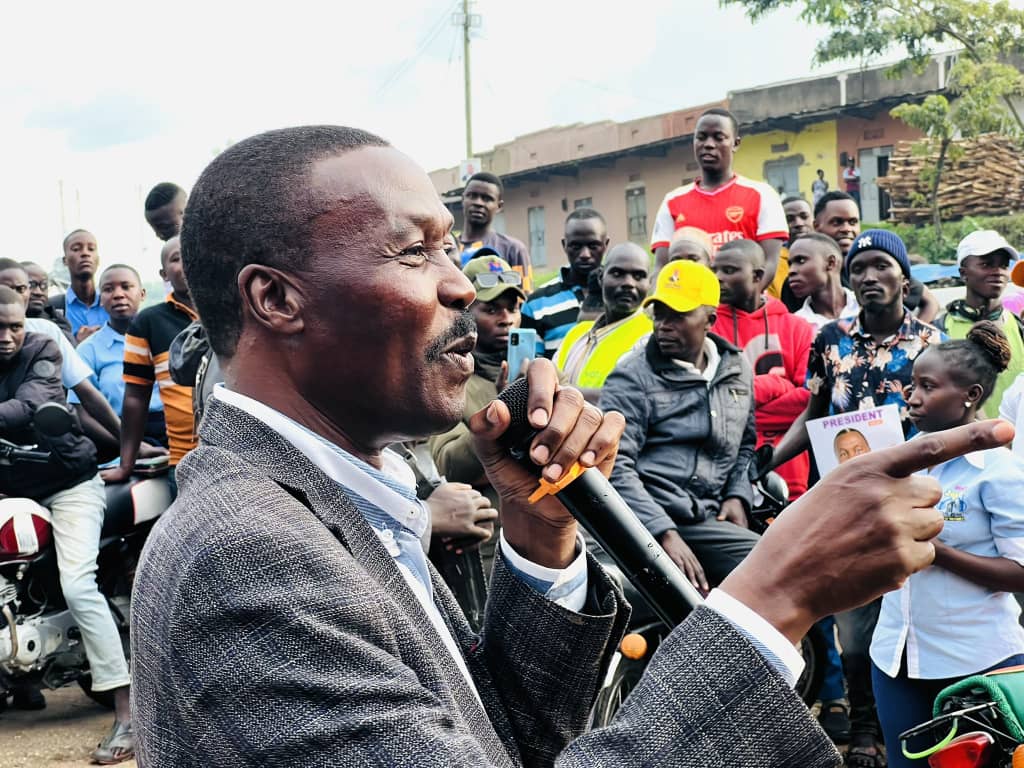
One of the 8 candidates challenging President Museveni for the presidency this year is his bush-war colleague, Retired Major General Gregory Mugisha Muntuyera, commonly referred to as Mugisha Muntu.
Like during the past elections, in Uganda Radio Network 2026 Presidential candidates, we examine Major General Mugisha Muntu, a figure many consider misunderstood, yet one whose life and career reflect an unwavering commitment to integrity, service, and principled leadership.
“Mugisha Muntu is a person of integrity, a very hard-working man, and a very passionate son of this nation,” says Alice Alaso, a former legislator and co-founder of the Alliance For National Transformation Party (ANT)
“When he went to the bush war, somebody would imagine that the army would have changed his character, but I have not seen any change in him ever since we met in 1978. He has remained the gentle person he is, he has remained the truthful person he is, he has remained a balanced person, a person who takes you for what you are without any bias. That is the man I know for General Mugisha Muntu—a very trustworthy fellow.” Says Alaso.
Alaso is no stranger to Mugisha Muntu, under whom she served as the Secretary General of Forum For Democratic Change (FDC), which, along with others, left to form ANT.
“Muntu is a person of integrity, a very hard-working man, and a very passionate son of this nation. Muntu loves Uganda, and Muntu would love to see a better Uganda, but also, Muntu, as his name suggests, loves people. The times we have worked with him, we have seen him literally listen to anybody, people of all walks of life and to all manner of argument.”
Born in October 1958 in Kitunga Village, present-day Ntungamo District, Muntu was the son of Enoch Ruzima Muntuyera, a former education inspector and Ankole Kingdom minister, and his mother was Aida Matama Muntuyera. Political upheavals shaped his early years; after Idi Amin toppled the Obote regime in 1971, Muntu’s father went into exile in Tanzania, leaving the young Muntu primarily in the care of his mother. His father later died in exile in Kenya.
Muntu’s early education included Mbara Junior School, Kitunga Primary School, and Kitunga High School, later renamed Muntuyera High School in memory of his father. He continued to Makerere College School before enrolling at Makerere University, where he graduated with a degree in political science and served as deputy president of the Students’ Union.
Describing Muntu during his university years, veteran West Nile political activist, Kassiano Wadri recalls: “Muntu was a man of faith, a man who was truthful, a man who would never change a word. Once he says yes, it’s a yes. No is a no.” While at Makerere University, Muntu’s hall of residence was Livingstone. That is where he met another future political actor, Dan Mugarura, also a former NRA fighter.
Asked to describe his contemporary, Mugarura emphasizes his adherence to principles: “He strives as much as possible to practice integrity, accountability and to try to be as fair and as simple as he can be because he cherishes the principle of justice and fairness. When he’s pursuing a just cause, when he’s assured that what he’s doing is justified and it is the proper way that it should be handled, it’s very difficult, if not impossible, to compromise out of the correct line.”
Muntu’s commitment to justice was evident even in the volatile environment of Ugandan student politics, where participation carried risks.
As he recalls, “As I grew up, there was something that was deep within me that desired to see justice… I always had that feeling within me that nobody should live in a situation where injustices are meted out, and there’s no response.” Muntu once shared.
Many recall that even when he was still at Makerere, Muntu was steadfast and purposeful without wandering into activities that would negatively affect his name.
Mugarura worked in the army under Mugisha Mutu, and he recalls that: “He tried very much to ensure that the systems of the army worked. As per the established arrangements about how an army should operate. And he had some problems with some commanders who wanted to do it the other way.”
Yokas Bihande Bwambale, a fellow student political activist who was with Muntu at Makerere University, highlights Muntu’s determination: “What was unique about him, about Mugisha Muntu, is the determination that should we fail to achieve what we want through the vote, and it appears as if we have been cheated through the vote, we shall join, we shall start Plan B. That determination that he was with as early as 1980, when we were in the campaigns, is what forced him to go to the booth.”
Bwambale continues, “When he is determined to do something, despite all odds on the way, he will make sure he goes there. He is a man of an independent mind and a go-getter.” Even when faced with skepticism, betrayal, or danger, Muntu’s integrity and courage stood firm.
Dan Mugarura recounts his resilience after being wounded in battle: “He was sneaked into Kampala. He went for treatment, which took over a month. And after a month or two, after healing properly, he walked back to the bush. By that time, if he was a mole, he would have gone to Obote and reported all that he saw. But he went back and walked until we came into government.” Muntu’s leadership style combines firmness with measured reflection.
“Some people say General Muntu is so soft… But then softness is an advantage. Softness in the way you approach issues. Softness in the way you analyze issues before you act. That is a stronghold of General Mugisha Muntu,” notes Kasiano Wadri.
Muntu led the NRA for nine years, a period marked by internal rebel threats and three cross-border conflicts. His success lay not in brute force but in mental strength, strategic discipline, and the ability to integrate diverse fighting groups into a cohesive national army. As head of military intelligence post-1986 NRA victory, Muntu commanded respect for his thoroughness and principled approach.
Dan Mugarura recalls, “As an intelligence officer, he was a person who would not entertain rumour-mongering. He would make sure that the intelligence brought to him would be thoroughly re-investigated and that decisions were made for a properly justified cause.”
Muntu’s rise within the NRA was swift, reflecting both capability and integrity. He was promoted to lieutenant colonel, NRA chief political commissar, division commander, and later promoted to major general and NRA commander. Throughout, he avoided corruption or personal gain.
Kassiano Wadri underscores this point: “He left the command post without any taint on him… You have never heard of General Muntu’s name being mentioned in any scandal of financial impropriety. And that’s him. And he’s a God-fearing person.”
Meet Muntu at any time, and he will criticize the current leadership in the UPDF, but also point to the fact that he was neither perfect when he was the commander of the National Resistance Army, later renamed UPDF.
“There were a number of mistakes that we were making even then. It was not that we were perfect because we were not perfect. Actually, when we were there, we were involved in warfare; we were fighting battles against several insurgencies.” He narrated, “But our mindset, our thought was that move from weakness to perfection. So, if there were weaknesses of 40% out of a hundred, keep reducing it.”
General Muntu left the army command in 1998. He thinks that by now the weaknesses in the UPDF should have drastically reduced beyond 95%. “But if you are degenerating, that is where the problem is. For me, I have never been one who says that we were not making mistakes, but we need to improve and professionalize.”
Mugisha Muntu was one of the presidents of the Forum For Democratic Party. He competed twice against Dr. Kiiza Besigye for the post of party President.
Internally, he faced some form of resistance. Many in the party claimed that he was President Museveni’s or the NRM’s moles in FDC. Something he came out to dispel as he walked out to form ANT.
“It would be strange for a spy to build a party rather than divide it. I have had many opportunities to divide the party if my mission was to divide the party. I have competed twice and supported the winner. And that has actually elevated the profile of the party,” said Muntu in one of the interviews with URN.
“My style of management is to unite people, not to divide them. So how can you be a spy, and all the efforts that you have are to bring dignity to the party, is to cause cohesion in the party.”
At the peak of the fights at Najjanakumbi, Journalist turned politician, Ibrahim Ssemejju Nganda told journalists that he had met very few people with such a rich profile who are as modest and genuine as Muntu. ” Unfortunately, it is this modesty and humility that some of our FDC people are selling as a weakness. It is this modesty and humility that Muntu has deployed to manage the FDC in the last five years. Some of our colleagues, including those in senior positions, have menacingly squeezed and undermined the man, but he has remained steadfast,” said Ssemujju.
He said FDC owed its unity and togetherness to this man. “His patience has been stretched to the limit. With no privileges or salary paid, very few can brave the Najjanankumbi insults. Yet each time he was confronted with such an experience, he remained calm and asked the rest of us working with him to keep learning how to manage people and to build institutions.”
Mugisha Muntu surely had his contribution to the FDC despite his disagreements with Dr Kiiza Besigye, Nathan Nandala Mafabi, and others. Some faulted him for not building a firm grassroots for the FDC as the chief mobiliser.
The expectation was that on leaving FDC, he would take a soft path, mend fences with President Museveni, and join the NRM for cabinet or any other post. He was yet to turn around, at least as this profile was being compiled.
Faith and humility are cornerstones of Muntu’s character. Originally Anglican, he later became a born-again Christian. “General Tumuwine used to preach to me before I got saved. Every time he would preach to me, he’d say, ‘You need to accept Christ in your life.’… That led me to start a Bible study, and within one year, I had accepted Christ into my life. The more you know God, the deeper you come within yourself. You start understanding life, you start understanding, and you go through a journey of becoming humble.” Says Muntu.
Even in difficult institutional challenges, Muntu demonstrated accountability. During the junk helicopter scandal, he explained, “I apologized, not on my behalf, but on behalf of the institution that I headed. Since it happened under my watch, I certainly had to take responsibility. But that does not mean I was personally involved.”
His philosophy is clear: “Ask Muntu to choose between material things and his name. Protection of his name will be key. Physical things perish… When a name goes, repudiation is very tough.” Muntu’s public service extended beyond military command.
He was a Constituent Assembly delegate (1994–1995), a UPDF representative to the Sixth Parliament, and a member of the East African Legislative Assembly.
He also remained principled when offered a ministerial post, reportedly declining the position to maintain his focus on service. Muntu’s personal discipline is reflected in his lifelong commitment to fairness, accountability, and justice.
Kassiano Wadri recalls, “Once he says yes, it’s a yes. No is a no.” Dan Mugarura adds, “When he’s pursuing a just cause… it’s very difficult, if not impossible, to compromise out of the correct line.” In his leisure, Muntu remains grounded.
Bwambale remembers, “At Makerere, Muntu loved and played cricket. We used to go swimming together… He was also good at badminton and chess.” These personal traits mirror his professional ethos: patient, disciplined, and consistent.
In summary, Major General Mugisha Muntu embodies a rare combination of courage, integrity, humility, and disciplined leadership. He has faced war, political turbulence, and institutional challenges without compromising his principles. His faith, personal discipline, and unwavering commitment to justice have earned him the respect of peers and subordinates alike.
As Alice Alaso concludes, “He reads his Bible, and he is a practicing Christian. He prays. That is what I know of him for. He is a disciplined man, a man of principle, a man of integrity.” Major General Mugisha Muntu’s life reflects a lesson in leadership that balances strength with humility, courage with justice, and service with faith.
His story is not just that of a soldier or politician, but of a man steadfast in character, a rare figure in contemporary Uganda who prioritizes principle over personal gain, and service over ambition.
***URN***