



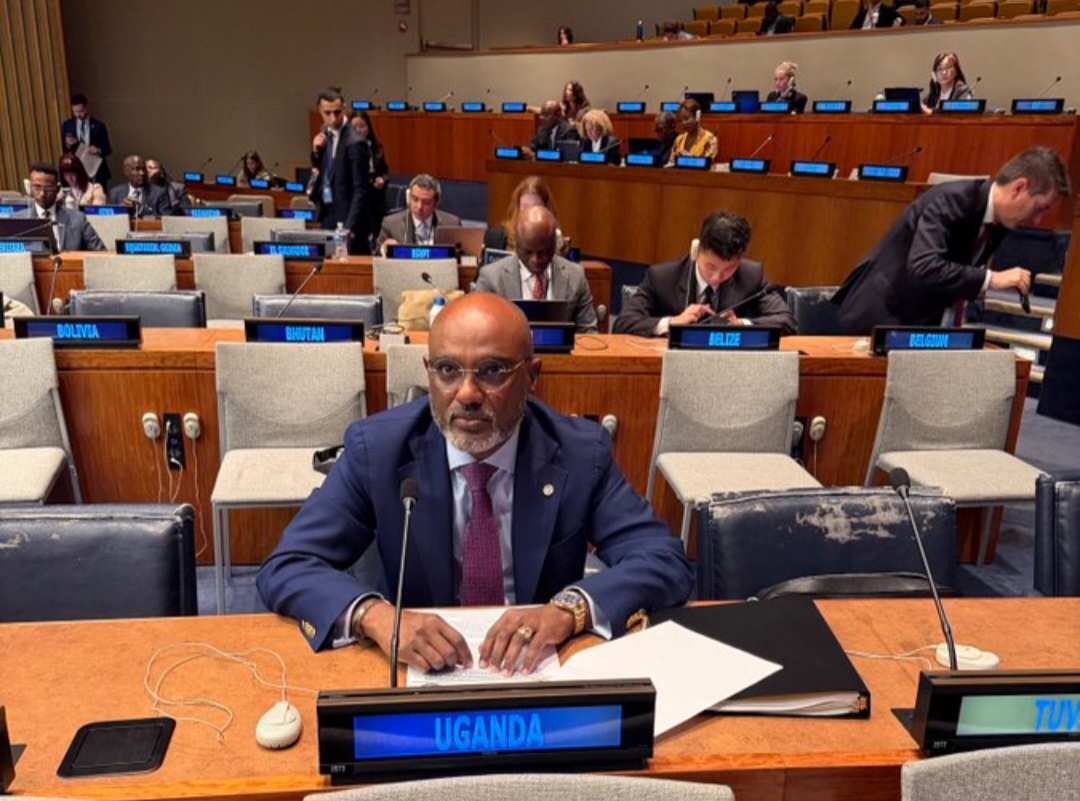
Uganda has called for profound reforms to the international economic structure and global financial architecture to create better conditions for developing countries to achieve sustainable development.
Foreign Affairs Minister Adonia Ayebare made the call in New York on September 23 while delivering Uganda’s statement on behalf of the Non-Aligned Movement (NAM) at a high-level United Nations General Assembly meeting commemorating 40 years of the Declaration on the Right to Development.
Ayebare said four decades after the declaration was adopted in 1986, developing countries continue to face economic and financial challenges that undermine their ability to fully realise the right to development.
He said the declaration recognises development as an inalienable human right, with every person and all peoples entitled to participate in, contribute to and benefit from economic, social, cultural and political development.
“Profound reforms of the international economic structure, and the international financial architecture, including the creation of economic and social conditions that are favorable to developing countries, are still needed,” Ayebare said.
Speaking on behalf of NAM, Ayebare said the Movement remains committed to promoting and protecting all universally recognised human rights, including the right to development.
He referred to the 19th NAM Summit held in Kampala in January 2024, where Heads of State and Government reaffirmed that all human rights are universal, inalienable, indivisible, interdependent and interrelated.
The summit also called for human rights issues to be addressed through constructive, non-confrontational and non-politicised dialogue, while respecting national sovereignty, territorial integrity and the principle of non-interference in the internal affairs of states.
Ayebare said global economic and financial crises have disproportionately affected developing countries through declining trade and foreign direct investment, tighter credit conditions and higher borrowing costs.
“These” pressures, he said, have negatively affected the realisation of the right to development by constraining social investment, deepening poverty and increasing unemployment.
The NAM also called for greater trade opportunities, improved market access and trade financing for developing countries as part of efforts to promote strong, sustained, inclusive and equitable economic growth.
Ayebare further criticised unilateral coercive measures imposed on some NAM member states, saying they risk undermining global economic stability by disrupting trade flows and global supply chains.
The Movement called for the “complete, immediate and unconditional repeal” of such measures, arguing that they impede the full realisation of the right to development.
NAM also urged the UN General Assembly to prioritise the operationalisation of the right to development in line with Human Rights Council Resolution 54/18.
The Movement called for consideration and negotiation of an international covenant on the right to development as a legally binding instrument.
Ayebare concluded by reaffirming NAM’s commitment to making the right to development a reality for everyone within the framework of the 2030 Agenda for Sustainable Development.