



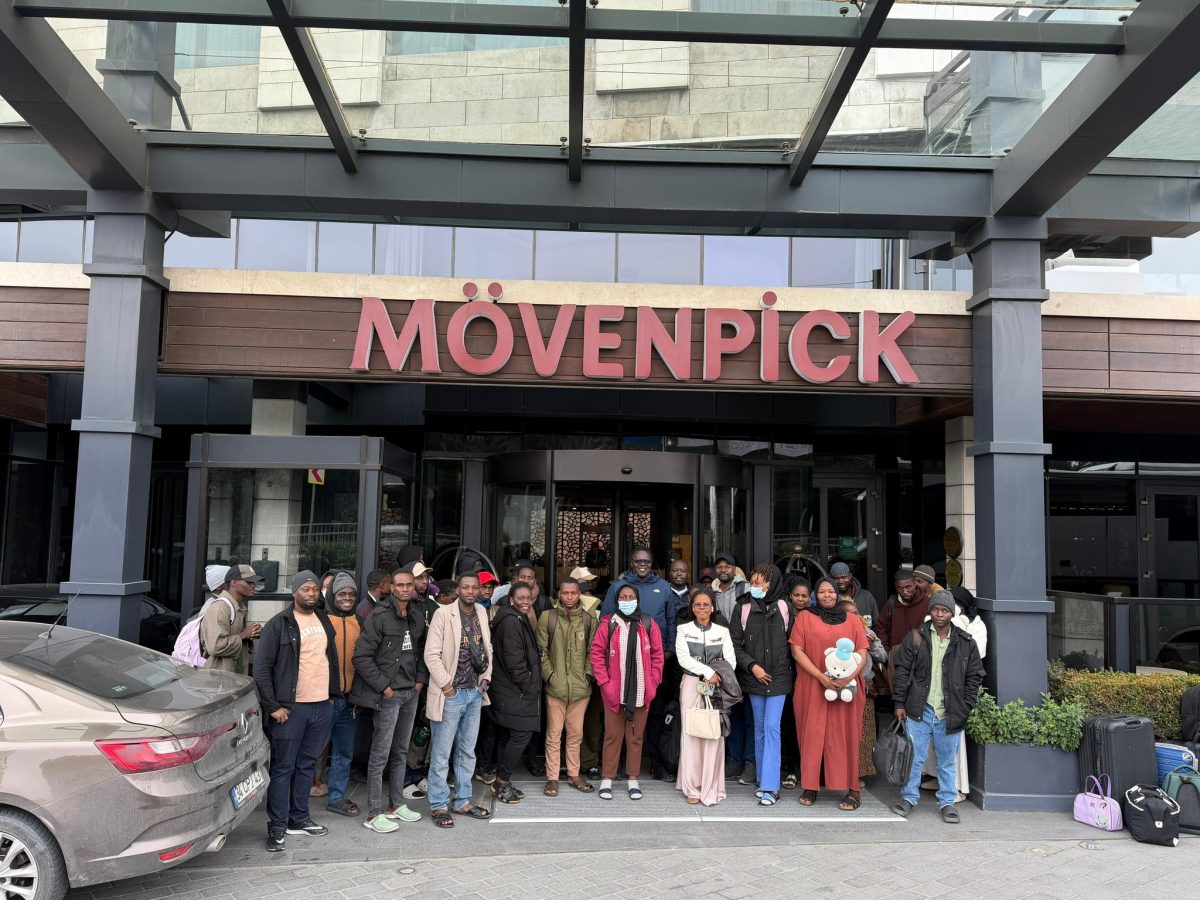
The Government of Uganda has successfully evacuated 43 Ugandan students from Iran following a wave of airstrikes that rocked the capital, Tehran, in late February 2026.
The strikes, attributed to the United States and Israel, targeted key sites in Tehran and reportedly resulted in the death of Iran’s Supreme Leader, plunging the country into uncertainty and triggering widespread security concerns.
For dozens of Ugandan students pursuing studies at institutions including Ahlul Bayt International University, academic life abruptly shifted to survival mode as airspace closures and explosions disrupted daily routines.
According to officials, the crisis response began on March 1 when Uganda’s embassy in Ankara, Turkey, received urgent evacuation requests from stranded students. With commercial flights suspended and Iranian airspace closed, authorities opted for a complex overland evacuation.
Uganda’s Chief of Defence Forces, Muhoozi Kainerugaba, working alongside the Ministry of Foreign Affairs, coordinated the operation. On the ground in Turkey, the effort was led by Major General Bob Ogiki, Uganda’s Defence Advisor in Ankara.
The evacuation plan involved assembling the students in Tehran and transporting them by road to the Turkish border before the security situation deteriorated further.
The students embarked on a 24-hour bus journey from Tehran to the Gurbulak border post on the Turkey-Iran frontier. Along the route, they navigated multiple military checkpoints amid heightened tensions, with documents scrutinized at every stop.
Meanwhile, Uganda’s mission in Ankara secured emergency transit visas from Turkish authorities, a critical step that allowed the group to cross into Turkey without being stranded at the border.
Upon arrival at Gurbulak, embassy officials received the exhausted students. However, their ordeal was not yet over. They faced an additional 18-hour bus ride to Istanbul, where they were accommodated at the Movenpick Hotel for rest and recovery.
Officials confirmed that evacuation efforts are ongoing for 53 other Ugandan students studying at Qom University, who remain in Iran as authorities work to secure safe passage.
Uganda’s Minister for Children and Youth Affairs, Balaam Barugahara, commended Yoweri Museveni and Uganda’s diplomatic missions for what he described as the “successful facilitation of the return of our young people.”
Government officials said the operation highlighted the effectiveness of Uganda’s use of its defence attaché network in crisis response. Compared to some other African nations that struggled to move citizens due to airspace restrictions, Uganda’s pivot to an overland strategy was described as swift and coordinated.
The students are expected to arrive at Entebbe International Airport on Thursday, March 5, 2026, at 5:45 p.m. aboard Ethiopian Airlines.
For families awaiting their return, the broader geopolitical fallout is secondary to the relief of knowing their children are safe.
For the team that coordinated the operation, the sight of 43 young Ugandans stepping off buses in Istanbul—exhausted but unharmed—marked a mission accomplished amid a rapidly unfolding international crisis.