

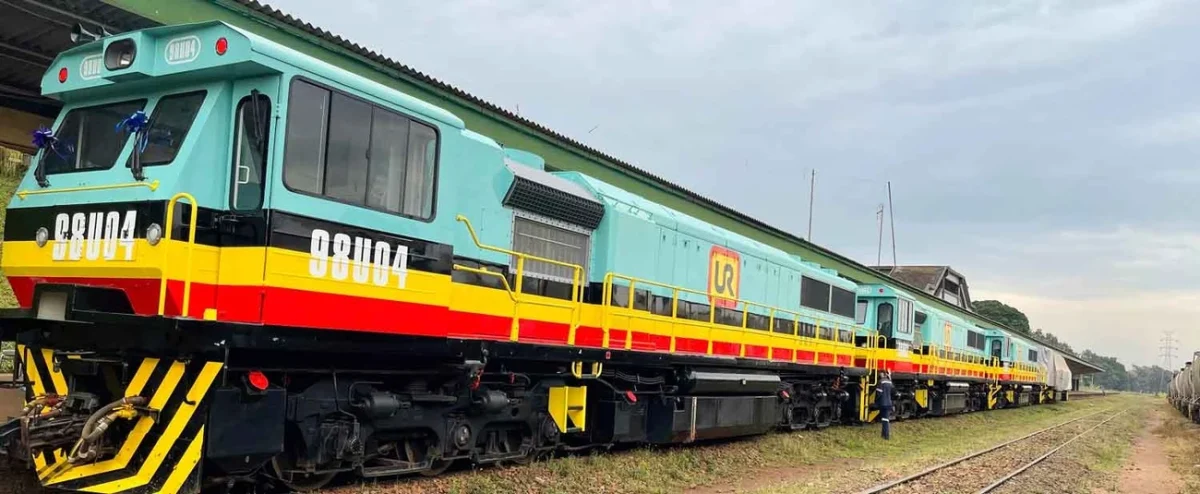
The Uganda Railways Corporation is in the process of purchasing 10 new Diesel Electric Locomotives, as the long-awaited Tororo-Gulu line works nears completion, as part of the several plans.
These and other ongoing projects by the corporation are part of the railway rehabilitation project, with the African Development Bank funding the Kampala-Malaba Meter Gauge Railway Line rehabilitation worth USD 298 million (UGX 1.071 trillion).
Under this project, planned activities include procurement of locomotives under the the contract for Supply and commissioning of ten new Diesel Electric Locomotives and Training of Maintenance and Operation personnel. All this is part of the East Africa Community Railway Rehabilitation Support Project.
A Diesel-Electric Locomotive uses a diesel engine to generate electricity, which powers electric traction motors, offering smooth power delivery and high starting torque.
The diesel engine (prime mover) powers an electric generator, which produces electricity to run electric traction motors that turn the wheels, effectively acting like a self-contained electric train without overhead wires. This makes it ideal for heavy hauling.
A standard diesel locomotive on the other hand, relies on mechanical (gearbox) or hydraulic transmission directly from the engine, simpler but limited by transmission strength.
The advantage of the diesel electric engine is the excellent starting power, smooth acceleration, no need for complex, heavy gearboxes, and efficient power delivery across speeds, and significantly low diesel consumption.
The EAC Railway Rehabilitation Support Project also involves rehabilitation of the Kampala-Malaba Meter Gauge Railway Line.
In the bid notices that were issued in November 2025 followed by addenda earlier this month, URC is also busy procuring contractors for the rehabilitation of the Malaba-Jinja and Port Bell-Kampala-Kyengera Railway Line Sections.
This project includes construction and/or rehabilitation of railway support infrastructure; station buildings, passenger terminus stations and halts, good sheds, workshops, fencing, automated level crossing signaling, improvement of Jinja Pier and Port Bell ancillary structures and dredging works.
URC has also stressed that the long-awaited works on the Tororo-Gulu line, which terminates at the Gulu Logistics Hub, Gulu City, are due for completion next month, according to the head of communications, John Lennon Ssengendo.
“Currently, we are working on Tororo – Gulu, works are expected to be completed in February 2026. Construction is at over 70 percent,” he says of the 375km line. This line runs through seven districts including Mbale, Soroti and Lira.
In general, the AfDB-supported project will also involve the acquisition of 100 “high-capacity flat wagons” and the procurement process is ongoing, while for locomotives, a special procurement notice has been issued for 10 units, and the date for submission is now set at January 27.
The European Union undertook a study to improve passenger services in the city, which was ended last year.
Following the study, the Bujuuko-Kyengera-Kampala-Namanve-Mukono section was earmarked for improvements as follows. The Bujuuko-Kyengera section, will be a single track, with one underpass and four overpasses which are aimed at solving the issue of road users interfacing with the train at level crossings.
The Kampala-Kyengera section will be double track, with five underpasses and two overpasses, with trains able to move in different directions, thus improving efficiency and service delivery, according to Ssengendo.
The Kampala-Namanve section will be double-truck, with three underpasses, while the one level crossing will be closed. The Namanve-Mukono double track will feature two underpasses and three overpasses.
On when procurement and works could start, URC says: “These studies are not undertaken in a few months. They take time to do the right thing and carry a year of commencement”.
The five-year target is to increase annual cargo movement from the current 290,000 to between 840,000 to 1 million.
****URN****