



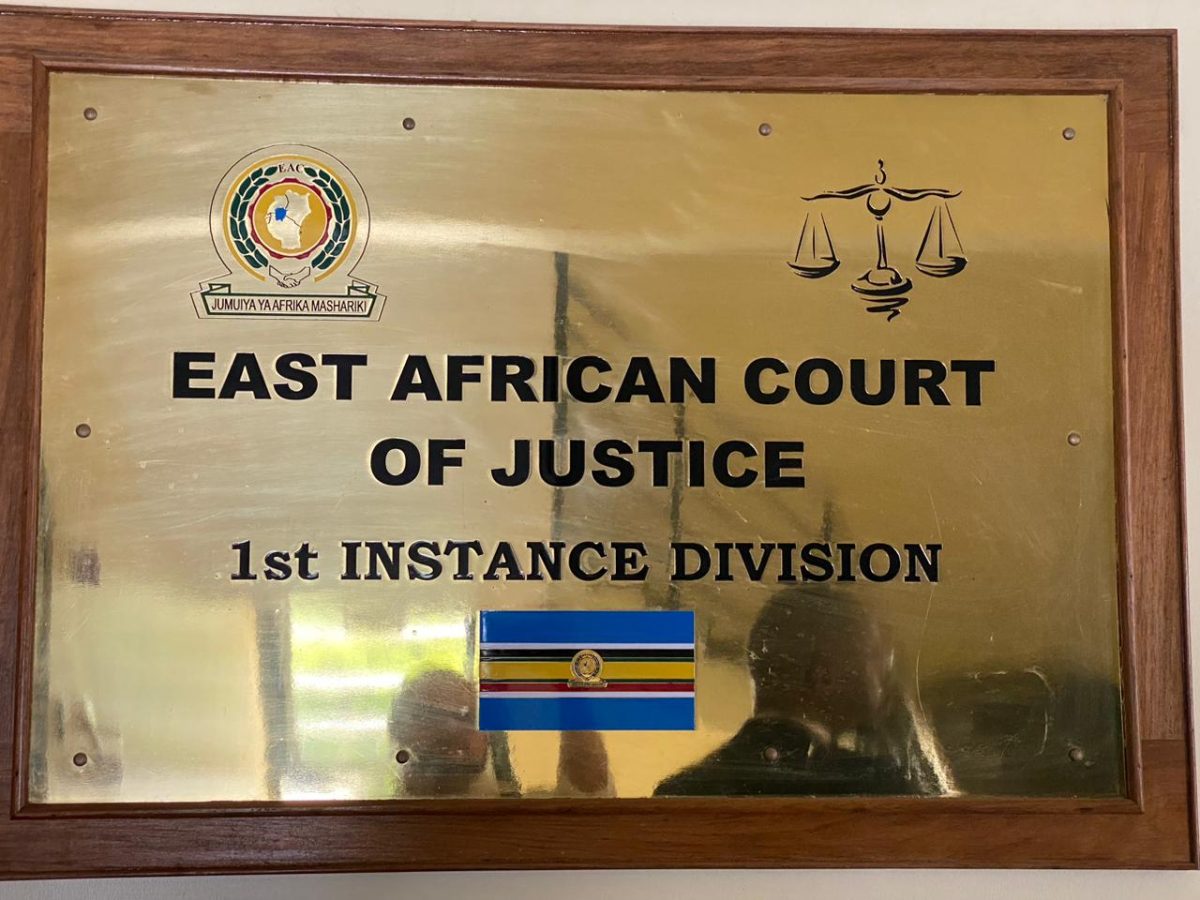
The government is ready to file a defense in a court case in which a Congolese civil society group and fishermen sued Uganda, DRC, and the EAC Secretary General, over oil and gas developments in the Albertine Graben.
The group in a suit beforethe East African Court of Justice (EACJ), accuses the Government of Uganda of violating regional environmental obligations related to the Tilenga and Kingfisher oil projects.
Joshua Lukaye, an Assistant Commissioner at the Ministry of Energy, confirmed that the Ministry has been notified by the Attorney General’s Chambers about the petition before the EACJ in Arusha.
Lukaye clarified that one of the key issues raised was the court case filed by the Democratic Republic of Congo (DRC). He noted that “most of the concerns raised by DRC are speculative” and said the Ministry of Justice has already taken up the matter.
“And it has been picked up by the Ministry of Justice, which has been brought up. The issues have been brought to us. Ministry of Energy, we have responded to the template’ he said.
He revealed that the Ministry of Energy has provided detailed responses, and the government is confident it has “a very good case.
”The petition this time around questions the operations of CNOOC’s Kingfisher operations located on the shores of Lake Albert. CNOOC’s Chief of Corporate Affairs, Zakalia Lubega, confirmed knowledge of the petition but declined to comment further.
Lukaye, on the other hand, stressed that CNOOC is currently not undertaking any operations on Lake Albert. “The only activity previously conducted on the lake involved seismic data acquisition during the exploration stage—before any drilling took place,” he said.
“And we believe we will have a very good case to address. You and me agree and know that CNOOC is not doing any operations on Lake Albert. If there was anything, it was during the time of exploration when we were doing seismic data acquisition,” he explained.
He said the Congolese would have raised the point, saying that we could be affecting the lake. Because seismic data acquisition involves going on the lake, and then you create sound.
He added that the seismic work, which uses sound waves to map subsurface structures, was completed years ago and only after a full Environmental Impact Assessment had been carried out.
He was speaking at a multi-Stakeholder Dialogue, running under the theme “Sustainable Development of the Oil and Gas Sector and Leveraging the Resource to support Uganda’s Tenfold Growth Strategy and Energy Transition.
The online and physical dialogue was organized by the Civil Society Coalition on Oil and Gas, the Natural Resources Governance Institute (NRGI), and the Advocates Coalition on Development and Environment, where the matter of the petition by the Congolese was raised.
Lukaye assured stakeholders that environmental compliance remains strict for every project being undertaken in Uganda.“It’s not only you monitoring us. Civil society, the international community, and even the oil companies themselves are very keen on environmental issues. They cannot afford to make a mistake.”
He said oil companies would resist any policy that compromises environmental standards, adding that environmental oversight is now stronger than ever.
Regarding the DRC case, he reiterated that the government is not worried: “We have looked at the issues, and they are purely speculative. We are responding to them.”
The case was filed by ASEP, a Congolese civil society platform, Owechiwele Moïse, a fisherman and president of the Fishermen Federation of Lake Albert, and Kambasu Kasuva Mukura Josué, a fisherman and president of the Fishermen of Lake Edward.
These individuals claim to represent thousands of community members who have experienced severe declines in fish stocks since oil activities intensified in Ugandan territory.
Narek Mwende and Olivier Ndohol, both Congolese lawyers and members of the Left Congolese School, emphasized that the case is rooted in documented environmental risks identified by scientific organizations, including the Environmental Law Alliance Worldwide (ELAW).
An ELAW report, published on October 2, said Oil & gas projects in Uganda have the potential to cause environmental impacts to citizens and residents of the Democratic Republic of Congothrough what the researchers described as Lake-wide eutrophication of Lake Albert, and the disposal into Lake Albert of oil processing wastes.
The petitioners said Uganda’s oil operations in the Albertine Rift are causing an alarming ecological risk, such as lake atrophy, oxygen depletion, and declining fish populations that local communities have already observed.
Violations of the East African Community Treaty Alleged.
According to the legal team, the petition highlights multiple violations of the Treaty for the Establishment of the East African Community (EAC), including failures in good governance, sustainable development, Environmental protection, and management of shared natural resources.
The petitioners accuse the Ugandan government of failing to conduct a transboundary environmental and social impact assessment (TESIA) before initiating major oil developments close to shared freshwater lakes.
They also assert that neither Uganda nor the Democratic Republic of Congo (DRC) consulted Congolese communities living along Lakes Albert and Edward, despite their direct dependence on these waters for survival.
The Secretary General of the East African Community is also cited for failing to ensure that member states respect their obligations under the Treaty.
Despite the fortunes of the Tilenga and Kingfisher projects, the petitioners claim that they are “dangerous” and “anachronistic” due to the lack of, ppublic participation, lack of access to information, and lack of judicial safeguards. The petition states that these projects threaten local livelihoods, regional biodiversity, and the DRC’s position as an environmental “solution country.
The applicants request the Court to order an immediate halt to all project operations that impact Lake Albert and its ecosystem, activesupervision by the EAC Secretary General to ensure effective cooperation between DRC and Uganda, and financialcompensation—general and exemplary damages—for affected Congolese communities.
Asked by URN why the lawyers and activists were filing a petition after the EACJ had dismissed AFIEGO’s petition against the EACOP project, the legal team explained that fishermen only recently learned, through scientific analysis, that their declining catches and ecological changes were directly linked to Uganda’s oil activities. Until then, communities lacked the scientific evidence and legal support needed to act.
Also questioned about the ongoing lake boundary dispute between Uganda and the DRC. Fishermen responded that ecological impacts such as fish depletion occur regardless of the exact demarcation, and local knowledge allows them to distinguish Congolese waters from Ugandan ones.
On whether impacts are already observable, lawyers explained that loss of fish, livelihood disruption, and ecological degradation constitute direct and measurable harm, justifying legal action before the regional court. The representatives reaffirmed their confidence in the East African Court of Justice and called for strong protective measures for petitioners, witnesses, and affected communities. The declaration concluded in Kinshasa and Tanzania on November 26, 2026, with a unifying message.
***URN***