

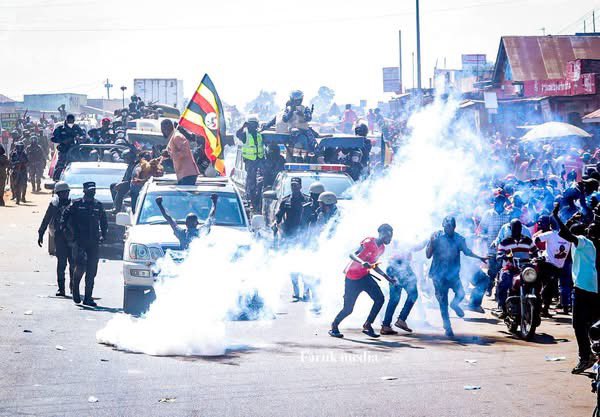
The ongoing presidential campaigns, which began with predictions of a peaceful process, have increasingly turned violent, raising concerns among election observers and human rights advocates.
For the first four weeks—from September 29 to the end of October—the campaigns were largely calm, with only isolated incidents in which opposition presidential candidates were briefly blocked but later allowed to proceed to their venues.
Observers attributed the early calm to pre-campaign security preparations, including refresher training for Field Force Unit (FFU) and General Duty officers on crowd and protest control. Inspector General of Police Abas Byakagaba directed Regional Police Commanders (RPCs) and District or Division Police Commanders (DPCs) to ensure that teargas, rubber bullets, and live ammunition were used strictly as a last resort. However, the situation has since shifted dramatically, with deadly clashes reported in several districts, including Iganga, where fatalities have occurred.
Others have been injured in what has been described as police and military brutality, most frequently during National Unity Platform (NUP) rallies involving the party’s presidential candidate, Robert Ssentamu Kyagulanyi.
Charity Ahimbisibwe, the Executive Director of the Electoral Laws Institute Uganda (ELIU), links the escalation to the absence of strong action against security officers accused of violence.
She argues that a lack of accountability—especially in cases like the fatal Iganga shooting—has emboldened perpetrators. She notes that neither the police nor the Uganda Human Rights Commission (UHRC) has held anyone responsible, including officers captured on video manhandling an elderly woman.
But Dina Kyasimire, the Acting Police Director for Legal and Human Rights Services, says the calm has deteriorated because some candidates have failed to follow designated routes to campaign venues.
She adds that some processions have blocked roads, disrupted businesses, and disrupted traffic flow. Kyasimire insists that officers have been cautioned against the use of unnecessary force and that investigations are underway to ensure corrective action is taken.
Presidential candidate Kyagulanyi on Tuesday accused security forces of deliberately obstructing his campaigns, citing a standoff in Fort Portal where his rallies were blocked for an entire day.
In a statement posted on X, he urged supporters to remain peaceful despite what he described as continuous provocation.
“In Fort Portal, we were barred from campaigning after the regime police held us in one position on the road for several hours until campaign time expired… Let us remain committed, courageous, and patriotic as we aspire to redeem ourselves from the prevailing military dictatorship,” he wrote.
The recent clashes echo earlier warnings from Presidential candidate Mubarak Munyagwa, who argued it was premature to describe the campaign period as peaceful. He claimed that security forces have been diverting opposition candidates onto rural routes while the incumbent faces no similar restrictions.
“You cannot say the campaigns are peaceful when we are being denied access to towns… If this continues, supporters will become frustrated and may choose to confront the security forces,” Munyagwa said.
His concerns appear to be materializing, with increased incidents of violence reported during Kyagulanyi’s recent rallies.
Electoral Commission spokesperson Julius Mucunguzi rejected accusations that the Commission is silent or reluctant to address violations against the NUP candidate. He maintained that the Commission is guided strictly by the law and is not influenced by any external actors.
Mucunguzi added that the Commission continues to meet with candidate agents and security officials to discuss emerging challenges. Since early November, dozens of NUP supporters have been arrested in Lira, Gulu, Iganga, Mbarara, and Kawempe.
The latest confrontation occurred on Tuesday when Kyagulanyi was blocked from accessing venues in Bunyangabu District and Fort Portal City.
During the 2021 presidential elections, more than 1,000 people — many of them NUP supporters — were arrested nationwide. According to the party, over 450 supporters have been arrested so far in the current campaign period. With fewer than five weeks remaining until the January 15 presidential and parliamentary polls, the country is watching to see whether the violence will intensify to levels seen in 2021, when more than 50 people were killed, and over 100 were injured. Many also wonder whether the relative calm of the campaign’s early weeks will return.
***URN***