

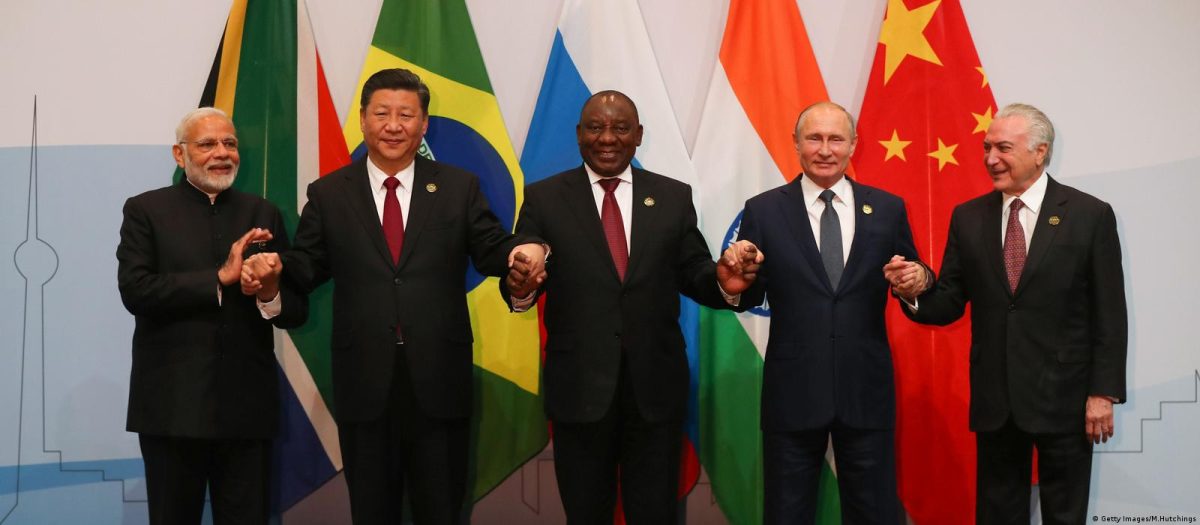
A South African academic has said African countries are already reaping major economic and political benefits from the growing influence of the BRICS bloc, arguing that the grouping is emerging as a key force for reforming global financial and governance institutions.
Speaking this week, Prof. Fulufhelo Netswera, Director of the BRICS Research Institute at Durban University of Technology, said BRICS has become “a powerful catalyst” for long-standing demands by developing countries seeking reforms at institutions such as the IMF, World Bank and the UN Security Council.
“Many Global South countries have agitated for such reforms for years without results,” Netswera said, noting that the increasing number of countries seeking BRICS membership demonstrates growing confidence in the bloc’s vision for a more multipolar world order.
The professor argued that African states are increasingly attracted to BRICS because of its emphasis on sovereignty and non-interference in domestic affairs.
According to him, the bloc’s financial architecture — particularly through the New Development Bank — offers developing countries alternatives to traditional Western-dominated financial institutions.
“BRICS can play a stabilizing role, through non-interference in domestic affairs, which is the posture of BRICS generally,” he said.
Founded in 2014 by BRICS nations Brazil, Russia, India, China and South Africa, the New Development Bank was created to finance infrastructure and sustainable development projects across developing economies.
The bank says it was established partly because existing global financial institutions were unable to fully meet the financing needs of developing countries.
Netswera said the NDB’s lending arrangements allow African governments to retain greater control over their economies compared to IMF and World Bank programs, which critics have often accused of imposing restrictive economic conditions.
The IMF recently approved reforms aimed at strengthening lending support for low-income countries, including expanded concessional financing programs.
However, debates over representation and voting power within Bretton Woods institutions continue, with BRICS finance ministers in recent years pushing for reforms to reflect the growing economic weight of developing nations.
Prof. Netswera described Africa as a continent with unmatched economic potential due to its vast natural resources, agricultural capacity and youthful population.
“Africa is so huge. It’s full of minerals. It has huge potential, perhaps the biggest potential globally, with more than 60% of global arable land,” he said.
“I think Africa can feed the world, Africa can power itself, Africa can do quite a lot of things in comparison to other continents.”
He further called for stronger continental unity, arguing that Africa’s bargaining power on the global stage would significantly increase if countries acted collectively.
“I wish we will reach a stage where Africa can stand as one platform and say, this is what we are doing, this is where we are going, this is our demand,” Netswera said.
“And yield that power as a single block. I wish we will reach that very soon because when that happens, I think there will be drastic changes in how other continents and big powers look towards Africa and trade with us.”
The BRICS grouping has expanded rapidly in recent years, attracting interest from countries across Africa, Asia and Latin America seeking alternatives to Western-led economic systems.
The New Development Bank has also continued expanding its membership and financing reach, recently adding new members while emphasizing lending without political conditionalities.