



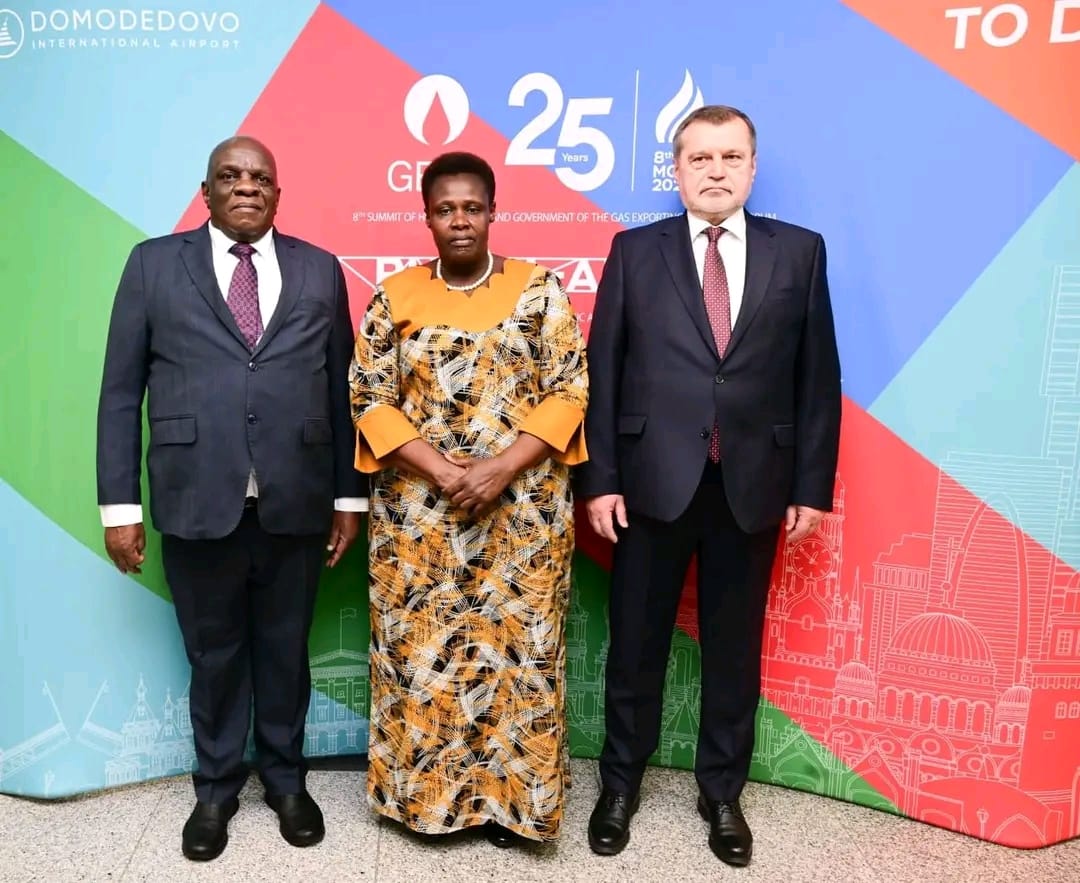
Vice President, H.E. Maj. (Rtd) Jessica Alupo, has arrived in Moscow, Russia, ahead of the Third Russia–Africa Summit scheduled for October 28–29, 2026, with the meeting expected to provide fresh opportunities to strengthen bilateral cooperation between the two countries.
Alupo arrived at Domodedovo International Airport, where she was received by H.E. Anatoly Bashkin, Director of the African Department at Russia’s Ministry of Foreign Affairs, and Uganda’s Ambassador to Russia, H.E. Moses Kizige.
She is in Moscow to represent President Yoweri Kaguta Museveni at the summit, which will bring together African leaders and Russian officials to discuss political relations, trade, investment, technology and other areas of mutual interest.
The summit is expected to focus on expanding trade and investment, food security, energy, digitalisation, artificial intelligence, nuclear cooperation and humanitarian partnerships.
Uganda’s participation comes as Kampala and Moscow continue to strengthen cooperation, particularly in defence and security, while pursuing opportunities in education, science, technology, trade and investment.
Defence cooperation takes centre stage
Defence and military technical cooperation remain among the most visible areas of Uganda–Russia relations, with recent projects aimed at strengthening the operational capabilities of the Uganda People’s Defence Forces (UPDF).
On October 21 and 22, President Museveni commissioned and launched military facilities, equipment and training infrastructure developed under the bilateral defence cooperation framework, following engagements with a Russian delegation led by Lieutenant General Aleksandr Kshimovskii.
The projects included a mechanised major repair facility at Magamaga Cantonment in Jinja District, valued at $53 million and donated by the Russian government. The facility is intended to improve Uganda’s capacity to maintain and repair military vehicles and other equipment.
Other installations and projects covered mechanised warfare training at Kalama in Mubende District, marine security facilities in Entebbe, and training and operational infrastructure at Kalangala.
The cooperation also includes facilities for arms and military equipment at Magamaga, watercraft maintenance, marine operations and training on armoured reconnaissance vehicles.
Museveni has called for Uganda to build technical expertise alongside acquiring equipment, including exploring opportunities for local production in partnership with Russian specialists.
Earlier, on October 9, the President met another Russian military delegation led by Major General Sergei Marchuk at State House, Entebbe, and commended Moscow for its continued support to Uganda’s defence sector.
The engagements demonstrate the practical dimension of the two countries’ military relationship, extending beyond diplomatic exchanges to equipment maintenance, infrastructure development, training and technical support.
Education and technology on the bilateral agenda
Education is another area in which Uganda is seeking to expand cooperation with Russia.
In May 2026, Foreign Affairs Minister General Jeje Odongo held talks with Russia’s Chargé d’Affaires in Uganda, Sergey Lobanov, during which the Russian side acknowledged Uganda’s request for increased scholarship opportunities for Ugandan students in the 2026–2027 academic year.
The two countries also identified education, technology transfer, science and technical cooperation as areas for further engagement.
The summit could provide an opportunity for Uganda to pursue expanded academic exchanges, technical training and skills development, particularly in science, engineering, energy and emerging technologies.
Cooperation in these fields could complement Uganda’s efforts to develop local technical capacity and support its wider economic and industrial ambitions.
Trade and investment opportunities
Beyond defence and education, Uganda and Russia have continued diplomatic engagement on economic and scientific-technical cooperation.
On October 7, 2025, the two countries held a technical session of the Uganda–Russia Intergovernmental Commission on Economic and Scientific-Technical Cooperation at Speke Resort Munyonyo in Kampala.
Discussions covered trade and investment, science and technology, education, agriculture, energy, health and defence. The meeting focused on implementing previous agreements and identifying additional areas for cooperation.
The Moscow summit presents an opportunity for Uganda to translate these discussions into practical economic partnerships, including potential collaboration in agricultural production, energy development, industrial technology and investment.
However, the scale of the economic benefits will depend on the agreements reached, their implementation and the ability of businesses in both countries to establish sustainable commercial partnerships.
Uganda and Russia have maintained diplomatic relations for decades, with defence cooperation and high-level political engagement forming important parts of their relationship.
In September 2026, Defence Minister Kiryowa Kiwanuka reaffirmed Uganda’s commitment to maintaining military cooperation with Russia, while expressing the country’s openness to mutually beneficial business opportunities.
The Third Russia–Africa Summit therefore comes at a time when both governments are seeking to sustain their established partnership while exploring additional areas of economic and technical cooperation.
Among the African leaders whose arrivals in Moscow have been publicly reported are Zimbabwean President Emmerson Mnangagwa, Mali’s transitional leader Assimi Goïta and Mozambican President Daniel Chapo.
As Alupo represents Uganda at the summit, Kampala’s priorities include strengthening diplomatic engagement, expanding educational opportunities, attracting investment and building on existing defence and security cooperation.
The meeting is expected to provide a platform for African countries and Russia to discuss shared interests and identify practical ways to advance their partnerships amid changes in the international political and economic landscape.