



Ethiopia goes to the polls tomorrow Monday 1 for its 2026 general election, with the process unfolding under sharply contrasting narratives—one emphasizing insecurity and political tensions, and another highlighting large-scale voter registration and extensive institutional participation.
On one side, interanational and regional discourse continues to frame Ethiopia’s political environment through the lens of insecurity, governance challenges, and unresolved conflicts in parts of the country, including areas of Amhara and Tigray.
These conditions have raised concerns among observers about political stability, safety, and the broader democratic environment in which the vote is taking place.
On the other side, official figures from the National Election Board of Ethiopia point to significant civic engagement ahead of the polls. More than 50.5 million citizens have registered to vote in the 2026 general election.
The electoral process has also attracted participation from 47 political parties, with 10,934 candidates competing for federal and regional positions.
Approximately 49,000 polling stations have been established across the country, while voter registration is reported at around 76 percent of the eligible voting-age population.
The scale of the election is further reflected in its national coverage. Ethiopia’s parliament consists of 614 constituencies, with elections scheduled in 606 constituencies—about 98.7 percent coverage—while eight constituencies are unable to participate due to security-related constraints. Despite these disruptions, the process remains widely implemented across the country’s administrative structure.

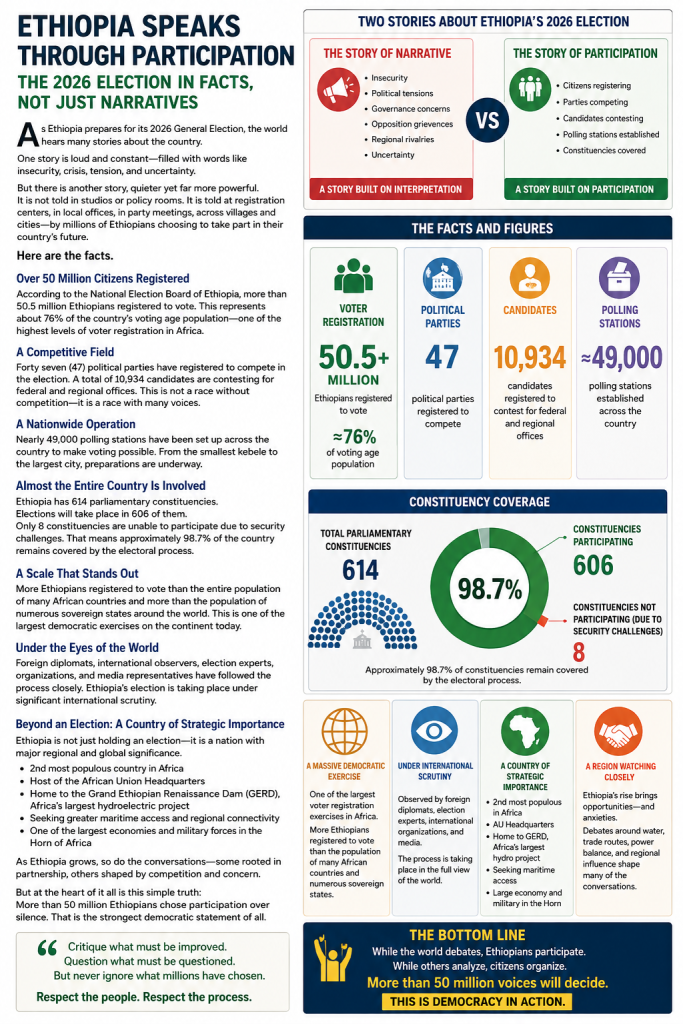
Taken together, these figures position Ethiopia’s 2026 election among the largest electoral exercises in Africa in terms of both participation and candidate volume. The presence of dozens of political parties and thousands of candidates underscores continued political engagement even under challenging conditions.
Ethiopia’s electoral significance is also shaped by its broader geopolitical and institutional role. The country hosts the headquarters of the African Union, making it a central diplomatic hub for Africa.
It is also one of the continent’s most populous nations and a key player in regional security and economic affairs in the Horn of Africa.
Major national infrastructure projects further reinforce its regional importance, including the Grand Ethiopian Renaissance Dam (GERD), which continues to shape regional discussions around energy security, water rights, and Nile Basin relations.
Despite the scale of participation, questions persist regarding political freedoms, security conditions, and the overall competitiveness of the electoral environment.
International observers and diplomatic missions are expected to continue monitoring the process, with assessments likely to vary depending on methodological and political perspectives.
Still, the central factual indicators remain significant: tens of millions of registered voters, nearly full constituency coverage, and thousands of candidates competing across federal and regional levels.
Supporters of the process view these figures as evidence of sustained civic engagement, while critics argue that participation statistics alone do not resolve deeper concerns about democratic quality.
Ethiopia’s 2026 election is therefore unfolding at the intersection of two realities—ongoing structural and security challenges on one hand, and extensive electoral participation on the other. How these dynamics are interpreted is likely to shape broader understandings of Ethiopia’s political trajectory in the years ahead.