

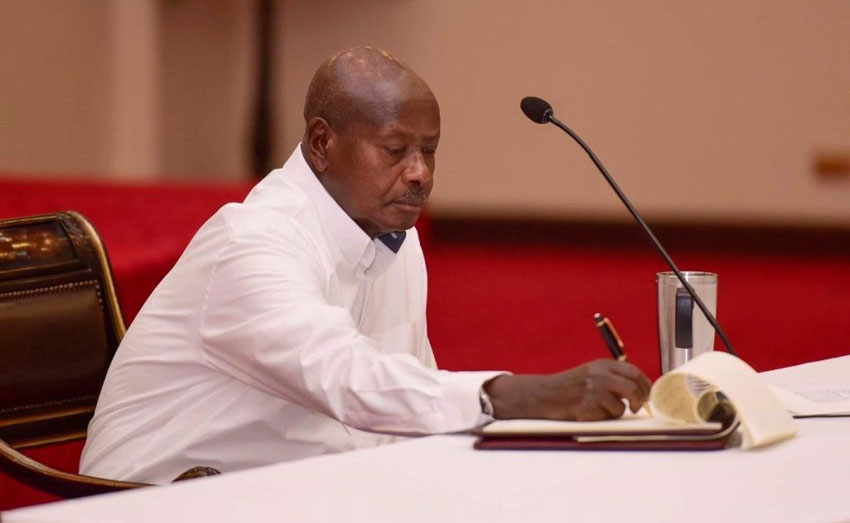
President Yoweri Museveni has assented to the Protection of Sovereignty Act, 2026, officially signing into law controversial legislation that government says is intended to shield Uganda from unlawful foreign interference in its political, security, and economic affairs.
The assent comes weeks after Parliament passed the Bill following intense national debate, public hearings, and widespread criticism from opposition leaders, civil society groups, financial institutions, and sections of the international community.
In announcing the development, government said the law seeks to “defend Uganda’s sovereignty by controlling unlawful foreign interference in the country’s political, security, and economic affairs while safeguarding legitimate investment, trade, humanitarian efforts, and academic collaborations.”
The legislation gives authorities expanded powers to investigate and act against individuals, organizations, or entities suspected of promoting foreign interests deemed harmful to Uganda’s national interests or constitutional order.
It also introduces penalties for persons found guilty of participating in unlawful foreign interference activities.
Among its key provisions are restrictions on foreign-backed political activities, mandatory disclosure and regulation of certain foreign-linked operations, enhanced investigative powers for security agencies, penalties for unlawful collaboration with foreign actors, and protections for legitimate investment, trade, humanitarian work, academic partnerships, and development cooperation.
The Protection of Sovereignty Bill was first introduced in April by State Minister for Internal Affairs David Muhoozi amid growing concern within government over what officials described as increasing external influence in Uganda’s domestic affairs.
Government supporters argued the law was necessary to preserve Uganda’s “self-governance” and national independence from foreign political and financial manipulation.
However, the Bill immediately triggered nationwide controversy.
Opposition leaders led by Joel Ssenyonyi argued that the proposed law duplicated existing legislation such as the Penal Code Act, Anti-Money Laundering Act, NGO Act, and Public Finance Management Act.
They warned that some clauses were broad enough to threaten democratic freedoms, civic activity, and Uganda’s investment climate.
Civil society organizations, human rights defenders, and governance groups also pushed back strongly against the Bill, warning that it could be used to suppress dissent, regulate NGOs, and limit independent civic participation under the guise of protecting sovereignty.
The debate intensified after early drafts of the Bill appeared to classify Ugandans living abroad as “foreigners” or “agents of foreigners,” sparking concern among the diaspora community whose remittances contribute significantly to Uganda’s economy.
The proposal also alarmed banks and economists who warned it could disrupt foreign exchange inflows, weaken investor confidence, and affect remittances and international financial transactions.
Governor Michael Atingi-Ego reportedly warned parliamentary committees that some provisions in the original Bill risked weakening the shilling, draining foreign reserves, and creating uncertainty in cross-border financial flows that sustain Uganda’s economy.
Facing mounting criticism, government later introduced sweeping amendments before the final parliamentary vote.
The revised version removed controversial proposals affecting the diaspora, narrowed definitions critics had described as vague, and limited some restrictions primarily to political activities linked to foreign interests.
Parliament eventually passed the amended Bill during a tense sitting chaired by Speaker Anita Among, with government insisting the legislation was necessary to protect Uganda’s sovereignty in an increasingly complex global political environment.
Supporters of the new law say it will help Uganda defend its constitutional order, reduce external political influence, and strengthen national independence ahead of the 2026 political period.
Critics, however, maintain that despite amendments, the Act could still be used to restrict civic space, target opposition activity, and tighten state control over organizations receiving foreign support.