



Uganda’s participation in the expanded BRICS partnership is opening new opportunities for the country to deepen trade, attract investment, access technology and strengthen economic ties with some of the world’s largest emerging economies.
The 18th BRICS Leaders’ Summit, scheduled for tomorrow September 12 and 13 in New Delhi, brings together an expanded coalition of countries from Africa, Asia, the Middle East and Latin America at a time when developing countries are seeking greater influence in global economic and political affairs.
For Uganda, the summit provides an important platform to pursue practical partnerships in areas central to its economic transformation, including agriculture, manufacturing, energy, infrastructure, technology, tourism and trade.
Uganda is among the 10 BRICS partner countries, alongside Belarus, Bolivia, Cuba, Kazakhstan, Malaysia, Nigeria, Thailand, Uzbekistan and Vietnam. The partnership places Uganda within a wider economic network linked to the 11 full BRICS members, including China, India, Brazil, Russia, South Africa, Egypt, Ethiopia, Indonesia, Iran, Saudi Arabia and the United Arab Emirates.
The scale of the grouping gives Uganda access to markets representing a significant share of the world’s population, economic output and international trade.
One of the biggest opportunities for Uganda is expanded market access. BRICS cooperation can help Ugandan producers explore new markets for coffee, tea, agricultural products and other exports while creating opportunities for partnerships that can increase local processing and value addition.
The bloc’s growing focus on investment and development finance could also benefit Uganda as the country seeks capital for infrastructure, industrialisation and energy projects.


Technology is another area where Uganda stands to gain. Stronger partnerships with BRICS economies could support the transfer of technology, digital innovation and skills while creating opportunities for Ugandan businesses and young entrepreneurs to connect with larger international markets.
BRICS cooperation also comes at a time when members are pushing for stronger economic links among developing countries, including discussions around cross-border payments, trade facilitation and greater cooperation in financial systems.
For Uganda, deeper participation in such initiatives could make trade with BRICS economies easier and help local businesses build stronger commercial relationships across Asia, Africa, the Middle East and Latin America.
The summit will also focus on food and energy security, health, disaster resilience, critical supply chains, connectivity and sustainable development. These are areas with direct relevance to Uganda’s development priorities.
India, which is hosting the summit under its 2026 chairship, has placed development, innovation, sustainability and the aspirations of the Global South at the centre of its BRICS agenda.
The opening leaders’ session on September 12 will focus on “Inclusive Global Governance and Strengthening Multilateralism,” while the September 13 session will examine resilience, innovation, cooperation and sustainability in pursuit of inclusive global growth.
The summit is expected to conclude with the adoption of the New Delhi Declaration, which could provide a roadmap for deeper cooperation among the expanded BRICS membership and its partner countries.
Uganda’s participation therefore gives the country an opportunity to move beyond diplomatic engagement and pursue concrete economic outcomes from its relationship with the BRICS network.
The country can use the platform to promote itself as an investment destination and a gateway to the wider East African and African markets, particularly as it seeks to attract investment into manufacturing, agro-processing, logistics, energy and technology.
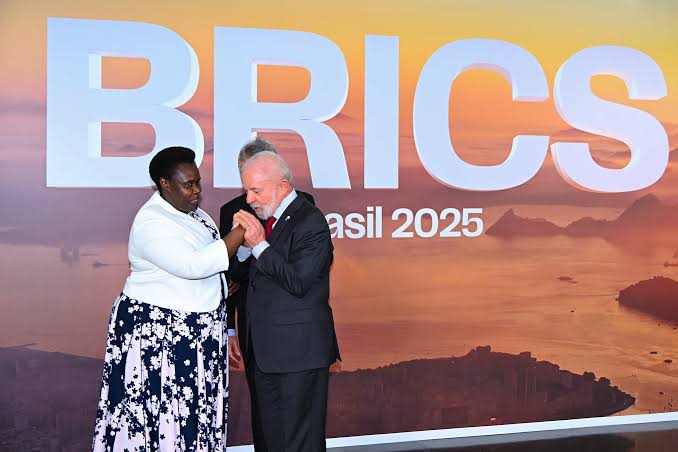
Uganda’s representation at the summit is being led by Vice President Jessica Alupo, who arrived in New Delhi on Friday ahead of the leaders’ meeting. She was received by India’s Minister of State for External Affairs Jayant Chaudhary and will lead Uganda’s delegation during the summit.
Alupo’s presence gives Uganda an opportunity to reinforce the country’s economic and diplomatic priorities as BRICS leaders and partner countries gather to discuss the future of Global South cooperation.
For Kampala, the importance of the New Delhi summit will ultimately be measured not only by declarations but by the investments, markets, partnerships and opportunities that Uganda can secure from its growing engagement with the BRICS family.