

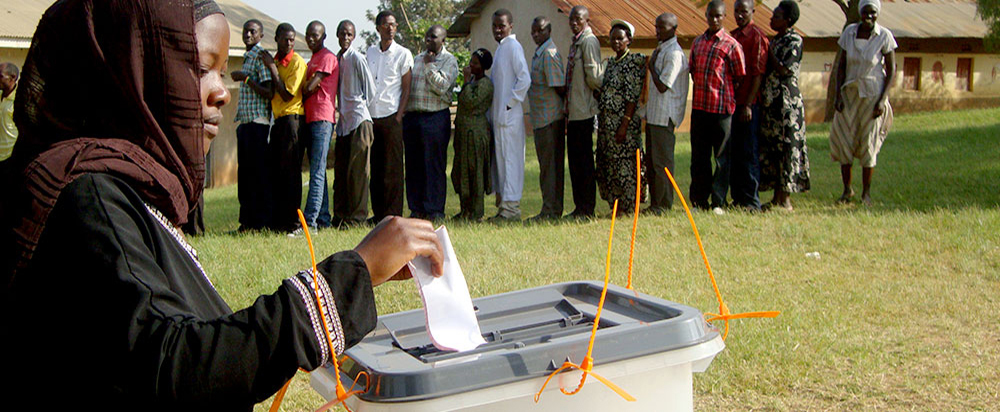
Political and civic leaders in Fort Portal City have raised concern over the low voter turnout recorded during last week’s Presidential and Parliamentary elections, despite increased voter registration, more polling stations, and repeated voter mobilisation efforts.
According to the Electoral Commission (EC), Fort Portal City had 75,550 registered voters, but only 37,060 people cast their ballots on Thursday.
This means 38,490 registered voters did not vote. Fort Portal City has a population of 137,549 people, according to the 2024 National Population Census.
The city is divided into North and Central divisions, with 25 parishes, 196 villages, and 190 polling stations.
Speaking to Uganda Radio Network (URN), the newly elected Member of Parliament for Fort Portal Central Division, Ronald Muhenda, blamed the low turnout on long-standing leadership failures.
He said many residents feel they have not benefited from past leaders and therefore see little value in voting.
According to Muhenda, voter apathy is not caused by lack of political awareness, but by frustration and disappointment over unfulfilled promises.
The State Minister for Primary Health Care and Fort Portal North Division MP, Margret Muhanga, said the Electoral Commission did not do enough civic education to encourage people to vote.
She noted that much of the voter sensitisation was done by candidates, yet civic education is the responsibility of the Electoral Commission. However, Muhanga also said some voters were simply reluctant to turn up on polling day.
Meanwhile, Francis Muhindo, the Peace and Conflict Manager at KRC Uganda, attributed the low turnout to election fatigue, voter complacency, and technical challenges.
He said many voters believed the incumbent leaders were already assured of victory, which discouraged them from voting.
Muhindo also noted that the breakdown of Biometric Voter Verification Kits (BVVKs) during the early hours of voting demoralised voters who had expected a smooth and fast process.
He called on the Electoral Commission to strengthen voter mobilisation efforts, stressing that civic education should be continuous and not limited to election periods.
He also urged candidates to improve grassroots engagement. Muhindo said meaningful political change depends on active citizen participation and that sustained civic education is key to rebuilding public trust and strengthening democracy.
Some residents who did not vote also shared their experiences. Meseach Kibuuka, a resident of Fort Portal, said he failed to vote due to problems with the BVVK machines.
He explained that he arrived at his polling station at 7:30 a.m., hoping to vote early and go to work, but voting had not started. He later decided to leave without voting.
Grace Byaruhanga said she registered to vote in her ancestral village but lacked transport to travel there on polling day.
Another resident, Jimmy Ndyanabo, said he could not vote because his name was missing from the voters’ register at his polling station. When he was advised to check another polling station, he declined, saying it would waste his time.
As concerns grow, leaders and civil society organisations are calling for stronger civic education, improved election management, and better voter engagement to restore confidence in the electoral process and encourage higher participation in future elections.
****URN****