

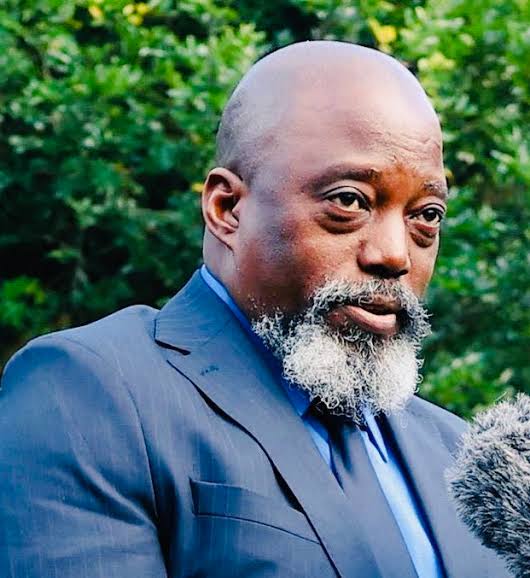
Former DRC president Joseph Kabila has cast doubt on ongoing peace efforts involving Democratic Republic of the Congo, warning that talks in Doha and Washington risk failing without genuine political will from Kinshasa.
In a rare interview with La Libre Belgique in Goma, Kabila said the multiplication of diplomatic initiatives show a lack of coordination rather than progress.
“The fact that there are so many initiatives shows there has been no harmonization,” he said. “How far will each process go?”
Negotiations are currently taking place in Doha between the government and armed groups, while parallel discussions in Washington involve regional actors, including Rwanda.
Additional mediation efforts are being led by African states and the African Union.
But Kabila argued that the core issue lies not in the number of talks, but in the absence of commitment from the Congolese leadership.
“What is missing above all is real political will in Kinshasa,” he said. “Today, the main problem in the DRC is governance and the lack of vision.”
He warned that without a coherent approach, the parallel negotiations could fail to deliver lasting peace in the conflict-ridden east.
“There are ingredients for a serious crisis,” Kabila said. “If we do not manage it well, we risk completely uncontrollable situations.”
Drawing on his experience during the early 2000s peace process, Kabila stressed that successful negotiations require inclusive dialogue and national ownership.
“At the time, we said the Congolese had to take charge of their own process,” he said.
“All those involved had to come together. That is how we achieved peace and reunified the country.”
He contrasted that period with the current situation, accusing the administration of President Félix Tshisekedi of prioritizing military solutions over dialogue.
“The answer has always been, ‘we will go to war,’” he said. “Five years later, we are still in the same war.”
Kabila also suggested that governance failures are undermining the credibility of any negotiations.
“We no longer have a Constitution. It is being trampled on,” he said, warning that internal political instability weakens the country’s position in external talks.
Despite his skepticism, Kabila maintained that peace remains achievable if the right choices are made. “War is a choice. Peace is also a choice,” he said.
He called for a shift toward a unified and inclusive process that brings together all Congolese stakeholders, arguing that fragmented diplomacy cannot substitute for internal consensus.
“The Congolese people must be at the center,” he said. “Otherwise, these processes will not succeed.”
As multiple tracks of diplomacy continue in Doha, Washington and across Africa, Kabila’s remarks highlight growing concerns that without alignment and political commitment, the efforts may struggle to end one of Africa’s most persistent conflicts.