



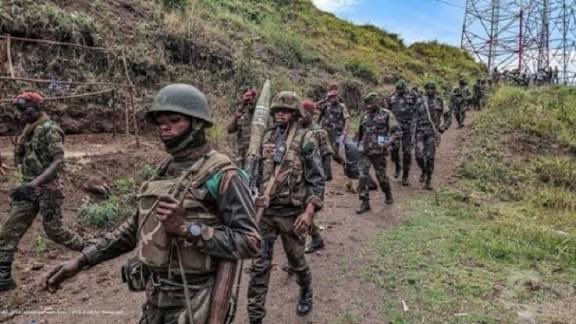
The Government of the Democratic Republic of the Congo and the Alliance Fleuve Congo / March 23 Movement (AFC/M23) rebels have signed a mandate in Doha, Qatar, marking a new step in the ongoing peace process for eastern Congo.
According to a statement released early Tuesday by Qatar’s Ministry of Foreign Affairs, the mandate was signed on Monday evening at the conclusion of a meeting of the Ceasefire Oversight and Verification Mechanism between the two parties.
The meeting was hosted by the State of Qatar as part of its efforts to help resolve the conflict in eastern DR Congo. The mandate stems from the International Conference on the Great Lakes Region framework.
The two sides also renewed their commitment to the ceasefire and the Doha Framework Agreement for Peace, signed on November 15, 2025, pledging to implement all obligations in good faith in support of the peace process.
The meeting reviewed developments on the ground and discussed existing challenges. Participants emphasized the need for practical measures to strengthen monitoring, verification, and information sharing to support the ceasefire.
Members of the mechanism reviewed implementation plans by the United Nations Organization Stabilization Mission in the Democratic Republic of the Congo (MONUSCO) and the International Conference on the Great Lakes Region, reaffirming their commitment to supporting and facilitating their work to ensure the success of field missions.
MONUSCO was tasked with dispatching its first field mission to Uvira in the coming days to monitor the ceasefire, with communication channels established to support the mission’s operations in line with the mechanism.
The meeting was attended by representatives of the mechanism, with the United States and the African Union participating as observers. The Republic of Togo, serving as the African Union–appointed mediator, as well as MONUSCO and the International Conference on the Great Lakes Region, were also present.
Based on the discussions, members agreed on follow-up steps to strengthen the effectiveness of the mechanism and ensure the continuation of regular meetings within its framework. Neither the Congolese government nor the AFC/M23 rebels had issued an official reaction to the signing of the mandate by Tuesday.
However, hours before Qatar’s announcement, AFC/M23 spokesperson Lawrence Kanyuka released a statement warning that the rebels could return to Uvira and surrounding areas if the Congolese army (FARDC) and its allies continue attacks against the Banyamulenge community.
Kanyuka alleged that following the withdrawal of AFC/M23 fighters, FARDC and allied forces carried out attacks in Mukoko, Gakenke, Point Zero, Gugezi, Biziba, Kundondo, Mitamba, and Kirungwa.
He also accused the army and its allies of deploying troops and equipment around Point Zero, Rwitsankuku, Mulima-Kananda, Fizia, and Baraka, which he claimed are being used as operational hubs for attacks against civilians in the High Plateaus.
AFC/M23 president Bertrand Bisimwa also accused the Congolese government of acting in bad faith, alleging that Kinshasa exploited the rebels’ withdrawal from Uvira to carry out selective massacres in Minembwe and reinstate a humanitarian blockade.
Despite the ongoing peace talks, fighting has continued on the ground, particularly in South Kivu Province. On Monday, FARDC spokesperson for Sukola South operations, Second Lieutenant Mbuyi Reagan, said the army has been engaged in fighting for five days to retake Minembwe, which he described as a stronghold of Twirwaneho and its allies, including AFC/M23, Red Tabara, and Gumino.
The March 23 Movement is an armed rebel group operating in the eastern Democratic Republic of the Congo.
It first emerged in 2012, accusing the Congolese government of failing to implement a March 23, 2009 peace agreement that had ended an earlier rebellion in the region. The group was militarily defeated in 2013 before resurfacing in 2021–2022.
The movement is led by Bertrand Bisimwa and military commander Emmanuel Sultan Makenga. The Congolese government has repeatedly accused Rwanda of backing M23, allegations denied by both Kigali and the rebels. M23 says it is fighting corruption, xenophobia, and discrimination within Congo’s political leadership. Earlier this year, the group launched a rapid offensive across eastern Congo, capturing several major towns and raising fears of a wider regional conflict.
****URN****