



The government of the Democratic Republic of the Congo (DRC) has said civilians were forced to demonstrate following the withdrawal of the March 23 Movement (M23) and its coalition from Uvira city and surrounding areas in South Kivu province.
M23 rebels announced on December 18, 2025, that they had withdrawn from Uvira and nearby areas in response to calls from the United States. Following the announcement, civilians in Uvira, Bukavu, and Goma cities, as well as in the towns of Rutshuru, Kamanyola, Sake, and Kiwanja, staged demonstrations until Monday, demanding that M23 remain in their areas.
Protesters argued that the rebels had provided better security for civilians and their property than the Armed Forces of the Democratic Republic of the Congo (FARDC) and other security agencies. Some demonstrators also called for direct dialogue between the DRC government and the M23 to resolve the conflict, while rejecting calls by the United States for the group’s withdrawal.
However, on Wednesday, the DRC government, through the Ministry of Communication and Media, rejected claims that the protests were voluntary, saying civilians were coerced by M23 rebels acting alongside the Rwandan Defense Forces (RDF). In a statement, the government said civilians, including women and young people, were forced to take part in demonstrations presented as support for what it described as the illegitimate presence of Rwandan forces and their allies. The government described the marches as a form of political and psychological manipulation, comparable to collective hostage-taking.
The statement further said using civilians as propaganda tools or human shields constitutes a serious violation of national sovereignty and human dignity, warning that those responsible would be held accountable. The government also said it remained committed to protecting civilians, restoring state authority across the country, and pursuing ongoing peace processes to achieve lasting stability in eastern Congo and the wider Great Lakes region.Later on Wednesday, M23 Administrative Secretary Benjamin Mbonimpa dismissed the government’s claims, saying the movement was “a space for empowering the population.” He argued that many civilians trust the group because they feel abandoned by the Congolese state.
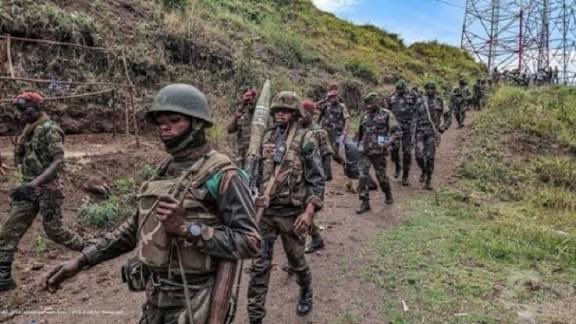
Meanwhile, clashes between M23 rebels and FARDC and allied forces in Makobola, about 14 kilometers from Uvira city, left the area under rebel control on Wednesday. The rebels later released photos from Makobola, claiming victory. Since the group’s resurgence in 2022 under leaders Bertrand Bisimwa and Emmanuel Sultan Makenga, the Congolese government has repeatedly accused Rwanda of backing the M23—allegations denied by both Kigali and the rebel group. M23 says its objective is to fight corruption, xenophobia, and discrimination within Congo’s political leadership.Earlier this year, the group launched a rapid offensive across eastern Congo, capturing major towns and raising fears of a wider regional conflict.
***URN***