

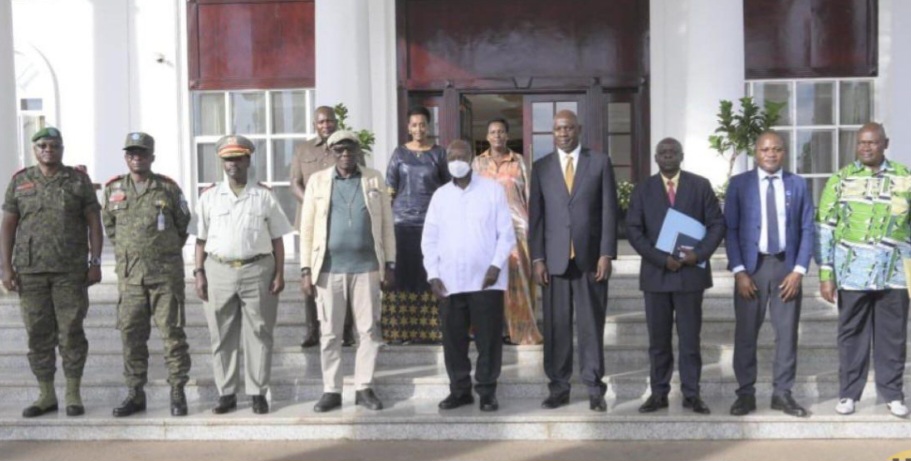
Thomas Lubanga Dyilo, the leader of the Convention for the Popular Revolution (CPR), an armed group operating in the eastern Democratic Republic of Congo (DRC), has declared a ceasefire following a meeting with Ugandan President Yoweri Museveni at State House Entebbe.
Lubanga reportedly met Museveni on Friday, October 9, 2026, alongside a delegation of Congolese government and military officials involved in efforts to restore peace in the conflict-hit northeastern DRC.
The Congolese delegation was led by Lieutenant General Jacques Ychaligonza, the Deputy Chief of Staff of the Armed Forces of the Democratic Republic of Congo (FARDC) in charge of operations and intelligence.
Others present included Major General Evariste Somo Kakule, the military governor of North Kivu Province, and Major General Gaby Kasongo Mulumba Batoka, the military governor of Ituri Province, where Lubanga’s group operates.
Ugandan officials at the meeting included the country’s ambassador to the DRC, Farid M. Kaliisa, and its chargé d’affaires in the DRC, Jeannette. Cyrille Muhindo Mbugheki, an expert on peace and security in northeastern DRC, also attended.
Although Museveni had not issued an official statement about the meeting by the time of publication, a group photograph of the participants was released by State House Entebbe.
On Saturday evening, Lubanga issued a statement announcing the cessation of hostilities against the Congolese government. In the statement, he directed the CPR’s Executive Secretary in charge of Defence and the Chief of General Staff to oversee implementation of the ceasefire within their respective areas of responsibility. The order, he said, would take effect on the date of its signature.
Lubanga said the October 9 meeting between the CPR and the military governor of Ituri had agreed to resume the pre-dialogue process initiated in April 2026 after two weeks.
He added that the facilitation team had strongly recommended that the parties refrain from armed confrontation to create an atmosphere of trust and confidence ahead of the dialogue.
The ceasefire announcement comes amid continued insecurity in eastern DRC, where several armed groups operate and efforts to negotiate an end to the fighting have faced challenges.
Lubanga’s CPR is a relatively recent addition to the complex network of armed groups operating in Ituri, a mineral-rich province that has experienced years of violence involving rival militias, community-based armed groups and government forces.
Born on December 29, 1960, in Djiba, Ituri Province, Lubanga rose to prominence during the violent conflict in the region in the early 2000s. He served as a military commander and defence minister in the Congolese Rally for Democracy–Liberation Movement (RCD-ML) before founding the Union of Congolese Patriots (UPC) in July 2001.
After being sidelined from military control within the RCD-ML in early 2002, Lubanga split from the movement. In September that year, he became president of the UPC and established its military wing, the Patriotic Force for the Liberation of the Congo (FPLC).
The largely Hema UPC became one of the principal armed actors in the conflict between the Hema and Lendu communities. The group seized control of Bunia, the capital of Ituri, in 2002 and demanded recognition of the province as an autonomous entity within the DRC.
Human Rights Watch accused the UPC, under Lubanga’s leadership, of involvement in ethnic massacres, murder, torture, rape and mutilation, as well as the recruitment and use of children in armed conflict. The organisation reported that approximately 800 civilians were killed on ethnic grounds in the gold-mining area of Mongbwalu between November 2002 and June 2003.
The UPC was driven out of Bunia by Ugandan forces in March 2003. Lubanga subsequently moved to Kinshasa, where he registered the UPC as a political party.
His military and political activities later brought him before the International Criminal Court (ICC). Congolese authorities arrested him on March 17, 2006, and transferred him to the court in The Hague, making him the first person to be taken into ICC custody under an arrest warrant issued by the court.
On March 14, 2012, the ICC found Lubanga guilty of recruiting and using children under the age of 15 in armed conflict in the DRC in 2002 and 2003. He was sentenced to 14 years in prison on July 10, 2012, with the time he had already spent in detention deducted from his sentence.
He was transferred to the DRC in December 2015 to serve the remainder of his sentence at Makala Central Prison in Kinshasa and was released on March 15, 2020. Lubanga returned to the armed conflict in eastern DRC years later.
In March 2025, he established the CPR in Ituri, according to the information available about the group. A United Nations Group of Experts report published in January 2025 also reportedly accused him of supporting armed groups, including the Zaire militia in Ituri and the March 23 Movement (M23), which has been fighting Congolese government forces.
Lubanga reportedly declined to join the local Aru-II peace process and instead aligned his new militia with M23, which had expanded its territorial control in eastern DRC by the end of 2025.
His latest ceasefire announcement could open a new opportunity for dialogue between the CPR and the Congolese government, although its significance will depend on whether the armed group observes the cessation of hostilities and whether the parties agree on a framework for negotiations.
Neither Museveni nor the Congolese government had publicly detailed the terms of the Entebbe meeting by the time of publication. It was therefore not immediately clear whether the ceasefire formed part of a broader agreement involving other armed groups or how compliance would be monitored.
The resumption of dialogue could be significant for Ituri, where civilians have endured prolonged violence, displacement and disruption of livelihoods. However, a declaration alone does not guarantee an end to attacks, and the durability of the ceasefire will depend on implementation and continued engagement between the parties.