



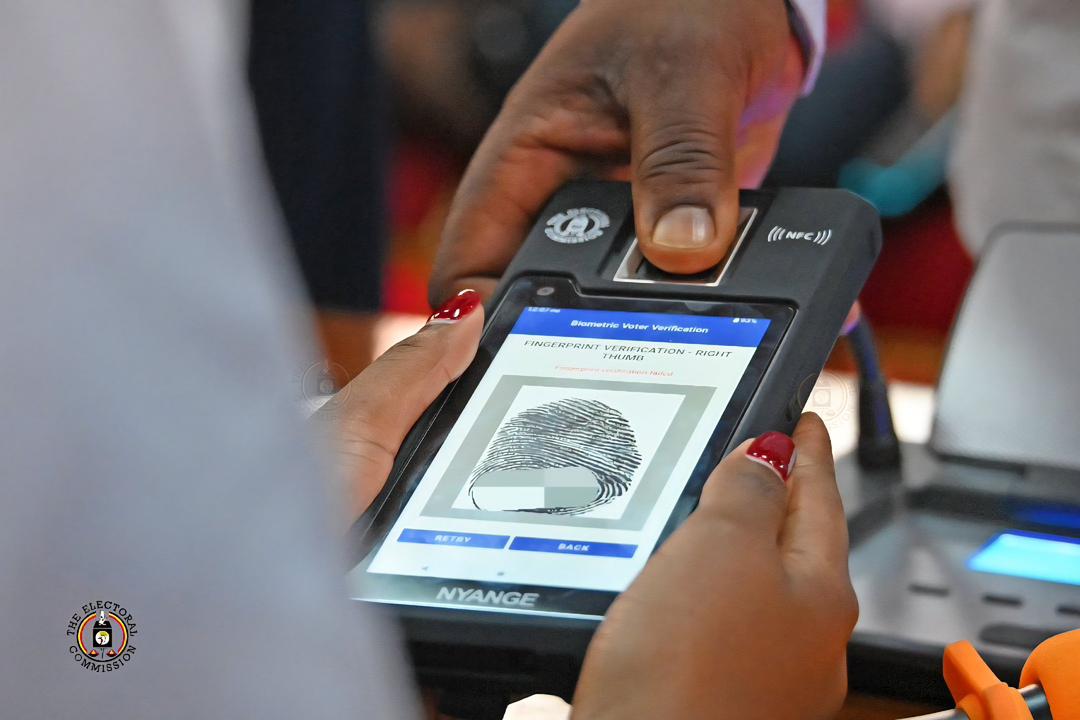
Biometric Voter Verification Kits (BVVKs) are being used in today’s municipal and city division elections, marking a shift from the presidential, parliamentary, and district chairperson polls, where the technology was abandoned following widespread login failures.
The technology, designed to enhance voter authentication and curb multiple voting through fingerprint and facial recognition, had not been consistently deployed in the previous two phases of the 2025/2026 general elections. Technical glitches forced Electoral Commission (EC) officials in many areas to revert to manual verification.
In Wakiso District, where elections are underway in municipalities including Entebbe, Nansana, Kira, and Makindye-Ssabagabo, our reporters observed BVVKs in active use at several polling stations.
Tolbert Musinguzi, the Wakiso District Returning Officer, confirmed that the EC had approved and authorised the use of the kits for the municipal elections and any subsequent phases in the ongoing cycle.
Despite this assurance, polling station observations revealed that some operators were still grappling with the devices, pointing to lingering training and adaptation challenges. At Nabweru Playground polling station, the presiding officer and the kit operator frequently consulted each other, at times debating the correct procedures while attempting to operate the machine. Similar scenes were witnessed at other stations, where additional EC officials stepped in to assist.
The verification process begins with voters presenting either a Voter Locator Slip (VLS) or a National ID, which is scanned using the BVVK. The system then confirms identity primarily through thumbprint biometrics, with facial recognition serving as a backup.
For voters without slips or IDs, officials consult the manual register, scan the relevant entry, and proceed to biometric confirmation. Once verified, polling officials scan the ballot papers issued to the voter, who then proceeds to mark and deposit them in the ballot boxes.
Our reporters noted that the entire sequence, from entry to exit, took an average of four to eight minutes per voter at several polling stations, exceeding the EC’s pre-election target time for verification.
To support smoother operations, extra personnel were deployed to polling centres. At Zimbena polling centre, for instance, two officials wearing tags from the “Office of the Returning Officer, Wakiso- Trainer” were seen guiding kit operators on setup, navigation, and troubleshooting.
One of our reporters, a registered voter, joined the queue at a polling station to experience the process firsthand and provide a direct account. Upon reaching the verification desk, the reporter deliberately presented himself without a National ID or Voter Locator Slip to test the contingency procedures.
The presiding officer and kit operator appeared unprepared for the situation. After moments of visible uncertainty, an EC trainer intervened, advising them to scan the voter register.
However, the register had already been returned to its secure box, requiring officials to retrieve it, a step that alone took nearly a minute. Scanning also proved problematic, as the operator repeatedly pointed the scanner at the entire open page, inadvertently capturing barcodes belonging to other voters.
This happened four times before the trainer intervened again, instructing the team to physically cover all other entries on the page and expose only the correct QR code. The system then successfully read and verified the voter’s details.
Following biometric thumbprint verification and scanning of the issued ballots, the reporter was cleared to vote. From entry into the polling station to receiving ballot papers, the process took approximately eight minutes. One voter behind the reporter voiced frustration shared by others in the queue: “This is time-consuming. One person takes all that time to be cleared from the desk. Why not just use the register?” Polling officials did not respond immediately.
The BVVKs, more than 109,000 units procured nationwide, are a key innovation in Uganda’s electoral system. First introduced in 2016, upgraded in 2021, and further refined for 2026, they are intended to reduce fraud and improve electoral integrity.
At Ntinda Hospital polling centre, our reporter found BVVKs in use across six polling stations within the compound. Although officials declined to be quoted, they reported that the machines were functioning well, though each verification still took between three and five minutes.
However, at Santa Maria Preparatory School, Kyambogo Primary School Playground, the Electricity Corridor, and parts of Kigoowa near Ntinda Hospital, voting commenced using manual voter registers rather than BVVKs.
In Kampala Central Division, confusion emerged over whether to use the kits. At one polling station, Presiding Officer Akello Grace informed polling agents and witnesses that registers would be used to verify witnesses to save time, while BVVKs would be used for voter verification. This decision sparked frustration among polling agents, who pointed out that the kits had failed during the presidential and mayoral elections.
When agents asked for the kits to be tested, they failed to function. The presiding officer subsequently reversed the decision, opting for manual verification using the voter register.
In Kawempe Division, our reporter observed BVVKs in use at several polling stations, with all ballot papers scanned before issuance, as required by the EC. In Kabale Municipality, polling officials and agents at Parents Primary School polling station in Central Ward were seen testing the BVVKs at 8:00 a.m. before voting commenced.
In Mbarara City, City Returning Officer Violet Atuhurra said a designated officer had been deployed to move between polling stations to enforce the use of biometric machines. “We are using them at all polling stations, and we don’t want excuses; for that reason, we have assigned a person to monitor their use,” she said.
At St. Mary’s Primary School, a candidate’s agent, Grace Orisiimwa, welcomed the technology, saying it would curb vote rigging experienced in previous elections.
In some areas, BVVKs were not delivered alongside other polling materials. In Fort Portal City, at Mungumwema polling station in Bazaar Ward, voters who arrived by 8:20 a.m. witnessed the opening of polling materials, but voting had not yet begun.
A polling assistant, who spoke on condition of anonymity, said they were still waiting for the BVVK to arrive, having been instructed that the machines must be used in the day’s voting process. The use of BVVKs has also been reported in Kitgum, Arua, Mukono, and other parts of the country.
During the January 15 presidential and parliamentary elections, BVVKs malfunctioned nationwide, often linked to internet restrictions, prompting their suspension and a shift to manual verification. In response, the EC issued guidance allowing voting to proceed using the National Voters Register whenever BVVKs fail, to prevent disenfranchisement.
Polling stations are required to remain open until 4:00 p.m., with all voters who are in the queue by that time permitted to cast their ballots.
****URN****