



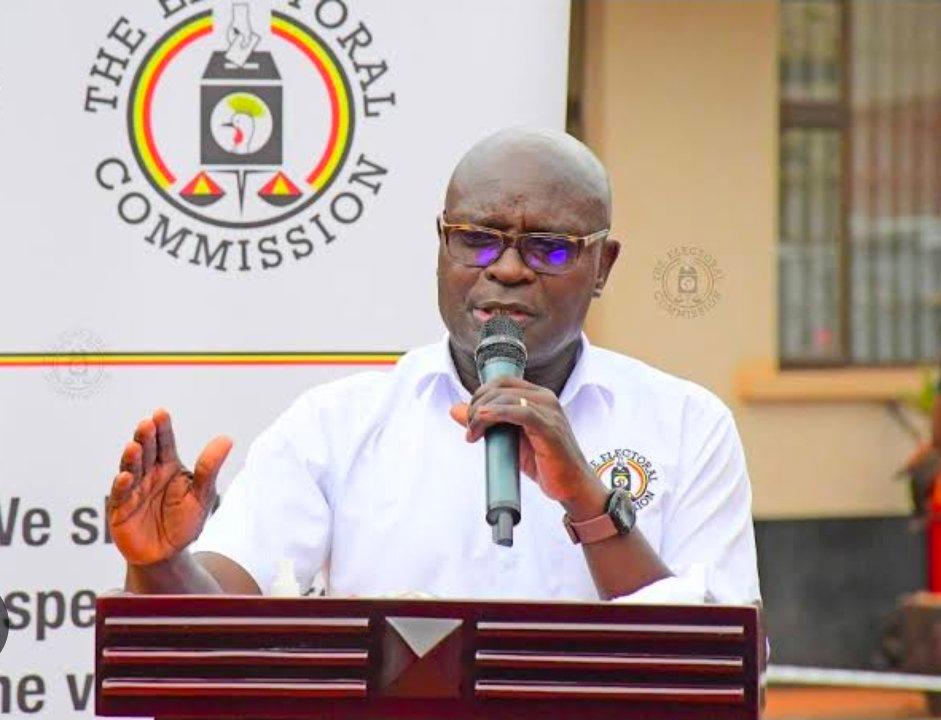
The Electoral Commission (EC) Chairperson, Justice Simon Mugenyi Byabakama, has told the Inter-Religious Council of Uganda (IRCU) that the delayed release of the voters’ register to political parties and presidential candidates was not deliberate, despite acknowledging that the Commission did not comply with the legal timeline.
Justice Byabakama made the remarks during a meeting with IRCU leaders led by Church of Uganda Archbishop Dr Stephen Samuel Kaziimba Mugalu.
Under Uganda’s electoral laws, the EC is required to release the voters’ register at least 14 days before polling day to allow verification and scrutiny by stakeholders. However, the register was released only two days ago.
Byabakama said the delay was due to efforts to ensure that the register issued was credible, complete, and free from errors, adding that the Commission is confident the version shared meets those standards.
The voters’ register is a critical component of the electoral process, as it enables political parties, candidates, and observers to confirm voter details, identify irregularities, and raise objections ahead of polling.
Delays in its release have previously been a source of contention in Uganda’s elections, often raising concerns about transparency and preparedness.
Responding to the EC Chairperson, Archbishop Dr Kaziimba said that delays of this nature risk undermining public confidence in the electoral process.
He cautioned that actions perceived as weakening electoral credibility should be avoided, especially in politically sensitive periods.
Concerns over the voters’ register were also raised by National Unity Platform (NUP) Vice President for Northern Uganda, Dr Lina Zedriga, who extended her questions to issues of security and enforcement during the campaign period.
She asked the Inspector General of Police (IGP), Abas Byakagaba, to clarify the police response to reports of abductions of opposition supporters during and after political rallies.
IGP Byakagaba said police had not received formal complaints regarding abductions. He called on political parties and affected individuals to lodge official reports to enable investigations.
The IGP also urged the public to distinguish between unlawful abduction and lawful arrest, noting that some individuals have been arrested and charged through established legal processes.
Dr Zedriga’s concerns followed reports that NUP Head of Mobilisation Habibi Buwembo, NUP Kibuye councillorship candidate Ronald Batabaale Lubwama, and Jose wa Bobi had been taken by security operatives earlier in the day.
Later, Kampala Metropolitan Police spokesperson SP Rachael Kawala confirmed that the three were in police custody, although details surrounding their arrest and detention were not disclosed. As the country approaches polling day, the conduct of security agencies has become a recurring subject of public debate.
While police maintain that arrests are conducted within the law, opposition parties and civil society groups have repeatedly expressed concern over arbitrary detention, delayed arraignment, and the use of force during campaigns.
Meanwhile, Justice Byabakama reminded voters that electoral laws prohibit individuals from wearing party colours, displaying posters, or carrying campaign materials at polling stations.
He said security personnel will enforce these guidelines to maintain order at polling stations. Ugandans are scheduled to vote for presidential and parliamentary candidates on Thursday next week.
The campaign period has unfolded amid heightened political tension, with allegations of violence and rights violations emerging alongside assurances from state institutions that the electoral process will be conducted in accordance with the law.
Observers note that how the EC and security agencies handle these concerns may significantly influence public confidence in the credibility and legitimacy of the elections.
The voters’ register is a central pillar of Uganda’s electoral process, as it determines who is eligible to vote and enables political parties, candidates, and observers to verify voter details before polling day.
Electoral laws require the Electoral Commission to release the register within specified timelines to allow scrutiny, corrections, and dispute resolution.
Delays in its release have, in past elections, generated debate over transparency, preparedness, and trust in the electoral process. Uganda’s elections have historically been characterised by tension between the state, opposition parties, and civil society, particularly around the role of security agencies.
While police and other security institutions maintain that their actions are guided by law and public order considerations, opposition parties and human rights organisations have often raised concerns about arbitrary arrests, prolonged detention, and the treatment of political supporters during campaign periods.
Religious leaders, under bodies such as the Inter-Religious Council of Uganda, have increasingly positioned themselves as moral voices in electoral matters, urging state institutions to adhere strictly to the law to safeguard peace and public confidence.
As Uganda approaches polling day, observers argue that adherence to electoral timelines, clarity in security operations, and transparent communication by institutions will be critical in shaping public perception of the elections and reducing the risk of disputes before and after voting.
****URN****