



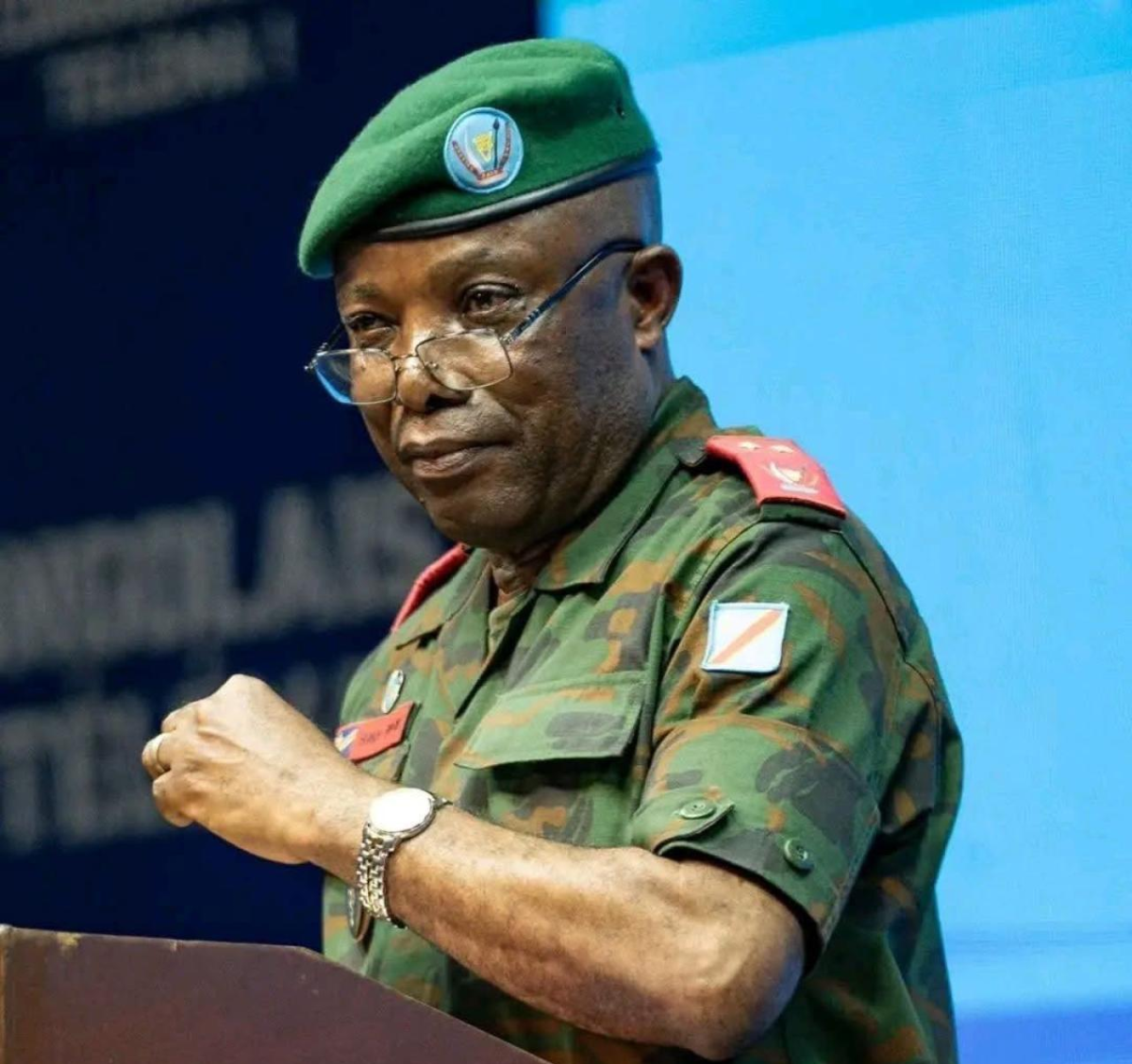
Major General Sylvain Ekenge Mobusa Efomi, the spokesperson of the Armed Forces of the Democratic Republic of the Congo (FARDC), has been suspended following a wave of national and international condemnation over discriminatory and hate-filled remarks targeting the Tutsi ethnic group.
The suspension was confirmed on Monday by Jules Banza Mwilamwe, the FARDC Chief of Staff, after Ekenge made the controversial statements during a televised address on Radio Télévision nationale congolaise (RTNC) on December 27, 2025.
During the broadcast, Ekenge warned Congolese men against marrying women from the Tutsi community and went on to describe the group as “Nilotic foreigners” and “invaders from Abyssinia,” invoking the discredited Hamitic conspiracy theory.
That ideology historically fuelled ethnic hatred and contributed to the mass violence and near-extermination of Tutsi populations in Rwanda between 1959 and 1994. Ekenge further alleged that the Kinyarwanda word Ubwenge, which means intelligence, was synonymous with deceit, manipulation, immorality, infidelity, and betrayal, traits he attributed to the Tutsi as inherent and immutable.
He also claimed that Tutsi children shared these same “morally corrupt” characteristics. The remarks triggered immediate backlash, with critics accusing the senior military officer of promoting ethnic hatred and echoing genocidal rhetoric.
Rwanda’s Minister of Foreign Affairs and International Cooperation, Olivier Nduhungirehe, issued a strongly worded condemnation, warning that such statements risk plunging the region into what he described as a “genocidal hell.”
Similarly, Bertrand Bisimwa, president of the March 23 Movement (M23), accused the Congolese army of laying the ideological groundwork for ethnic cleansing.
“The FARDC is justifying an eternal enemy it has itself created, an enemy defined by language, physical traits, and ethnicity,” Bisimwa said, alleging collusion with perpetrators of the 1994 genocide.
In his official statement, Lieutenant General Mwilamwe said the FARDC “categorically condemns” Ekenge’s remarks, describing them as incompatible with republican values and the constitutional mandate of the armed forces. He stressed that the comments did not reflect the position of the Democratic Republic of the Congo, the Supreme Commander of the FARDC, President Félix Tshisekedi, or the government.
“The FARDC reaffirms its unwavering commitment to defending the sovereignty and territorial integrity of the country, and to protecting the security of all Congolese men and women without distinction,” Mwilamwe said, adding that the military would continue to act with discipline and professionalism, even at the cost of ultimate sacrifice.
He also called on the population to uphold unity and national cohesion and to reject all forms of hate speech, especially at a time when the country faces significant security challenges. Since 2022, the Congolese government has been battling an insurgency led by the M23, which controls large parts of North and South Kivu provinces in eastern DR Congo.
Multiple peace initiatives have failed to halt the conflict, with both sides accusing each other of ceasefire violations. Kinshasa has repeatedly accused Rwanda of backing the M23, allegations that both Kigali and the rebel group deny.
The M23 maintains that its rebellion is driven by grievances over corruption, xenophobia, and systemic discrimination within the Congolese political and military leadership.
***URN***