

Following a steady decline of French influence across parts of West Africa and the Sahel, France has increasingly shifted its diplomatic, economic and security focus towards East and Southern Africa.
Paris presents this strategy as part of a renewed partnership with African countries based on investment, dialogue, innovation and shared development goals.
It is however argued that the latest French push into East Africa shows a broader effort to preserve strategic influence on a continent where its standing has weakened considerably.
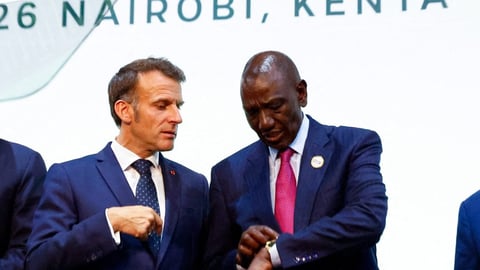
The clearest example of this shift was the Africa Forward Summit held in Nairobi, Kenya, in May 2026. The summit, jointly hosted by French President Emmanuel Macron and Kenyan President William Ruto, brought together more than 30 African leaders, business executives and development partners.
It was the first major France-Africa summit to be held in an English-speaking African country, a move widely interpreted as an attempt by Paris to expand its influence beyond its traditional Francophone sphere.
At the summit, France announced approximately €23 billion in joint investment commitments involving French and African companies. The investments were targeted at sectors such as energy, technology, infrastructure, artificial intelligence and logistics.
French officials described the summit as the beginning of a new chapter in relations between Africa and France based on equal partnership and mutual benefit.
Despite the ambitious announcements, many analysts questioned whether the summit delivered meaningful solutions to Africa’s most urgent financial challenges.
Critics argued that while France promoted new financing mechanisms and investment guarantees, it stopped short of supporting more far-reaching proposals such as debt cancellation, debt restructuring and payment suspensions for heavily indebted African countries.
According to several development experts, the proposals largely preserved the existing global financial architecture rather than addressing long-standing structural inequalities within it.
The growing France-Kenya partnership has become central to Paris’ strategy in East Africa. France is already among Kenya’s largest foreign investors. More than 140 French companies operate in Kenya and billions of euros have been invested in sectors ranging from energy and transport to telecommunications and manufacturing.
During the Africa Forward Summit, additional agreements worth approximately €170 million were signed in renewable energy, digital infrastructure, education and water management.
Alongside economic cooperation, military and security ties have also expanded. France and Kenya have deepened defence cooperation through training programmes, intelligence collaboration, maritime security initiatives and joint military exercises.
Supporters argue that these arrangements strengthen Kenya’s capacity to confront regional security threats, including terrorism and piracy in the Western Indian Ocean.
However, concerns have been raised about sovereignty, accountability and the growing presence of foreign military personnel on African soil.
These concerns are amplified by France’s troubled recent history in the Sahel.
Over the past several years, Mali, Burkina Faso and Niger have all expelled French forces and significantly reduced political cooperation with Paris. The governments of these countries accused France of excessive interference and questioned the effectiveness of long-running military missions that were originally launched to combat terrorism.
France rejected these accusations and maintained that its operations were intended to support regional security and stability.
Nevertheless, the withdrawals represented a major geopolitical setback for Paris and highlighted the extent of anti-French sentiment that has emerged across parts of West Africa.
For many African observers, the debate surrounding France’s role on the continent cannot be separated from historical experience.
Critics frequently point to several examples that continue to shape perceptions of French policy in Africa.
One frequently cited issue is the CFA franc system, which for decades linked the currencies of several African countries to French monetary structures.
It is argued that the arrangement limited monetary independence and reinforced economic dependence, while supporters maintained that it provided financial stability and lower inflation.
The debate remains one of the most enduring symbols of France’s post-colonial influence in Africa.
Another source of controversy has been France’s extensive military presence across Africa. From Chad and Senegal to Mali, Niger and Burkina Faso, French troops maintained a significant footprint for decades.
It is viewed as evidence of continued geopolitical control while French officials argued that such deployments were conducted at the invitation of host governments and focused on combating terrorism and promoting regional security.
Questions have also been raised about the economic relationship between France and resource-rich African nations.
In countries such as Niger, the argument is that strategic resources generated significant benefits for foreign interests while local populations continued to struggle with poverty, unemployment and underdevelopment.
These perceptions have fuelled growing demands for African countries to exercise greater control over their natural resources and development priorities.
The Africa Forward Summit therefore represented more than a diplomatic gathering. It became a test of whether France can genuinely redefine its relationship with Africa at a time when many African nations are demanding greater sovereignty, fairer economic partnerships and reduced dependence on former colonial powers.
Supporters of the summit argue that stronger engagement between France and Africa can attract investment, create jobs, improve infrastructure and strengthen cooperation in critical sectors such as energy, health and technology.
Critics respond that genuine partnership requires more than investment announcements. It requires transparency, accountability, respect for national sovereignty and economic arrangements that place African interests at the centre.
As Africa’s geopolitical importance continues to grow, competition among global powers is intensifying. China, India, Türkiye, the Gulf states, Russia, the European Union and the United States are all seeking stronger partnerships across the continent.
In this increasingly multipolar environment, many African voices argue that the continent should engage with all partners from a position of strength while avoiding relationships that risk recreating old patterns of dependency.
The future of Africa-France relations will ultimately be judged not by summit declarations or investment pledges, but by whether ordinary Africans experience tangible improvements in their lives and whether African states retain full control over their political, economic and security decisions.