

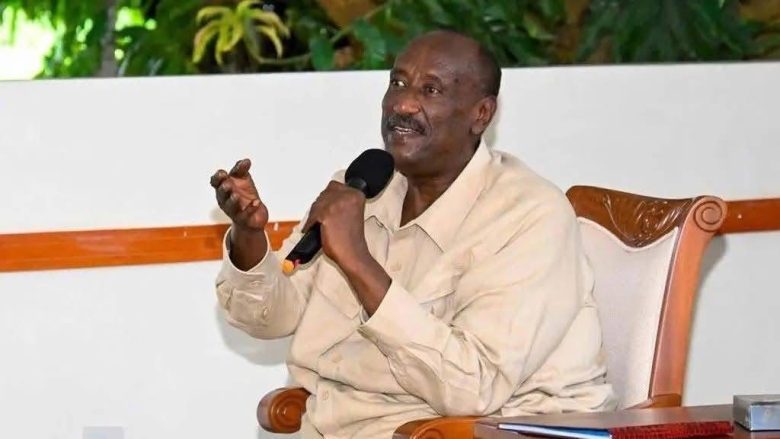
Political parties under the Inter-Party Organisation for Dialogue (IPOD), the National Consultative Forum (NCF) and other stakeholders have agreed to integrate the proposed Consociational Democracy Agreement (CDA) into Uganda’s National Dialogue Framework in a renewed effort to address political divisions and build national consensus.
The resolution was reached on Friday, November 13, 2026, during a consultative meeting held at Kirema Heritage Farm in Nakaseke District, hosted by retired General Caleb Akandwanaho, popularly known as Salim Saleh.
The meeting brought together representatives of political parties, the CDA team and other stakeholders to examine Uganda’s political and governance challenges and explore pathways towards national reconciliation.
According to a joint press statement signed by NCF Chairman Godfrey Kiwanda Ssuubi, IPOD Council Chairman Gerald Blacks Siranda and CDA Team Leader Professor Ogenga Otunnu, participants agreed that the CDA initiative should be incorporated into the Uganda National Dialogue (UND) Framework.
The framework was established under the authority of President Yoweri Museveni on December 18, 2018, and chaired by former Prime Minister Ruhakana Rugunda. It was conceived as an inclusive platform for addressing Uganda’s political, constitutional, economic and governance challenges through dialogue and consensus-building.
The integration is expected to provide an established national platform for broader stakeholder engagement, political reconciliation, socioeconomic transformation and national cohesion.
What the Consociational Democracy Agreement proposes
The Consociational Democracy Agreement is a political power-sharing and national reconciliation proposal championed by General Salim Saleh and Professor Ogenga Otunnu.
It seeks to address what its proponents describe as longstanding problems of sectarianism, political exclusion, marginalisation and unequal access to national opportunities.
Drawing on the principles of consociational democracy, the proposal advocates negotiated cooperation among major political and social groups to prevent the domination of national institutions by a single political constituency.
The model is traditionally built around four principles: grand coalition, proportional representation, mutual veto and segmental autonomy.
Grand coalition encourages the inclusion of significant political groups in national decision-making, while proportional representation seeks to ensure that different constituencies have a fair share of political representation and public institutions.
Mutual veto provides safeguards for minority interests on critical matters, while segmental autonomy allows different communities a degree of self-governance over issues affecting their interests.
The Ugandan proposal envisages institutional mechanisms to facilitate cooperation between political leaders, grassroots representatives and other stakeholders.
Among the proposed structures are a National Consociational Council, an Elite Cooperation Chamber, a Grassroots and Multi-Stakeholder Chamber and a technical implementation secretariat.
The technical secretariat would be responsible for translating agreed commitments into programmes, budgets, timelines and measurable implementation targets.
The proposal also contemplates legislative and constitutional measures to provide an institutional foundation for the arrangement.
How the initiative emerged
The CDA emerged from discussions led by General Salim Saleh and Professor Ogenga Otunnu, who developed a proposal examining the historical roots of Uganda’s political divisions and recurring governance challenges.
The initiative gained wider political attention in October 2026 when political party representatives participated in discussions on the proposal during a retreat in Jinja on October 15 and 16.
The consultations brought together political actors and other stakeholders to examine whether negotiated power-sharing and broader political inclusion could provide a pathway towards national reconciliation.
The proposal has since generated debate among political parties, particularly over the implications of power-sharing for multiparty competition, political independence and the country’s governance arrangements.
The 2018 National Dialogue Framework
The Uganda National Dialogue Framework, into which the CDA is now expected to be integrated, dates back to December 18, 2018, when President Museveni launched the initiative.
It emerged from consultations involving six national dialogue convening organisations, commonly referred to as the Group of Six.
The initiative sought to establish a non-partisan platform where Ugandans could discuss fundamental national questions beyond electoral competition and partisan politics.
Its areas of focus included national political consensus, constitutionalism and the rule of law, national values, management of diversity, land and natural resources, economic transformation and public service delivery.
The framework was intended to provide a mechanism for identifying shared national priorities and building consensus on Uganda’s long-term political, economic and social direction.
Former Prime Minister Ruhakana Rugunda was appointed to chair the process.
The latest agreement to integrate the CDA into this framework could revive the national dialogue agenda while introducing a more specific approach to political inclusion and negotiated cooperation.
However, Friday’s statement does not outline the proposed implementation arrangements, the precise institutional changes required or whether all participating political parties have formally endorsed the substantive power-sharing provisions of the CDA.
The success of the initiative will largely depend on whether it can secure confidence across the political divide and translate its proposals into an inclusive process that addresses concerns about political representation, accountability and the distribution of national power.