



The trial of military officers, some of whom have spent nearly a year in military custody alongside civilians, is set to resume in the first week of February, according to military sources.
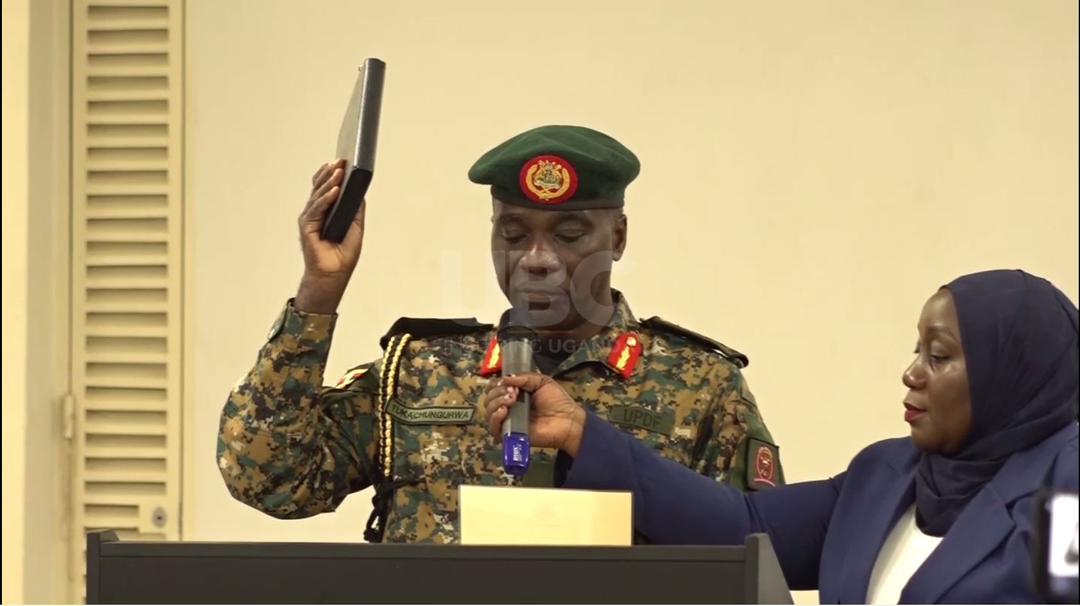
The resumption of Court Martial proceedings follows the appointment of Brigadier Richard Tukachungurwa as Chairperson of the General Court Martial, replacing Brigadier Freeman Robert Mugabe. Brigadier Tukachungurwa took the oath this week to lead a newly constituted panel of senior army officers appointed to serve on the court.
The panel includes Colonel Simon Tusah Wankandya, Colonel Asha Patra, Colonel Fredrick Kangwamu, Colonel Raphael Mugisha, Lieutenant Colonel Mohammedie Nasser Igambi, Major Samuel Moses Amodoi, Major Emmanuel Arihaihi, Major Abubaker Nyombi, and Major Denis Chemtai.
With the new panel assuming office, the General Court Martial is expected to resume proceedings, beginning with the trial of Maj. Gen. James Birungi, the former Commandant of Defence Intelligence and Security (DIS), formerly known as Chieftaincy of Military Intelligence (CMI).
Maj. Gen. Birungi was arrested in late August on allegations of orchestrating fake terror bombings in Kampala, incidents in which two women were killed. Before his arrest, the Commander of Defence Forces, Muhoozi Kainerugaba, had ordered the arrest of Maj. Gen. Birungi’s close aides, including Colonel Peter Ahimbisibwe, then Director of Counterterrorism at CMI, and Lieutenant Colonel Ephraim Byaruhanga, who headed Special Operations.
The Uganda People’s Defence Forces (UPDF) also arrested ten junior officers and two civilians for their alleged involvement in staging fake terror incidents in Munyonyo and Kalerwe. Investigations were later expanded to cover bomb incidents in Bunamwaya, Nateete, and Komamboga.
In a separate case, Colonel Patrick Semakula was arrested over allegations of receiving 300,000 US dollars to share UPDF intelligence with a foreign country interested in military operations in the Democratic Republic of Congo.
UPDF First Division spokesperson, Maj. Charles Kabona said that once the General Court Martial resumes operations, division-level courts will also recommence their work. However, he said he was unable to confirm the exact number of junior officers under the First Division currently awaiting trial.
The changes follow a January 31, 2025, Supreme Court ruling that rendered military courts inactive. In a landmark judgment led by Chief Justice Alfonse Owiny-Dollo, the court ruled that civilians can no longer be tried in military courts, declaring the long-standing practice unconstitutional.
The Supreme Court held that military courts lacked the legal competence to try civilians, citing the absence of mandatory legal training for panel members, lack of security of tenure, inadequate facilities for defence preparation, and the absence of an independent appellate mechanism.
The court ordered all Court Martial proceedings involving civilians to cease and directed that pending cases be transferred to the Director of Public Prosecutions for handling in civilian courts. Following the ruling, Court Martial activities were suspended for several months.
In response, Attorney General Kiryowa Kiwanuka introduced amendments to the UPDF Act, which were approved by Parliament and later assented to by President Yoweri Museveni.
The changes reinstated civilian trials in military courts under a narrow exception permitted by the Supreme Court, where a civilian is jointly charged with a soldier who is deemed the principal offender. The court cautioned that this exception must not be abused to reintroduce widespread civilian trials through a legal loophole.
The constitutional challenge originated from a successful appeal by former MP Michael Kabaziguruka against the Attorney General, after his treason trial before the Court Martial was declared a nullity.
Under the amended law, particularly the requirement that the General Court Martial be composed of officers trained in judicial law, military personnel who commit offences, as well as civilians who aid soldiers in committing crimes or unlawfully possess government stores, may now be tried under military law.
****URN*****