

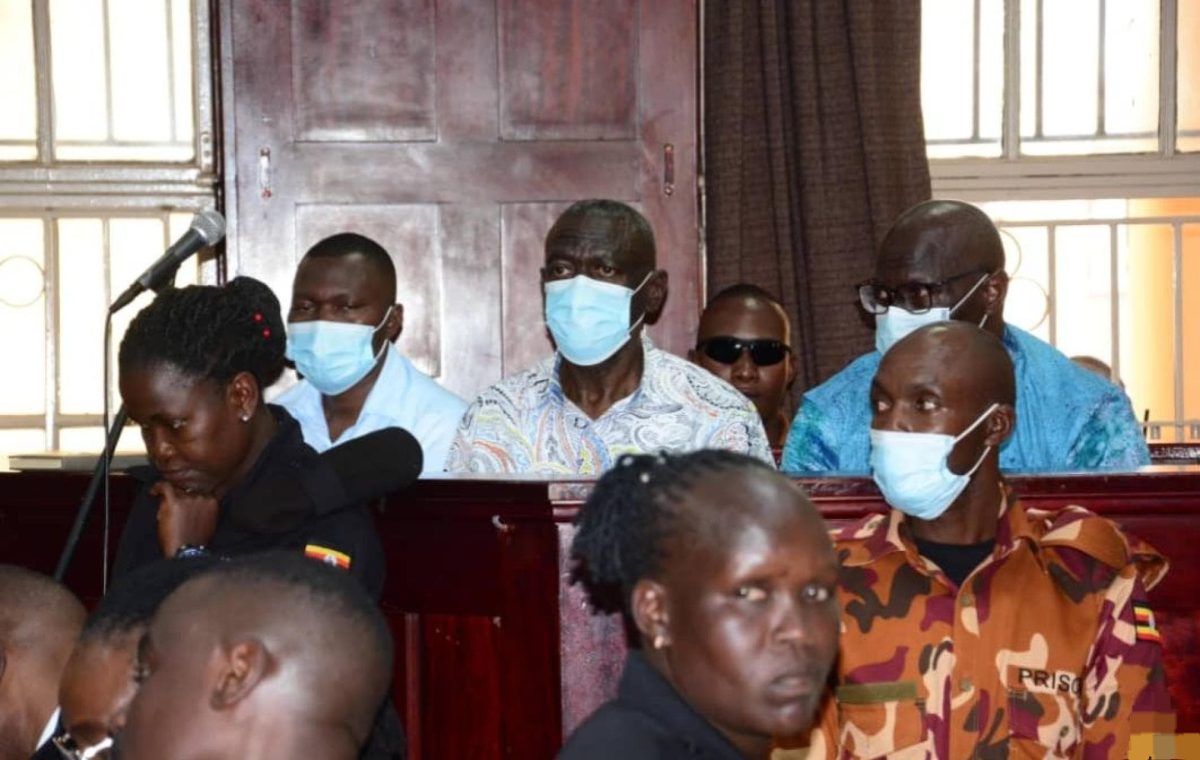
The High Court Criminal Division has dismissed an application by opposition politician Kizza Besigye and his co-accused seeking to refer several questions to the Constitutional Court, clearing the way for the commencement of their treason trial next week.
In a ruling delivered on Monday evening through the Judiciary’s Electronic Court Case Management Information System (ECCMIS), Justice Emmanuel Baguma held that the issues raised by the defence did not amount to substantial constitutional questions requiring interpretation by the Constitutional Court.
Dr. Besigye, Hajji Obeid Lutale, and Captain Denis Oola are jointly charged with treason over allegations that they plotted to overthrow the government. The application followed the prosecution’s full disclosure of evidence on June 1, 2026.
Prosecutors, led by Assistant Director of Public Prosecutions Thomas Jatiko and Chief State Attorney Richard Birivumbuka, subsequently secured directions requiring both parties to return to court on June 8 for a preliminary hearing, with trial set to commence on June 11.
However, defence lawyers led by Erias Lukwago, Ernest Kalibala, Bayern Turinawe, and Frederick Mpanga challenged the timelines, arguing that they infringed on the accused persons’ constitutional right to a fair hearing under Article 28 of the Constitution.
The defence sought referral of three questions to the Constitutional Court, including whether seven days was sufficient time to prepare for a preliminary hearing following disclosure, whether restrictions on access to clients during weekends and public holidays violated fair trial rights, and whether setting trial dates before conclusion of the preliminary hearing was constitutional.Justice Baguma dismissed all three arguments.
On preparation time, the judge ruled that one week was adequate for the preliminary hearing, noting that the June 1 disclosure mainly concerned the identities of six witnesses whose details had previously been withheld. He further observed that the prosecution had already made disclosures on January 21, March 4, and March 11, meaning the defence had had access to much of the relevant material for several months.
Regarding access to the accused persons, the court noted that prison authorities could make special arrangements to allow lawyers to meet their clients on weekends and public holidays. Justice Baguma said the court had already directed the Deputy Registrar to engage prison authorities to facilitate such access.
The judge also upheld the decision to schedule trial dates before the conclusion of the preliminary hearing, describing the move as necessary for effective case management and planning.
Citing established legal principles governing constitutional references, Justice Baguma emphasized that disagreements over procedural directions do not automatically raise constitutional issues.”Counsel for A1 (Besigye) and A2 (Lutale) have not made out prima facie questions of law to warrant reference to the Constitutional Court for interpretation,” the judge ruled.
He subsequently dismissed the application and directed both parties to appear for the preliminary hearing on June 8, 2026, at 11:00 a.m., while ordering the prosecution to remain ready to commence its case on June 11. According to the prosecution, Besigye, Lutale, and Oola allegedly held meetings in Geneva, Athens, Nairobi, and Kampala to solicit funds, acquire weapons, and organize paramilitary activities aimed at overthrowing the government.
The state further alleges that Besigye met a Kurdish intelligence operative identified as Andrew Wilson and received USD 5,000 to facilitate the transportation of 36 Ugandan recruits to Kisumu, Kenya, for military training. Prosecutors contend that the recruits were intercepted and deported before the training could take place.
The prosecution also alleges that the accused sought surface-to-air missiles, ricin poison, and counterfeit currency, and planned to use drone technology to assassinate Yoweri Museveni. State prosecutors say they intend to rely on audio and video recordings, social media communications, immigration records, and phone logs as evidence in the case. URN