

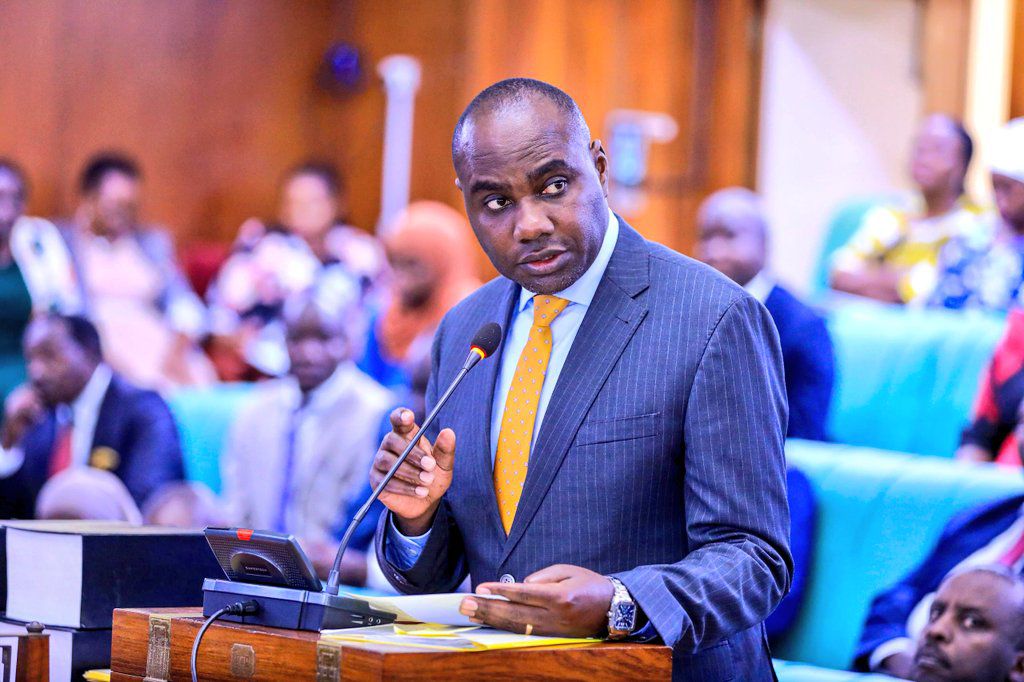
Uganda’s delegation at the ongoing World Bank/International Monetary Fund (IMF) Spring Meetings 2026 in Washington DC in the USA, is focused on negotiating low-cost concessional credit financing.
The delegation led by State Minister for Finance, Henry Musasizi and Permanent Secretary and Secretary to the Treasury, Ramathan Ggoobi, also has Attorney General Kiryowa Kiwanuka and the Governor Bank of Uganda Michael Atingi-Ego.
Ggoobi says they will take advantage of the meetings to request for new long-term financing through the IMF’s Extended Credit Facility (ECF).
“Our focus this year will be on advancing negotiations for a new ECF Program with the IMF, and also negotiate for more concessional financing from the World Bank for our transformative projects and for financing the budget,” says Ggoobi.
Uganda and other developing countries are increasingly finding it hard to access friendly foreign financing, amidst rising indebtedness.
Uganda’s debt-to-GDP ratio is hovering around 52% after the country’s total national debt shot to UGX 132 trillion (USD 35 billion) as of December 2025, with external debt accounting for about 46 percent, according to the latest Ministry of Finance figures. The IMF and the World Bank Group’s credit facilities combined account for about one fifth of Uganda’s total debt stock, and about 54 percent of the external debt stock.
Data at the IMF Library puts the organisation’s claim on Uganda at USD 1.61 billion (about UGX 6 trillion) while the country owes the World Bank Group, through the International Development Association (IDA) approximately USD 5.3 billion (UGX 19.6 trillion).These are mostly concessional loans, also carrying significant grant elements, low or zero interest, and long maturity periods, which helps keep Uganda’s debt assessed as sustainable with moderate risk of distress by the two institutions.
This gathering which brings together policy makers, government leaders, private sector leaders and development partners to deliberate on the state of the global economy, financial stability, growth outlook and development as well as poverty reduction, is organised under the theme: “Building Prosperity through Policy.”
The Uganda delegation is also taking part in the second US-Uganda Business and Investment Forum, and is expected to meet with the US Administration, the World Bank Vice-President for Africa region and the IMF Africa Department Director, Abebe Selassie.
They are also expected to participate in the Coalition of Finance Minister’s on Climate Action meeting, according to the Ministry’s Principal Communications Officer, Apollo Munghinda.
At the Spring meetings, the global leaders are set to explore how policy, investment and innovation can support job creation and unlock private investment to drive economic growth. On the agenda is the discussion about finding practical approaches to delivering results across sectors such as energy, water, agriculture, health and digital development.
They also have to agree on the most effective and desirable policies for creating jobs, attracting and sustaining private investment, delivering results across all sectors and expanding services and economic opportunities. According to the latest Africa Economic Update by the World Bank (April,2026), Sub-Saharan Africa’s economic recovery for successive global shocks is losing momentum with growth projections for 2026 revised downwards.
The geopolitical spillovers from the conflict in the Middle East, the high debt service burdens and structural weaknesses are some of factors limiting growth prospects according to the report.
The report proposes pragmatic eco-system-based approach that aligns policy tools with country capabilities to deliver productivity gains and structural transformation. The delegation aims to advance financing for Uganda’s budget and transformative initiatives while participating in the US-Uganda Business Forum, climate action talks, and discussions with IMF and World Bank Africa leaders under the theme “Building prosperity through Policy.”
The report references the World Bank’s April 2026 Africa Economic Update, highlighting downward growth revisions for Sub-Saharan Africa due to Middle East conflicts, high debt burdens, and structural weaknesses, advocating ecosystem-based policies for productivity gains.
IMF’s ECF Programme in Uganda:
The Extended Credit Facility is concessional lending instrument for low-income countries to support medium-term economic reforms, poverty reduction, and balance-of-payments needs.
Uganda has engaged with the ECF on multiple occasions, the most recent programme being a three-year ECF arrangement approved in June 2021 for about SDR 722 million (roughly USD 1 billion at the time, or 200 percent of Uganda’s quota).
SRD (Special Drawing Rights) is an internal reserve asset created by the IMF with each of the IMF member countries having its quota. To “use” SDRs, a country exchanges them (via the IMF’s SDR Department) for actual hard currencies from another member willing to take the SDRs (of a borrowing country) in return.
The 2021 ECF Programme for Uganda expired in June 2024 after five reviews, with total disbursements reaching around SDR 631.75 million (about USD 870m).
It helped the country to finance budgetary shortages arising from the COVID-19 pandemic and supported recovery of the economy over the next years.
Earlier IMF-supported programs, like in the 1990s to the early 2000s, are credited with helping Uganda achieve macroeconomic stabilization after periods of instability, supporting liberalization, revenue efforts, and growth rebound.
Uganda is now negotiating a new ECF, reflecting ongoing reliance on such support for transformative projects amid global uncertainties.
Experts largely support the kind of credit facilities like the ECF as highly concessional, as a tool for prudent fiscal management, private sector-led growth, governance improvements, and signaling credibility to investors. However, many caution of risks like governance issues like corruption; project absorption capacity; and limited fiscal space.
IMF itself in its post-financing assessments, affirms Uganda’s repayment capacity but flags vulnerabilities from rising current spending and institutional gaps.
Fred Muhumuza, a senior economist cautions against heavy reliance on external borrowing, including IMF facilities, warning of a “vicious cycle” where new loans service old ones, crowd out social spending, and risk debt distress if projects are poorly executed or revenues lag.
He stresses better domestic resource mobilization over repeated IMF engagements, though he agess that these have short-term stabilization benefits.