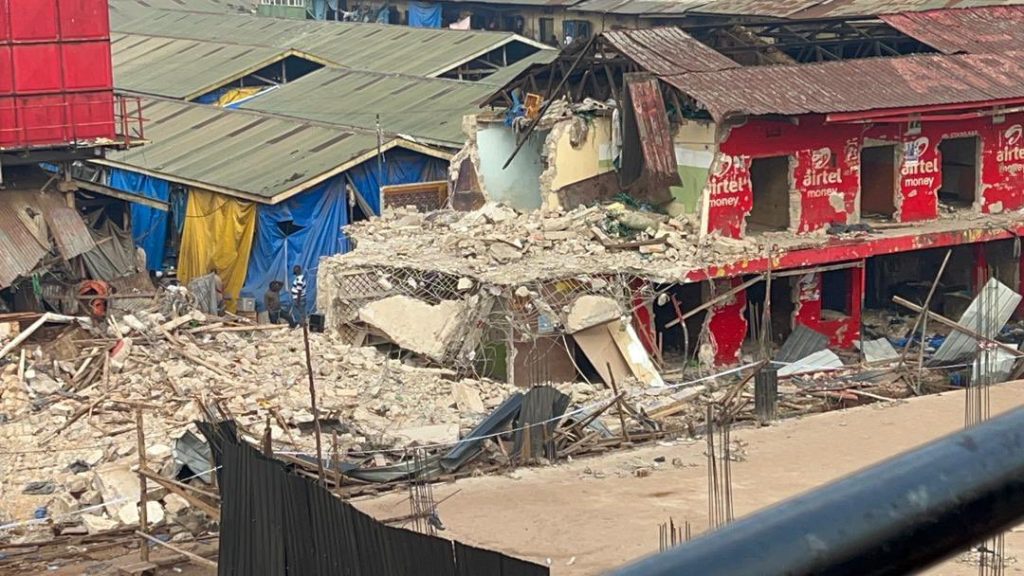



A week after a small part of St. Balikuddembe (Owino) Market was demolished on March 7, fresh details from traders, city officials and security agencies reveal that the operation was planned and communicated well in advance, contradicting claims that it was a sudden or illegal action.
The interviews this authoritative news website has conducted with vendors, officials from Kampala Capital City Authority, and police sources indicate that the structures removed were located directly in the Nakivubo Channel reserve, an area earmarked for flood-control works and environmental restoration.
Traders say they were compensated and warned
Several traders who operated in the demolished stalls confirmed that they had received prior notice to vacate and compensation before the demolition. Israel Walyendo, a trader who deals in second-hand clothing said the occupants were given time to remove their merchandise.
“We were informed earlier that those structures were sitting in the drainage reserve and would have to be removed,” Walyendo said. “Most of us were facilitated and told to relocate our goods before the machines came.”
Another vendor added that the affected traders were each given financial compensation, enabling them to move their merchandise before demolition began.
“People are now saying it was sudden, but those of us who were there know we had time to pack our goods,” the vendor said. “Some people are just turning it into politics.”
Drainage and flood-control concerns
We have established that the demolished structures were obstructing key storm-water drainage infrastructure feeding into the Nakivubo Channel, Kampala’s main flood-control channel.
According to a technical official from Kampala Capital City Authority, who prefered anonymity, the buildings were sitting directly above feeder drainage lines that carry storm water into the main channel.
“Those structures were right in the channel reserve and above feeder drainage channels,” the official said. “They were blocking the smooth flow of storm water into the main channel.”
The official said the demolition was necessary to allow expansion of the drainage infrastructure, including construction of a flood-control chamber designed to manage the increasing volumes of water flowing into the channel during heavy rains.
Under the redevelopment plan, engineers intend to expand the channel width from six meters to twelve meters, while constructing waste-filtration chambers to capture solid waste before it enters the main drainage system.
Garbage and pollution concerns
Plus News spoke to a couple of City engineers who also described serious environmental hazards beneath the demolished structures.
“Under those stalls there were heaps of garbage including plastic bottles, polythene bags and other solid waste,” a KCCA technical officer said. “All kinds of waste from the market were being discharged directly into the channel.”
This waste buildup, officials say, had been undermining the functionality of the new underground drainage system recently constructed in the area.
To address the problem, engineers plan to install waste filtration and collection systems to prevent refuse from flowing into the drainage network.
Structures lacked city approval
According to planning officials, the stalls that were demolished did not have approved building plans from the city authority and had been erected within the legally protected channel reserve.
“Those structures had no approved plans and were sitting in the Nakivubo Channel reserve,” a KCCA physical planning official said.
The official added that the demolition followed technical approvals issued by the city’s physical planning committee after reviewing the redevelopment requirements for the channel.
Police confirm environmental clearance
Security officials say the operation was not carried out arbitrarily.
A police officer, name withheld due to the sensitivity of the matter, familiar with the operation said security agencies reviewed environmental documentation before allowing the demolition to proceed.
“Police reviewed the environmental impact assessment certificate issued by National Environment Management Authority and the relevant planning approvals before giving clearance,” the officer said.
The officer added that the occupants had already vacated their merchandise before demolition began.
Development versus politics?
Despite the explanations, the demolition has sparked a heated political debate in Kampala, with some leaders questioning how the operation was conducted.
However, some traders argue that the controversy is being amplified by individuals pursuing personal interests.
“Those of us who were affected were talked to and facilitated to leave,” one vendor said. “Now people who were not even working there are making it political.”
The situation raises several questions.
If traders were compensated and warned in advance, why has the demolition sparked such intense political backlash?
If the structures were sitting in a drainage reserve without approved plans, should the city have allowed them to remain indefinitely?
And as Kampala continues to struggle with flooding and poor drainage, should development projects aimed at fixing these problems be halted because of political pressure?
With the widening of the Nakivubo Channel expected to double its capacity and introduce waste-management chambers, the project will help to preventing flooding in the City.