



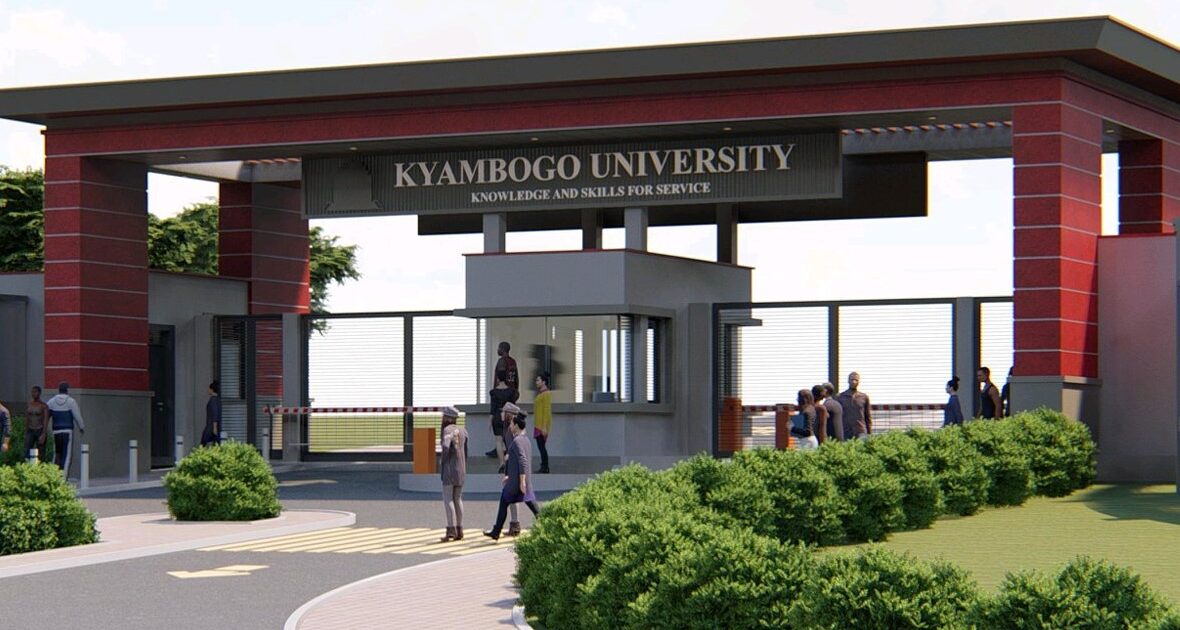
Kyambogo University is turning its plans for graduate studies into results, significantly increasing its PhD output. Since awarding its first doctorate in 2020, the university is set to graduate 23 PhD candidates this year, signalling a growing focus on advanced research and academic excellence.
Prof. Eli Katunguka Rwakishaya, the university vice chancellor, said Kyambogo is working to expand its presence in graduate studies and research to enhance teaching quality and strengthen research capacity across all departments. “We began by phasing out some diploma and certificate programs, and now we are focusing more on the graduate school, increasing the number of master’s and PhD students,” Prof. Katunguka said.
He made the remarks while addressing journalists ahead of the university’s 21st graduation, scheduled for Wednesday and Thursday. According to a graduate list obtained by URN, 12 of the PhD candidates are from the School of Education, four from the School of Art and Industrial Design, three from the Faculty of Arts and Humanities, and four from the Faculty of Science.
However, as Kyambogo expands its graduate programs, it continues to face staffing challenges, with a shortage of professors and senior academic staff. Records from August 2024 show that the university has only five professors out of the required 63, 23 associate professors instead of 113, and 62 senior lecturers compared to the needed 206.
The university employs 176 lecturers, while 312 are required. Prof. Katunguka noted that the limited number of professors and senior PhD-qualified lecturers restricts supervision for students at higher levels. To tackle this, the university has launched a staff development programme in partnership with several regional universities, with over 80 staff members currently pursuing PhDs.
Globally, universities run programmes that build internal capacity, allowing staff to rise through academic ranks. Prof. Katunguka said that during his time at Makerere University, such programmes helped develop a strong academic workforce—a model Kyambogo is now following.
Academics have long raised concerns about the low number of PhD graduates produced by local universities, noting that the shortage limits Uganda’s capacity for research, innovation and development. The country produces about 200 PhDs annually, although it needs at least 500 each year. Universities have since expanded their graduate programmes. Before 2020, Makerere University produced about eight PhDs annually; the figure has since increased to about 150.
Prof. Katunguka also cited limited funding for graduate studies as a key challenge slowing many PhD completions. He said some Kyambogo candidates who were due to graduate this year failed to complete because of financial constraints. He called for stronger funding support, noting that students spend about 8 million shillings for humanities programmes and up to 12 million for science fields.
Meanwhile, Kyambogo University will award degrees to 5,138 students, including 3,157 males and 1,981 females. The Faculty of Engineering has the highest number of graduands at 1,515, followed by the Faculty of Education with 952. Reuben Twinomujuni, the university’s principal public relations officer, said the numbers are unusually low because the graduating students are from the 2021/2022 cohort, which was admitted during a period when no UACE examinations were conducted.
“This year’s graduating class is smaller, but it is understandable. They are students who had not been admitted to higher education earlier,” said Twinomujuni. According to guidelines issued to parents, each graduate is allowed to bring only two guests. President Museveni is expected to preside over the ceremony as the chief guest.
***URN***