



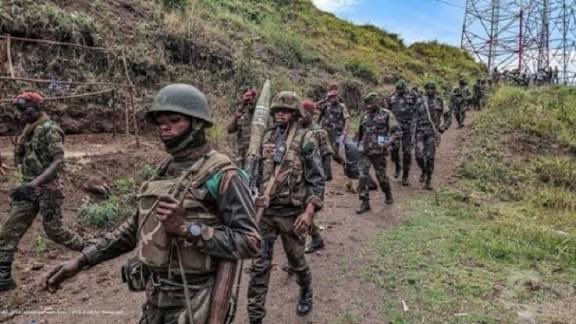
The March 23 Movement/ Alliance River Congo (M23/AFC) rebels and their coalition of Twirwaneho are trading barbs over drone attacks against Democratic Republic of Congo government’s International Airport of Bangoka located in Kisangani, Tshopo Province.
The DR Congo said that the drones attacked the airport between January 31-February 1, 2026. According to the government, all the drones were intercepted and destroyed by the army before reaching their targets.
Government said the country suspected of having manufactured the devices has been identified and investigations are ongoing. The government accused M23 rebels of being behind the act.
On February 3, 2026, M23 rebels released a statement claiming responsibility for the attacks. The M23 claimed that all the drones precisely reached the target and destroyed the command centre of the government army that was being used as a primary hub for planning and executing well coordination deadly operations targeting civilian populations as well as M23/AFC positions in liberated areas of Masisi, Walikale, Rutshuru, Lubero, Kalehe, Mwenga and Minembwe.
In a statement, M23/AFC rebels asked the government to make an equivocal choice between peace and war adding that if it chooses peace, it must strictly respect the ceasefire and if it chooses war, or else it will bear full responsibility and all the consequences that may result.
On Thursday (February 6,2026), the African Union Commission, through Ahairman Ali Youssouf Mahmoud, released a statement expressing deepest concern and strongly condemning the drone attack carried out at Kisangani Airport by the AFC/M23 rebels. In the statement, Mahmoud underscored the fact that the attack was directed against an airport infrastructure located in a major urban centre He explained that this gravely endangers civilian populations, constituting a serious violation of international humanitarian law, in particular the principles of distinction, proportionality and precaution.
He recalled that in the absence of objective evidence establishing the strictly military nature of the target, such infrastructure retains its presumption of civilian character and as such, benefits from full protection under international law.
Mahmoud warned against the expansion of hostilities to cities far from the front lines, which constitutes a major factor of escalation and poses unacceptable risks to national and regional stability, as well as to the already critical humanitarian situation in eastern part of DR Congo.
Chairman Mahmoud called on AFC/M23 to immediately cease all hostilities, renounce the use of indiscriminate means and methods of warfare, and to strictly comply with the commitments undertaken within the framework of ongoing peace efforts. He also urged all concerned parties to proceed, without delay and in good faith, with the full implementation of the Doha Agreement, as an essential foundation for an effective ceasefire, lasting de-escalation and a return to political dialogue.
The statement reads:
“The Chairperson of the African Union Commission, H.E. Mahmoud Ali Youssouf, expresses his deepest concern and strongly condemns the drone attack carried out against Kisangani Airport, in eastern the Democratic Republic of the Congo, and claimed by the armed movement AFC/M23. The Chairperson underscores that this attack, directed against an airport infrastructure located in a major urban centre and gravely endangering civilian populations, constitutes a serious violation of international humanitarian law, in particular the principles of distinction, proportionality and precaution. He recalls that, in the absence of objective evidence establishing the strictly military nature of the target, such infrastructure retains its presumption of civilian character and, as such, benefits from full protection under international law. In light of the relevant instruments of the African Union, in particular the 1999 OAU Convention on the Prevention and Combating of Terrorism and its 2004 Protocol, the Chairperson of the Commission considers that this attack may amount to an act of terrorism. He strongly reaffirms that non-state armed groups cannot invoke any political, security or military justification to legitimize acts that target or endanger civilians or civilian infrastructure. Such acts may also entail the individual criminal responsibility of their perpetrators and sponsors, in accordance with applicable international law. The Chairperson of the Commission warns against the expansion of hostilities to cities far from the front lines, which constitutes a major factor of escalation and poses unacceptable risks to national and regional stability, as well as to the already critical humanitarian situation in eastern Democratic Republic of the Congo. In this regard, the Chairperson of the Commission calls on AFC/M23 to immediately cease all hostilities, to renounce the use of indiscriminate means and methods of warfare, and to strictly comply with the commitments undertaken within the framework of ongoing peace efforts. He urges all concerned parties to proceed, without delay and in good faith, with the full implementation of the Doha Agreement, as an essential foundation for an effective ceasefire, lasting de-escalation and a return to political dialogue.”
But, in the early hours of Saturday Morning, M23/AFC rebels through their spokesperson, Lawrence Kanyuka released a statement condemning African Union Commission’s statement saying it is defamatory. In a statement M23 questions why African Union Commission condemns the neutralization of attack drones but remains silent about the repeated bombardments targeting both civilian populations and AFC/M23 military positions carried out by the Kinshasa regime using same attack drones.
The AFC/M23 says that for nearly two months and particularly since January 22, 2026, civilian populations in Minembwe and the Haut Plateau have faced a significant escalation of military operations conducted by government forces using eight to twelve attack drones operated by foreign mercenaries where drones have bombed densely populated areas, including Minembwe, Twangiza, Rwitsankuku, Katogota, Sange, the Port of Kalundu, the Highlands, Masisi, Walikale, Rutshuru, Lubero, Mwenga, and Kalehe, as well as civilian targets such as hospitals, schools, and churches, causing the deaths of many civilians, including women and children.
M23/AFC says that the drone-neutralization operation, which exclusively targeted military assets at Bankoka International Airport, caused no civilian casualties and aimed to protect innocent populations while enforcing the ceasefire established by the Doha Agreement.
According to M23/AFC, by condemning the defensive action without prior investigation or requests for contradictory information, the African Union Commission adopts an unbalanced position that calls into question its impartiality in the peace process it is supposed to lead and effectively positions itself as a defender of a regime responsible for serious violence against civilians rather than standing alongside the victims.
M23/AFC adds that describing as terrorist an action that helped save human lives constitutes a dangerous step backward for the African Union, weakens its moral credibility, and departs from its fundamental mandate to protect African peoples.
“The Alliance Fleuve Congo / Mouvement du 23 Mars (AFC/M23) expresses its deep concern regarding the defamatory statement issued by the African Union Commission, which condemns the neutralization of attack drones while remaining silent about the repeated bombardments targeting both civilian populations and AFC/M23 military positions carried out by the Kinshasa regime using those attack drones.
“The AFC/M23 recalls that, for nearly two months and particularly since January 22, 2026, civilian populations in Minembwe and the Haut Plateau have faced a significant escalation of military operations conducted by government forces using eight to twelve attack drones operated by foreign mercenaries. These drones have bombed densely populated areas, including Minembwe, Twangiza, Rwitsankuku, Katogota, Sange, the Port of Kalundu, the Highlands, Masisi, Walikale, Rutshuru, Lubero, Mwenga, and Kalehe, as well as civilian targets such as hospitals, schools, and churches, causing the deaths of many civilians, including women and children.
“The AFC/M23 states that the drone-neutralization operation, which exclusively targeted military assets, caused no civilian casualties and aimed to protect innocent populations while enforcing the ceasefire established by the Doha Agreement. By condemning this defensive action without prior investigation or requests for contradictory information, the African Union Commission adopts an unbalanced position that calls into question its impartiality in the peace process it is supposed to lead. It effectively positions itself as a defender of a regime responsible for serious violence against civilians rather than standing alongside the victims.
“Describing as terrorist an action that helped save human lives constitutes a dangerous step backward for the African Union, weakens its moral credibility, and departs from its fundamental mandate to protect African peoples.”
Colonel Welcome Kamasa Ndakize, the Coordinator of Twirwaneho fighters , a coalition of M23/AFC rebels based in South Kivu province also in the early hours of Friday morning released a statement saying that whereas continued drone attacks against civilians in the Hauts Plateaux of South Kivu, notably within the Banyamulenge community in Minembwe carried out within the context of military operations involving FARDC, Wazalendo militias, FDLR, and Burundian forces, African Union Commision has remained silent.
Ndakize says the comdemnations by the commission against M23/AFC rebels raises serious humanitarian and protection concerns that deserve urgent and impartial attention.
He also says the Commision’s biased statement risks undermining the ongoing African Union-led mediation efforts and weakening confidence in the impartiality required for a credible peace process. The development continues to raise doubt of an early end to the insurgency despite ongoing talks between the parties in Qatar’s capital, Doha.
Since the group’s resurgence in 2022 under leaders Bertrand Bisimwa and Emmanuel Sultan Makenga, the Congolese government has repeatedly accused Rwanda of backing M23, claims denied by both Kigali and the rebels. M23 says its objective is to fight corruption, xenophobia, and discrimination within Congo’s political leadership.
Earlier this year, the group launched a rapid offensive across eastern Congo, capturing major towns and raising fears of a wider regional conflict.
****URN****