

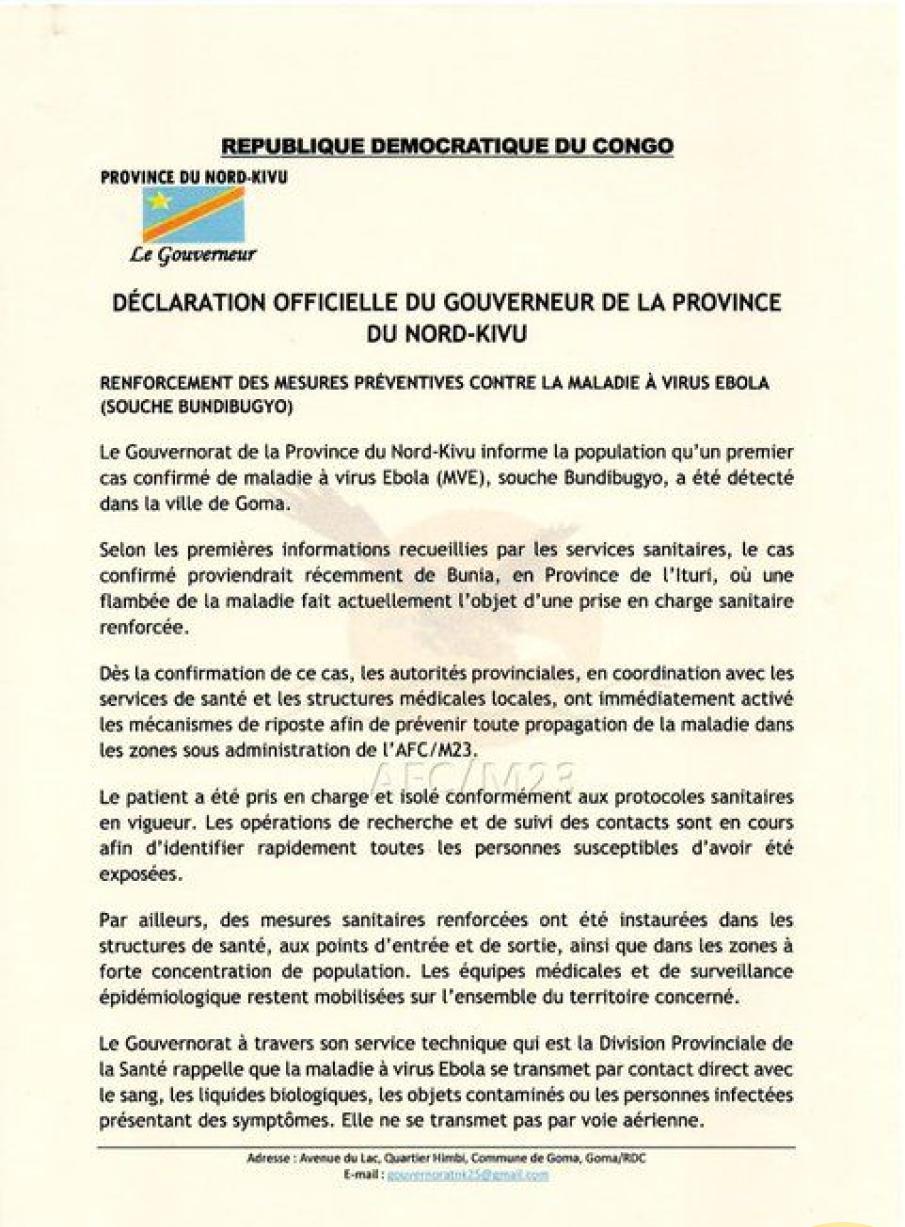
The March 23 Movement/Alliance Fleuve Congo (M23/AFC) rebels have issued strict public health guidelines after an Ebola case was detected in Goma City, one of the areas under their control in North Kivu Province in eastern Democratic Republic of Congo.
The development led to the closure of the Rubavu border crossing between Rwanda and DR Congo, which connects Goma and Gisenyi, with locals saying the border remained closed on Sunday morning.
According to Professor Jean-Jacques Muyembe, Director General of the National Institute for Biomedical Research, an Ebola virus disease case linked to the ongoing outbreak was identified in Goma on Saturday evening. Reports indicate that the wife of a man who died of Ebola in Bunia later travelled to Goma after her husband’s death.
On Sunday, Erasto Bahati Musanga, the M23/AFC-appointed governor of Goma, released a statement confirming the detection of the Ebola case in the city. Bahati says provincial authorities, working in coordination with health services and local medical structures, immediately activated emergency response mechanisms to prevent the spread of the disease in areas under M23/AFC administration.
According to Bahati the patient had been isolated and placed under medical care in accordance with established health protocols, while contact tracing and monitoring operations were ongoing to identify all individuals who may have been exposed. Bahati also says reinforced health measures had been introduced in health facilities, at entry and exit points, and in densely populated areas.
He noted that medical and epidemiological surveillance teams remained deployed across the affected territory. He urges residents to strictly avoid physical contact with people showing suspicious symptoms, wash hands regularly with clean water and soap, avoid contact with bodily fluids, immediately report suspected cases to health authorities or nearby health facilities, and follow instructions issued by medical teams and local authorities.
Bahati also calls on the public to remain calm, avoid spreading rumours, and continue with normal activities while strictly observing prevention and hygiene guidelines. He instructs local leaders to actively support surveillance and response measures in close collaboration with health teams.
On May 15, 2026, the Africa Centres for Disease Control and Prevention (Africa CDC) declared an Ebola outbreak in the gold-mining towns of Mongwalu and Rwampara in Ituri Province after about 246 cases and 80 deaths were reported. Ugandan health authorities on Friday also confirmed an imported Ebola case from DR Congo in Bundibugyo District. Officials said a 59-year-old man who died on Thursday had tested positive for the virus.
Tedros Adhanom Ghebreyesus, Director-General of the World Health Organization (WHO), said that after consultations with DR Congo and Uganda, where the Bundibugyo strain of Ebola is currently circulating, he had determined that the outbreak constitutes a Public Health Emergency of International Concern (PHEIC)Common
Ebola symptoms include sudden fever, severe headaches, muscle pain, extreme fatigue, vomiting, diarrhoea, general body weakness, and unexplained bleeding. URN