



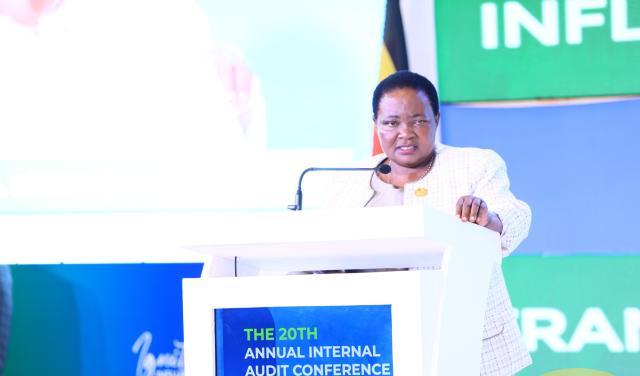
Prime Minister Robina Nabbanja has challenged internal auditors to take a more decisive role in fighting corruption. She warned that failure to act continues to cost the country billions of shillings in lost public funds.
She was addressing the Institute of Internal Auditors at its 20th Annual Internal Audit Conference alongside the 17th Board and Audit Committee Workshop, events aimed at strengthening governance, accountability, and leadership across institutions. The workshop that opened at t Speke Resort Convention Centre in Munyonyo under the theme “Ignite. Influence. Transform.”
It attracted more than 800 participants, including auditors, risk managers, regulators, board members, and industry leaders. The conference is taking place against a backdrop of growing concern about the effectiveness of internal auditors in curbing corruption, despite their presence across government institutions.
IIA Uganda President Ruth Doreen Mutebe earlier said the event is intended to prompt professionals to rethink their role in an increasingly complex and data-driven environment. “Anybody with an ambition, whether an individual, business, or country, needs an internal auditor to help them achieve it faster and with fewer hurdles,” she said.
Mutebe emphasized that internal auditors are critical in identifying risks early, strengthening governance systems, and guiding decision-making, but clarified that their role is advisory rather than enforcement. “Audit is not about penalizing individuals; it is about building systems that work for society and the country,” she noted.
Questions persist over whether auditors are doing enough to prevent misuse of public resources. Maurice Taremwa, President of the ISACA Uganda Chapter, argued that auditing should go beyond identifying problems to addressing root causes and preventing recurrence.
“The true value of auditing is not just in pointing out what went wrong, but in the recommendations that help prevent it from happening again,” he said, adding that many audit recommendations are never implemented.
He noted that implementation often depends on top decision-makers, who may choose to ignore or delay action. Annet Musiime, Assistant Commissioner for Internal Audit at the Ministry of Finance, in an interview last week, defended auditors, saying they often provide early warnings that are ignored.
“In most instances, auditors come early enough, but those informed may act late,” she said, attributing governance failures to weak accountability among managers. said Nabbanja.She describes auditors as the “goalkeepers” of public funds who must stop corruption before it happens.“I am not an auditor, but I know all the tricks,” she said.
“When it comes to money, you are the goalkeepers. But some of you allow the ball to pass even when it is coming straight at you.” She called on auditors to embrace patriotism, one of the core principles of the National Resistance Movement, and resist any attempts to compromise their integrity.
“Once you love your country, nobody can influence you to do anything wrong against your fellow Ugandans,” she said. Nabanja questioned why Uganda remains poor despite its natural resources, pointing to corruption and weak oversight as key obstacles to development. She singled out the Parish Development Model (PDM) as one of the programmes being undermined by corruption at the grassroots.
She expressed concern that some local officials and parish chiefs were extorting beneficiaries, demanding bribes of up to 300,000 shillings. “That money is meant to uplift the poor, but some of our people are stealing it. And you, the auditors, are there. Why don’t you move to the field and verify?” she asked.
She urged auditors to go beyond office-based work and physically inspect projects and communities to ensure accountability. The Prime Minister emphasized the need for auditors to shift from traditional roles of checking vouchers and paperwork to becoming strategic partners in national development.
In these days, we are digitalised. Do you check online, or are you still stuck on vouchers?” she asked. She called for a focus on high-risk areas, use of data to inform decisions, and proactive advisory services to strengthen governance across ministries, departments, and agencies.
Nabbanja also highlighted the issue of inflated project costs, citing a bridge in her home area that was initially estimated at between 3.6 billion and 16 billion shillings but was eventually constructed through community mobilisation at about 420 million. “This is how we lose money through fraud,” she said. “Are we patriotic?” Her example underscored broader concerns about inefficiency and weak oversight in public expenditure.
Nabanja said existing frameworks, such as the Public Finance Management Act of 2015, which established audit committees and strengthened internal audit functions, urged auditors to fully utilise them. She also called for stronger collaboration with oversight institutions, including Parliament, the Auditor General, and the Inspectorate of Government.
“You are the eyes and ears of government,” she said.“You must ensure systems are strong, transparent, and accountable.” The Prime Minister urged auditors to act with integrity and independence, even in the face of pressure.
“I know when you are independent, they will fight you. But when you have done the right thing, be proud,” she said. She warned that indecision enables corruption, insisting that auditors must take firm action when irregularities are identified.
“An auditor who does not make decisions should not be an auditor,” she added. Uganda has about 1,000 registered internal auditors under the IIA, a number considered too small given the growing complexity of institutions.
It has been noted that many organisations operate with limited audit teams, constraining effective oversight. The conference has provided a platform for professional development, networking, and knowledge-sharing, particularly in digital transformation and strategic leadership.
Doreen Mutebe encouraged professionals to leverage the opportunity to strengthen governance practices and build partnerships.“This is about improving skills, building connections, and ultimately making the world a better place through better governance,” she said.
Internal auditors have stated that while they identify faults, the failure by implementers to act on their recommendations remains a major bottleneck in the fight against corruption in Uganda. URN