



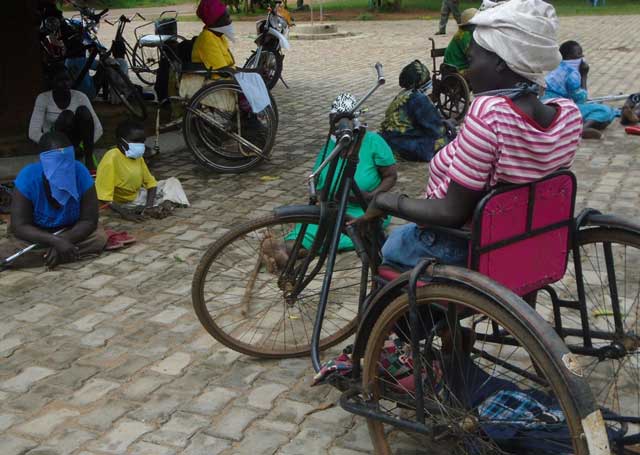
Persons with Disabilities (PWDs) in Nebbi District have appealed to the government to introduce direct education scholarships to support their learning and improve their livelihoods.
They say direct scholarships, particularly for Technical and Vocational Education and Training (TVET) institutions and other learning centres, would allow beneficiaries to choose courses that suit their abilities while helping them overcome economic barriers.
The appeal was made in Nebbi Town during the disbursement of the National Special Grant for PWDs, under which groups of five are set to receive Shs5 million to support income-generating activities.
Isaac Fred Wathum, a PWD in Nebbi, said scholarship opportunities often bypass people with disabilities and instead benefit individuals without disabilities.
He noted that PWDs are allocated minimal funding in district budgets, a situation he said continues to frustrate their activities, particularly in rural areas.
“In education scholarship programmes, PWDs are sidelined, while the benefits go to relatives of leaders who are not even registered as PWDs,” Wathum said.
Edwin Tumusiime, a Monitoring and Evaluation Expert at the Ministry of Gender, Labour and Social Development, acknowledged that inadequate funding remains the biggest challenge facing PWDs, given the high demand for support.
He said the national prevalence of disability stands at 13.6 percent, according to the Uganda Bureau of Statistics (UBOS).
Tumusiime explained that under the National Special Grant programme, more than 65,000 PWDs have so far benefited, with many reporting improved livelihoods, including the ability to pay school fees and meet medical expenses.
He added that the programme provides up to Shs30 million per group of six members—equivalent to Shs5 million per individual—and an additional Shs10 million for home-based care to reduce financial inequality among PWDs.
Meanwhile, Foska Oyungrwoth, a mother living with a disability and caring for five children, said PWDs face multiple challenges beyond education, including limited access to clean water in rural areas. She expressed optimism that the special grants would help improve livelihoods but cautioned that poverty levels require beneficiaries to use the funds carefully and responsibly.
“The level of education among PWDs is still very low, which is why we are calling on the government to provide direct scholarships,” Oyungrwoth said.
Harriet Mandhawun, the Community Development Officer for Nebbi Municipality, said inadequate funding in the community development department makes it difficult to collect accurate data on PWD beneficiaries in rural areas.
She noted that limited transport and resources hinder follow-up and monitoring of government-supported projects targeting people with disabilities.
“We couldn’t trace the number of PWDs children completing P.7 because some PWDs children are being denied access to education based on their geographical locations and poverty, Mandhawun said.
****URN***