

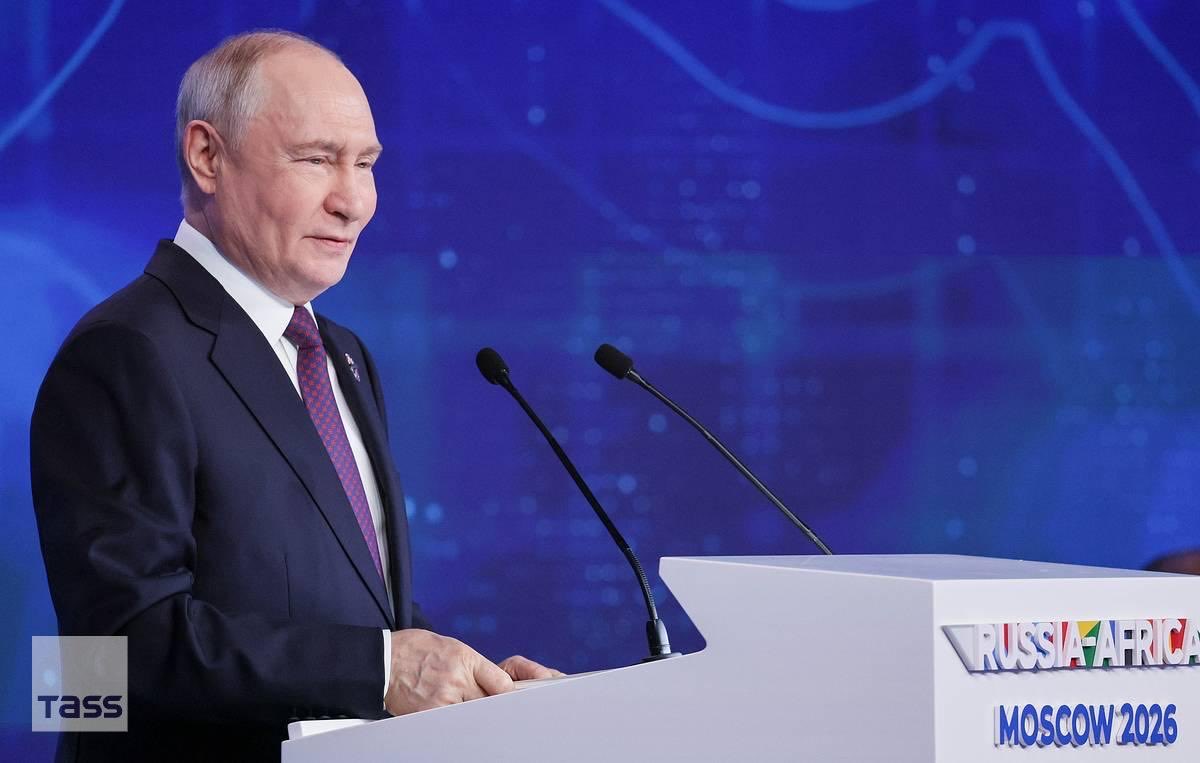
Russian President Vladimir Putin has declared that the emergence of a multipolar world order is an “objective and irreversible trend”, arguing that the era in which a small group of powerful countries determined the fate of entire continents is giving way to a global system in which developing nations, particularly African countries, are demanding a greater voice.
Putin made the remarks on Wednesday while opening the Russia-Africa Summit in Moscow, where he outlined Russia’s vision of a changing international order, championed the role of the BRICS bloc and called for stronger African representation in global governance, financial institutions and economic decision-making.
“We are witnesses to the fact that the multipolar world is becoming a reality, and this is an objective and irreversible trend,” Putin said in his opening address.
“An era when the fates of entire continents were determined by a narrow block of states are irrevocably leaving. A more just world is taking its place, in which the voices of all countries participating in international communication should be heard,” he added.
The Russian leader presented the shift as an opportunity for African countries to exercise greater sovereignty, strengthen their economies and pursue development priorities without undue external pressure.
He identified BRICS as one of the principal centres of the emerging global order, describing the grouping as a major platform for cooperation among countries across Africa, Eurasia, Latin America and the Middle East.
Putin said BRICS members were united by principles of equality, mutual respect, friendship and solidarity, arguing that these values offered an alternative framework for addressing international challenges and promoting economic development.
“Such approaches to partnership, a unifying agenda are highly demanded and give tangible, positive results,” he said.
To illustrate the growing economic weight of emerging economies, Putin claimed that BRICS countries had accounted for more than 40 per cent of global gross domestic product over the preceding five years, while the G7’s contribution was below 30 per cent. He predicted that the balance would continue shifting in favour of developing countries.
The Russian president singled out Africa as an increasingly important force in this transformation, citing its vast natural resources, demographic potential and strategic position along major transcontinental trade routes.
“Africa is all the more energetically proclaiming itself as one of the poles of global economy and politics,” Putin said, describing the continent as an increasingly influential participant in international affairs.
He added that Africa’s growing influence was being accompanied by a stronger determination among its countries to protect their interests and determine their own development priorities.
“A new awakening of the continent is taking place, its sovereignty is being strengthened, influence and authority on the world arena are growing,” he said.
Putin’s remarks placed African sovereignty at the centre of his argument for a multipolar international system, with the Russian leader portraying the continent as a partner whose resources, markets and political influence would be increasingly important to the global economy.
However, he warned that the transition was not taking place without resistance, accusing some Western countries of seeking to preserve their dominance through economic and political pressure.
“The formation of a multipolar world is, of course, not easy,” Putin said, arguing that countries accustomed to the existing international order were unwilling to accept the emergence of new centres of power.
He accused Western governments of employing tariffs, sanctions, economic pressure, blackmail and interference in the domestic affairs of other states to maintain their influence.
“Active attempts are being recorded by Western countries to drive Africans back into the debt pit,” Putin said.
He presented Russia as a partner in efforts to ease Africa’s financial burden, saying Moscow was participating in initiatives intended to reduce debt pressures and support national economic development projects.
“In general, we have joint programs for the use of debt funds to finance national economic growth projects,” he said, without providing details of the programmes during the address.
Putin also called for a stronger African role in international financial decision-making, particularly within the International Monetary Fund and the World Bank. He said Russia was contributing to efforts to strengthen the continent’s representation in multilateral development institutions.
The comments come amid continuing debates over Africa’s access to affordable financing, the terms of external borrowing and the influence of international financial institutions on national economic policies. Putin’s remarks framed the issue as part of a wider question of whether developing countries have sufficient influence over the institutions shaping the global economy.
Beyond finance and governance, the Russian president highlighted technological sovereignty as another critical area for cooperation, warning that advances in artificial intelligence, digital platforms and autonomous systems were making control over digital infrastructure increasingly important.
He said countries needed the capacity to protect their data, secure digital networks and develop technological systems that support economic activity, public administration, healthcare, education and social services.
“Technological sovereignty and jurisdiction are critically important in cybersecurity, data storage and processing, network and cloud infrastructure, platform solutions and artificial intelligence models,” Putin said.
He described these capabilities as essential to the functioning of modern economies and the protection of national interests, adding that Russia had made technological independence a strategic priority.
Putin said his country had developed capabilities in generative artificial intelligence, including what he described as a complete chain of large generative models, and noted that Russia had two large language models.
The focus on technology adds another dimension to Moscow’s efforts to deepen engagement with African countries, where governments are seeking investment, digital infrastructure, technical skills and improved access to emerging technologies.
The two-day Russia-Africa Summit, taking place in Moscow on October 28 and 29, brings together Russian and African representatives to discuss political relations, trade, investment, energy, security, technology and humanitarian cooperation.
Putin’s opening address sought to position Russia as a partner in Africa’s pursuit of economic growth, technological capacity and greater influence in international institutions, while linking those ambitions to Moscow’s broader call for a redistribution of global power.
The summit offers an opportunity for African governments to pursue investment, expand markets and explore partnerships in sectors ranging from energy and manufacturing to digital technology and education.
The practical impact of such engagements will depend on the agreements reached, the resources committed and the extent to which announced initiatives translate into measurable economic benefits for African countries.