

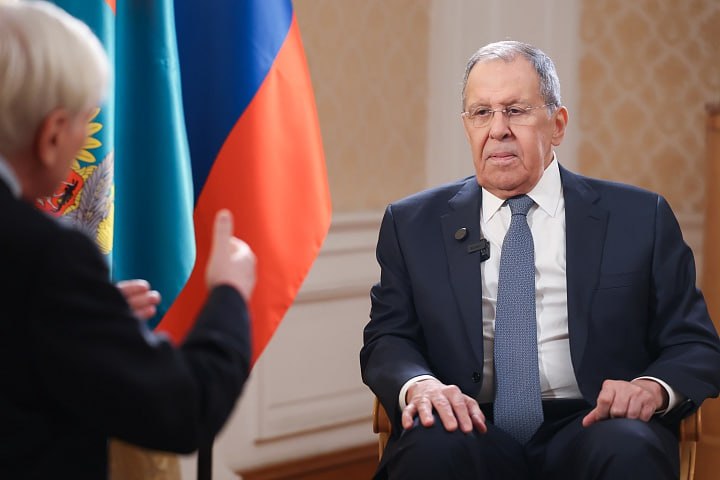
Russia’s Foreign Minister Sergey Lavrov has issued a stark warning about the state of global affairs, saying the world is drifting toward a system where power overrides international law, while defending Moscow’s diplomatic approach as grounded in pragmatism, history, and national interest.
Speaking in an interview marking the anniversary of the Institute of World Economy and International Relations, Lavrov said analytical institutions play a vital role in shaping policy, calling their input “extremely valuable” in navigating complex international crises.
Lavrov noted that Russian diplomacy relies heavily on long standing cooperation with research bodies, which help develop strategic doctrines and provide deeper analysis beyond day to day diplomatic pressures.
He credited figures such as Yevgeny Primakov for introducing structured analytical methods that continue to guide foreign policy thinking. While diplomats deal with immediate developments, he said, experts offer “calm analysis” that strengthens decision making.
Addressing global tensions, Lavrov argued that the international system is entering a dangerous phase. “We are moving toward a reality where might is right, where force is treated as truth,” he said, warning that no single country can manage the current instability.
He accused the United States of sidelining international law and acting purely in its own interest, claiming Washington pursues dominance through political pressure and control of global resources.
The Russian minister also criticised the European Union, accusing it of dishonesty over past agreements on Ukraine and pursuing what he described as a neocolonial agenda. Referring to the Minsk Agreements, Lavrov said Western leaders later admitted they had no intention of implementing them, calling it a strategy to buy time for arming Ukraine. “History will ultimately hold them accountable,” he said.
On the Ukraine conflict, Lavrov reiterated that any settlement must protect Russia’s security interests and the rights of Russian speaking populations.
He argued that earlier diplomatic efforts, including proposals for federalisation in 2014, could have prevented escalation but were abandoned. “Diplomacy is the art of the possible,” he said, adding that compromises are inevitable but must not undermine core national interests.
Turning to the Middle East, Lavrov warned that unresolved issues such as Palestinian statehood remain a source of instability. He said ignoring longstanding grievances would only delay future conflict. “This injustice is widely felt… it will explode anyway,” he noted, pointing to unimplemented UN resolutions on a two state solution. He added that dealing with Iran requires an understanding of its history and national identity.
Lavrov also highlighted the importance of personal relationships in diplomacy, citing his past cooperation with former US Secretary of State John Kerry. He pointed to joint efforts on Syria’s chemical weapons and early Ukraine talks as examples where dialogue produced results, though he acknowledged that even formal agreements were not always honoured.
Lavrov said history may move in cycles but warned that current developments are serious and consequential. He argued that the world is shifting away from structured systems established after events like the Yalta Conference, toward a more unpredictable order driven by raw power.
He stressed the importance of strength and self reliance in Russia’s foreign policy. Echoing President Vladimir Putin, he said national resilience, technological advancement, and military capability will define the country’s position in the world.
“God helps those who help themselves,” Lavrov said, describing it as a guiding principle in an increasingly uncertain global landscape.