



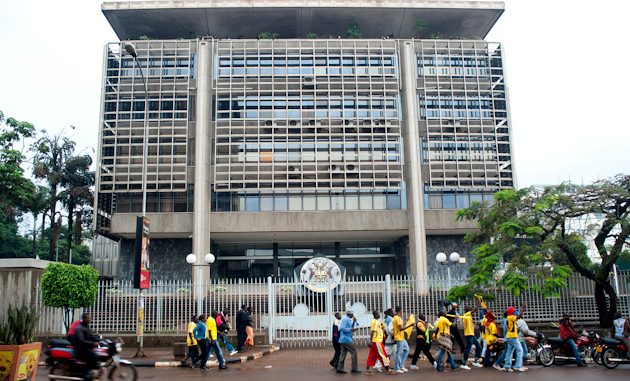
Uganda’s economic future is poised between opportunity and caution, according to top officials from the Bank of Uganda and the National Planning Authority (NPA).
In a wide-ranging discussion this week, Professor Augustus Nuwagaba, Deputy Governor of the Bank of Uganda, and Dr. Muwawala, Executive Director of the NPA, and Francis Kamulegeya, formerly of Price Waterhouse coopers-PwC highlighted strategies to leverage natural resources, stabilize the economy, and maximize the benefits of Uganda’s National Development Plan (NDP) 2040.
Professor Nuwagaba emphasized the importance of macroeconomic stability as the foundation for private sector growth.
“The economy is likely to remain extremely stable, so you can conduct your economic activity and expect sufficient returns,” he said, noting that the central bank had maintained its benchmark rate at 9.75% earlier this week.
On Uganda’s natural resources, the Deputy Governor urged careful reporting and management of gold, which has become the country’s largest export commodity.
“Export performance shows gold is our largest commodity, approximately $6.4 billion, followed by coffee at $2.4 billion,” Professor Nuwagaba explained.
“The Bank of Uganda is ready to purchase gold. Pre-qualified companies can sell one kilogram or more, which supports foreign currency inflows and stabilizes the shilling.” He cautioned journalists and investors alike to handle gold information carefully.
“Gold is sensitive. Even if you’re not selling it directly, its contribution to foreign exchange benefits all sectors,” he said. Speaking about oil and the economy, Professor Nuwagaba stressed that it should act as an enabler, not a solution.
“Oil revenue will increase aggregate demand and create opportunities in transport, logistics, and services. But the economy must not become oil-dependent. We must save and manage revenues carefully in the sovereign wealth fund,” he said.
“This is the mistake in Nigeria, in Angola, Equatorial Guinea, with the exception of only one country, which is Norway,” He said.
“So, when we get this money, let’s invest it well. Particularly in economics or econometrics, there is a term we use called resource movement effects. Resources movement effect means that when you get something, in this case, when you get oil, then those who have been involved in Agriculture think that they should stop agriculture.” He explained.
Professor Nuwagaba emphasizes that oil is transformative, but it’s not a silver bullet. Uganda must focus on savings, fiscal discipline, and diversification. He revealed that the Central Bank has already started creating a model that includes oil and gas as part of the economy.
“So, what we are modeling for us in the Bank, we are ensuring that we also bring oil into our models, we are bringing climate changes into our models to give us that projection. When Oil comes, what is going to be our balance of trade?”
Dr. Joseph Muvawala echoed the importance of strategic planning, highlighting Uganda’s broader mineral sector.
“Minerals such as iron, steel, gold, tin, and development minerals, if well managed, can outperform oil and gas in the long term. The key is to plan strategically and align business with government priorities,” he said. Still on the cautionary note, Nuwagaba said he would not encourage the government to go on a spending spree based on oil and gas revenue.
“Let’s first solve that current account deficit, and we solve our entire fiscal deficit, which is still very high at 7% of GDP, and also have this money saved in the sovereign wealth fund.” Francis Kamulegeya, a business leader, coffee farmer, and social entrepreneur in of the view that oil and gas are going to be a major enabler in the economy by creating catalytic effects within the economy. “So much that everybody is going to see benefits directly, indirectly, and induced. In fact, it is already happening,” he said.
Francis Kamulegeya, though not active in the oil and gas sector, was initially involved in shaping some of the policies driving the sector today.
“The first thing was to ensure that we have the right players in the market; secondly, we need to have the right regulatory environment. I was involved in the setup of Uganda National Oil Company in 2011.”
While there has been concern that Uganda has delayed to have oi and gas out of the ground, Kamulegeya says that the twenty years of waiting for oil were not wasted.
“Don’t tell us what we should not expect. Tell us what we should expect. Given how much we have prepared for this industry over the last twenty years.”
Joseph Muvawala detailed how Uganda’s NDP 2040 identifies key sectors for growth: agro-industrialization, tourism, mineral development, and science, technology, and innovation. “The challenge is moving from planning to execution,” he said, urging businesses to align with government priorities to benefit from incentives and support.
He also emphasized the role of value addition in agriculture. “Simple improvements in seed quality, wash stations, and traceability can increase revenue more efficiently than investing heavily in branded processing,” Muvawala said. All three agreed that execution is key. Professor Nuwagaba urged agro-industrialists to focus on farm-level production and technology adoption.
“Agro-industrialization is a process, not an event,” he said. Dr. Muwawala concluded with a call for strategic alignment and fiscal discipline: “Macroeconomic stability is essential. Incentivize value addition and local production. Policies are there to guide, but execution is key.”
He says Uganda is the most prepared country for oil production among the new players in the industry.
Uganda’s path to prosperity lies not only in discovering or exporting resources but in strategically managing them.
Oil, gold, and minerals can fuel growth, but only if accompanied by discipline, planning, and alignment with national priorities.
The coming years will test the country’s ability to convert natural wealth into sustainable development, creating opportunities for jobs, industrialization, and long-term economic resilience.
****URN****