



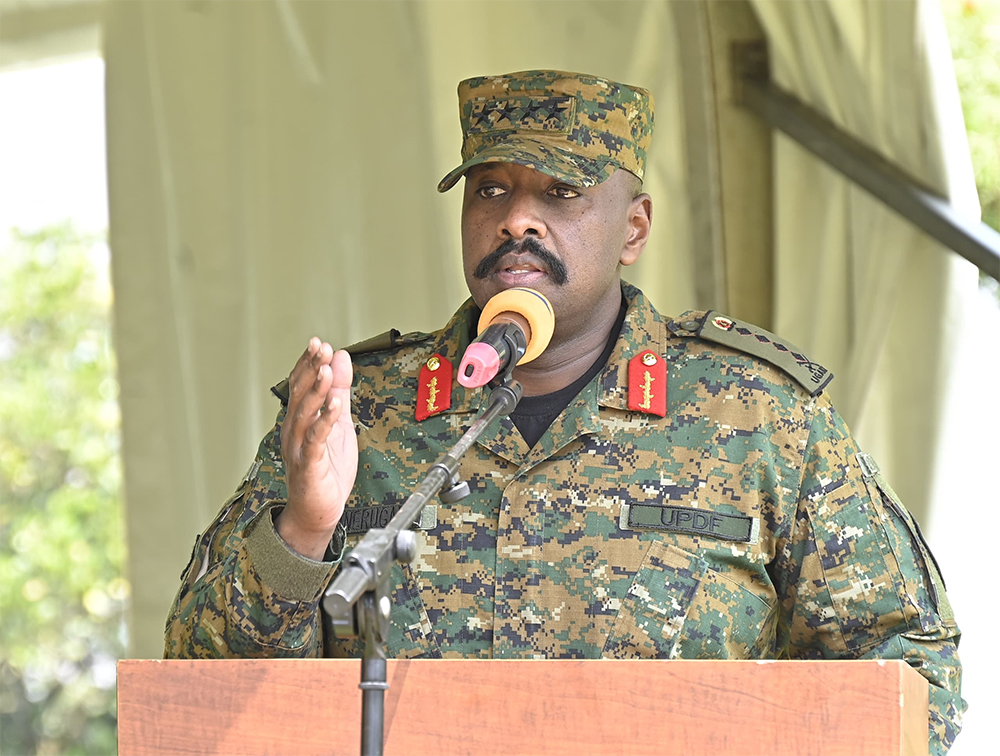
The Uganda People’s Defence Forces (UPDF) has expressed support for the Ethiopian National Defence Force (ENDF) amid a fresh eruption of fighting in northern Ethiopia, calling for an immediate cessation of hostilities and respect for the Pretoria Peace Agreement.
In a statement, UPDF Commander of the Defence Forces, General Muhoozi Kainerugaba, said: “UPDF expresses its support for our brothers in the Ethiopian National Defense Force in this latest eruption of fighting in northern Ethiopia. We call for an immediate cessation of the escalation and hostilities. We call for the respect and adherence to the Pretoria Peace Agreement. Ethiopia’s unity and sovereignty must be respected and protected by all.”
The statement comes after regional forces in northern Ethiopia’s Tigray region on Wednesday seized control of three airports and clashed with federal troops in multiple locations, raising fears of a major new offensive after months of escalating tensions.
The renewed fighting threatens to shatter the Pretoria Agreement, which formally ended the 2020-2022 war between the Tigray People’s Liberation Front (TPLF) and Ethiopia’s federal forces. The conflict killed hundreds of thousands of people and displaced millions.
The peace process has been under increasing strain, with both sides accusing each other of violating the agreement.
Tensions have also grown following internal divisions within the TPLF. A hardline faction reasserted control over the region and removed an interim administration.
More recently, the TPLF joined six other armed groups from across Ethiopia, including former adversaries from the previous war, in an alliance aimed at overthrowing Prime Minister Abiy Ahmed’s government.
It remains unclear how many members of the alliance participated in Wednesday’s clashes. Ethiopia, however, has several heavily armed regional forces capable of mobilising significant numbers of fighters.
The Ethiopian government has accused Eritrea of financially supporting members of the alliance. Asmara has denied the allegations.
Eritrea’s role
Attention is now turning to Eritrea, whose relationship with Ethiopia has deteriorated significantly since the two countries restored diplomatic ties under Abiy.
Abiy won the 2019 Nobel Peace Prize after ending two decades of hostility between Ethiopia and Eritrea. When war erupted in Tigray in 2020, Eritrean forces supported Ethiopia’s federal army.
Eritrea was not a party to the Pretoria peace agreement, despite its involvement in the conflict, and relations with Addis Ababa have since deteriorated.
Access to the Red Sea remains another major source of tension
Ethiopia has been landlocked since Eritrea’s independence in 1993 and has repeatedly argued that access to the Red Sea, particularly the port of Assab, is important to its long-term economic and security interests.
Eritrea, however, has expressed fears that Ethiopia could seek to obtain access to Assab by force.
Earlier this month, the United States lifted sanctions on the Eritrean Defence Forces and other entities. The impact of the decision on the evolving situation remains unclear, but it has been viewed as part of wider US strategic calculations around Eritrea’s coastline and the Red Sea.
Wider regional risks
Diplomats warn that a renewed conflict in Tigray could have consequences far beyond Ethiopia.
The Horn of Africa is already facing a highly volatile security environment, with Sudan’s devastating civil war, instability in Somalia, tensions over the Nile and growing Middle East geopolitical rivalries affecting the region.
Ethiopia has been accused of supporting Sudan’s Rapid Support Forces (RSF), which is fighting Sudan’s army. Addis Ababa denies the allegations.
The allegations have been linked to Ethiopia’s close relationship with the United Arab Emirates, which has itself been accused by UN experts and others of supporting the RSF. The UAE has denied the accusations.
Eritrea, meanwhile, maintains closer relations with Sudan and has developed relatively close ties with Egypt, a long-standing rival of Ethiopia.
Egypt and Sudan have both raised concerns over Ethiopia’s Grand Ethiopian Renaissance Dam (GERD), which is built on the Blue Nile, arguing that its operation could threaten their vital water supplies.
A renewed Tigray conflict could therefore intersect with existing disputes involving Ethiopia, Eritrea, Sudan and Egypt, while the wider Horn of Africa remains exposed to geopolitical competition extending from the Red Sea and Middle East.
For Uganda, General Muhoozi’s call places emphasis on ending the escalation, preserving Ethiopia’s unity and sovereignty, and maintaining the Pretoria framework as the basis for resolving the dispute.