

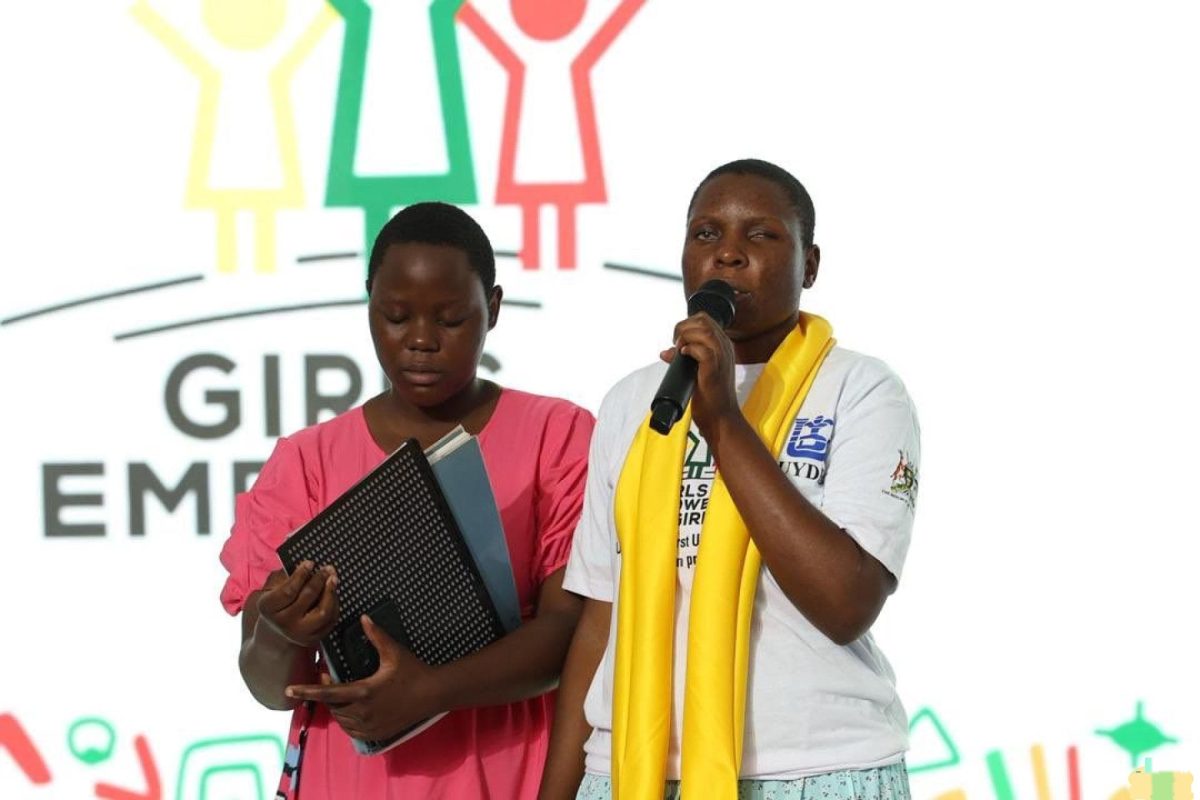
Joseline Namutebi, a visually impaired student, is among the 35,000 adolescent girls whose lives have been transformed by the Girls Empowering Girls (GEG) program, which recently concluded in Kampala.
Namutebi, a learner at St. Francis Secondary School for the Blind, shared her story during the program’s closing event. She recalled that after completing her Primary Seven examinations in 2020, her future seemed uncertain.
“I had no hope of continuing with my education and stayed at home for some time,” she said. Namutebi’s turning point came when she was identified by Kampala Capital City Authority(KCCA) through the local council system and enrolled in the GEG program, which supported her return to school.
Beyond covering her school fees, the program also provided financial assistance to her mother, helping sustain her education. Through mentorship and empowerment initiatives under the program, Namutebi says she has gained confidence and a renewed sense of purpose.
She expressed gratitude to UNICEF, the Belgian government, and the Kampala Capital City Authority (KCCA) for their support.Reflecting on her journey, Namutebi emphasized that disability should not define one’s potential.
“Inability is the worst disability, when a person with a disability can speak and develop skills, that is not inability, i am pleased with my disability because disability is not inability.” She said.She also called on communities to end stigma and neglect of persons with disabilities, urging greater inclusion and support.
Now in Senior Six, Namutebi is pursuing a combination of History, Literature, and Divinity, with ICT as a subsidiary subject. As the GEG program comes to a close, she has appealed for continued support to help her achieve her dream of a university education.
Namutebi’s stands as a testament to the impact of targeted educational programs in empowering vulnerable girls and shaping brighter futures.
The Girls Empowering Girls (GEG) programme is an urban social protection initiative implemented by the Kampala Capital City Authority (KCCA) in partnership with UNICEF and the Government of Belgium. The programme was launched in 2019 and has run for six years, empowering girls in Kampala.
Speaking at the high-level close-out meeting, Sheila Birungi Gandi, the programme coordinator and Director of Gender at KCCA, said that the initiative was designed to address the growing challenges faced by adolescent girls in urban settings, particularly in Kampala.
It focused on those most at risk, including out-of-school girls, teenage mothers, refugees, and girls living with disabilities.G
andi also noted that throughout its implementation, the initiative combined mentorship, cash transfers, and referral systems to improve access to education, healthcare, and social services.
A peer mentorship model provided structured guidance, while financial support helped keep girls in school or supported their reintegration into education.
The programme also facilitated access to critical services for vulnerable groups, including 101 teenage mothers who received healthcare and social support, 58 girls with disabilities, and 69 refugee adolescents.
Gandi emphasized that the programme leaves behind a strong foundation for future urban social protection efforts in Uganda.
Its evidence-based approach, data systems, and demonstrated impact are expected to inform similar initiatives going forward. Hajjat Sharifah Buzeki, the KCCA Executive Director, said that the GEG programme has restored dignity and hope.
She noted that hundreds of girls who had dropped out of school were re-enrolled in formal education. Dozens acquired vocational skills, and over 35 started their own small businesses.
Buzeki also revealed that the programme delivered financial support totaling to 2.6 billion shillings to vulnerable households, helping to stabilize families and enable girls to remain in school or training.
She further attributed the programme’s success to strong collaboration between government, development partners, and community stakeholders.
Key contributors included UNICEF, the Government of Belgium, the European Union, and local implementing organizations such as the Uganda Youth Development Link and Trailblazer Mentoring Foundation.
Buzeki requested partners to consider reopening or expanding the programme in Kampala, noting that many girls across Uganda continue to migrate to the capital in search of better opportunities.
She emphasized that empowering girls requires a holistic approach to education, skills development, social protection, and community support.
Buzeki pledged to integrate its lessons into ongoing city strategies, ensuring that girls and young women remain central to Kampala’s development agenda.
Robin Nandi, the Country Director of UNICEF, noted that despite a reduction in monetary poverty, multidimensional child poverty in Uganda remains high at 44 percent, highlighting the scale and complexity of the challenges facing children.
He added that by 2040, more than 20 million Ugandans will be living in urban areas, the majority of whom will be children and young people.
He said for many, especially adolescent girls, urban living does not translate into opportunities but instead brings heightened risks such as exposure to exploitation, limited access to services, and constrained life choices.
Nandi said that Kampala, as a metropolitan city, is not spared from these challenges. While education indicators are better, completion rates, especially at the secondary level, remain low. These challenges prompted the partnership between KCCA, UNICEF, and the Government of Belgium to launch the GEG project targeting adolescent girls in urban settings.
Through the project, education outcomes are said to have improved, with 95 percent of girls who completed Primary Leaving Examinations transitioning to secondary school.
Nandi revealed that the GEG project has now been extended to 11 more districts, including Lango, Acholi, West Nile, Tororo, and Bunyoro, targeting an additional 15,000 girls. This expansion is funded by additional support from the European Union, the Government of Iceland, and the Kingdom of the Netherlands.
Jesca Alupo, the Vice President of Uganda, stated that the GEG initiative has demonstrated that with the right investment and partnerships, the lives of vulnerable adolescent girls in urban communities can be transformed.
She emphasized that investing in girls is investing in national development, noting that when girls are educated, skilled, and protected, they contribute meaningfully to economic growth, social stability, and community transformation.
Alupo encouraged girls under the GEG programme to look up to successful women in government as role models and mentors in order to achieve their aspirations. URN