



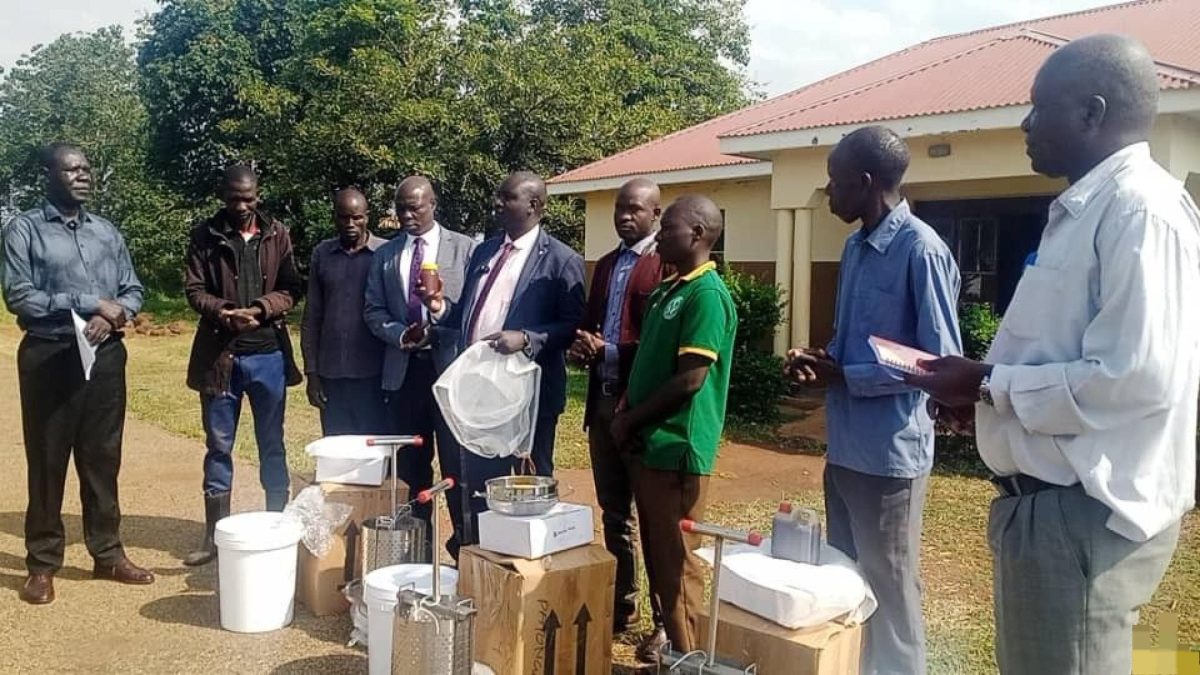
Agago District Local Government has begun distributing honey harvesting and processing equipment worth Shs 9 million to farmer groups in a bid to promote beekeeping as an alternative source of income amid declining crop production caused by recurring dry spells.
The equipment, which includes honey extractors, honey filters, honey testing machines, grading equipment and pollen processors, has been handed over to three apiary farmer groups: Ngyeragiri Apiary Farmers Group in Patongo Sub-county, Bedikwo Apiary Farmers Group in Ajali Sub-county and Yilamalo Apiary Farmers Group in Kuywee Sub-county.District
leaders said the initiative is intended to improve the quality of honey produced in Agago, increase household incomes through value addition and encourage environmental conservation by promoting beekeeping.
Agago District Entomology Officer Robert Kenny Okwera said the equipment will enable farmers to process and package honey instead of selling it in its raw form. “We planned to procure these machines to help our beekeepers process their honey. Instead of selling raw honey, they will add value, which enables them to earn better prices from the market,” Okwera said during the handover ceremony.
He said the district has been supporting beekeepers over several financial years and currently has 70 registered apiary farmer groups, while 43 groups are also receiving support under the Uganda Climate Transformation programme through market linkages and climate resilience initiatives. Geoffrey Otema, the Agago District Commercial Officer, said several farmer groups have already demonstrated the commercial potential of value-added honey.
He cited successful beekeepers who are supplying processed honey to supermarkets in Gulu, Kitgum and Lira following district support through trade exhibitions and market promotion. “When honey is sold unprocessed, it fetches about UGX 12,000 per kilogram, but after processing and packaging, the price starts from about UGX 25,000 per kilogram, depending on the quality,” Otema said.
He noted that Agago’s abundant shea nut trees contribute to the distinctive aroma and quality of locally produced honey, adding that the district had previously received international recognition for producing high-quality honey. Otema said the district plans to support farmers to obtain certification from the Uganda National Bureau of Standards (UNBS) and trademarks to enable them to access regional and international markets.”We don’t want to stop here.
We shall guide them and link them to UNBS so they obtain quality standards and certification that will allow them to compete in international markets,” he said. He said expanding beekeeping offers a reliable alternative livelihood after repeated crop failures caused by prolonged dry spells, enabling families to earn income for school fees and other household needs while reducing dependence on rain-fed agriculture.
Farmers in Agago harvest honey four times a year, with flowering shea nut trees contributing to higher-quality honey. According to district officials, individual groups harvest up to 750 kilograms of honey per season, with prices ranging from about UGX 9,000 for raw honey to UGX 25,000 per kilogram for processed honey, depending on the level of value addition.
Speaking on behalf of beneficiaries, Geoffrey Olara, a member of Star Bee Group in Kuywee Sub-county, commended the district for investing in beekeeping, saying the support would help position Agago as one of Uganda’s leading honey-producing districts. “We believe that within the next three years, Agago’s name will be among the best in bee farming.
We are working with the district entomologist to ensure the potential of beekeeping is fully realised,” Olara said.He noted that the group had invested in its own beekeeping equipment even before receiving government support, demonstrating its commitment to commercial honey production.
“We did not wait for support. We bought some of our own equipment because we believed we should first invest in ourselves. The district’s support has now strengthened our efforts,” he said.Olara revealed that honey produced in Agago had previously been exported to Italy, where it received positive quality assessments, crediting the district for supporting farmers to improve production.
“Our honey was sent to Italy, and we received a good report. We are grateful to the district for supporting us to produce quality honey,” he said. Despite the progress, Olara said farmers still face challenges that limit the competitiveness of their products, and technical challenges associated with honey produced from shea nut trees, which dominate Agago’s landscape.
He explained that shea honey naturally crystallises after some time, leading some consumers to mistakenly believe it has been adulterated with sugar. “Honey from shea nut trees crystallises naturally but melts again when exposed to sunlight. Many buyers do not know this and think the honey has been mixed with sugar,” he said.
He appealed to the district to support farmer groups with honey heaters to restore crystallised honey before packaging and marketing.”We need honey heaters because our honey often solidifies. We also ask the district to help us secure reliable markets because the quality of our honey is very good,” Olara said. URN