



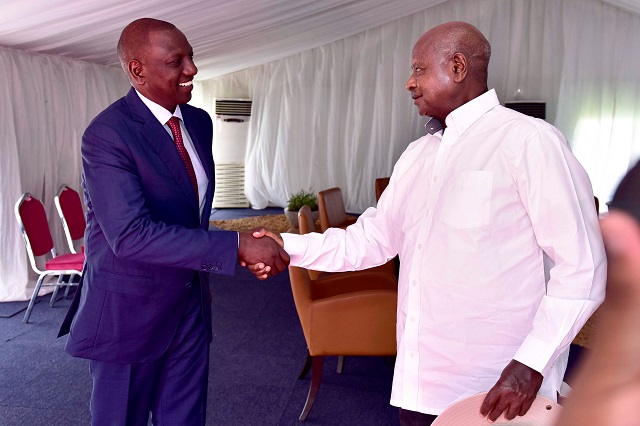
President Yoweri Museveni has hit back at sections of the Kenyan media over reports surrounding Uganda’s petroleum import arrangements, saying his remarks had been misrepresented while praising President William Ruto for helping Uganda secure a cheaper fuel supply deal.
In a birthday reflection released on Sunday, Museveni said some Kenyan media outlets had “put pilipili,” or red pepper, in comments he made while presiding over the groundbreaking of Uganda’s 320-million-litre petroleum storage facility at Buyala.
“In the meantime, some Kenya Media People decided, recently, to put pilipili (red pepper) in what I said recently when I was laying the Foundation stone of the 320 million litres oil storage centre at Buyala,” Museveni said.
Museveni said his main concern had been Uganda’s previous system of purchasing petroleum products through intermediaries in Kenya.
He said he first learnt about the arrangement around 2019 after being alerted by Kenyan politician Cyrus Jirongo, whom he identified as a Kenyan senator at the time.
“It was a Kenyan Senator called Jirongo who told me this around 2019. I immediately tasked the then Minister Irene Muloni to sort out that mess,” Museveni said.
According to Museveni, the matter remained unresolved until 2023 when Uganda entered into an arrangement with Vitol, a global energy trader and bulk supplier.
He said the agreement signed on August 18, 2023 reduced the premiums Uganda paid for petroleum products. For diesel, Museveni said the price fell from USD 118 to USD 83 per metric tonne. Petrol dropped from USD 97.50 to USD 61.50, while aviation fuel fell from USD 114.25 to USD 79.25 per metric tonne.
Museveni also directly praised Ruto for supporting the new arrangement, contradicting the impression that his earlier comments were directed at the Kenyan President.
“I want to thank H.E Ruto because he prevailed over some actors in Kenya who were trying to resist,” Museveni said.
He added that Kenya subsequently allowed Uganda to transport its petroleum products through the Kenya oil pipeline, with Uganda acquiring a 20.15 percent stake in the Kenya Pipeline Company.
“We are very happy with the Kenya Government of President Ruto on this matter,” Museveni said.
The clarification comes as Kenya’s government has been defending its own government-to-government fuel import arrangement following Museveni’s earlier comments about middlemen and petroleum costs.
Kenya’s Energy and Petroleum Cabinet Secretary Opiyo Wandayi said on Sunday that Kenyan oil marketing companies involved in the G-to-G arrangement were selected by international oil suppliers and were not simply imposed by the Kenyan government.
Wandayi said the Kenyan arrangement was introduced in 2023 amid a severe shortage of US dollars and concerns over the country’s ability to finance petroleum imports.
The government negotiated 180-day credit arrangements with major international suppliers, including Saudi Aramco Trading, ADNOC Global Trading and ENOC.
Kenya’s explanation followed renewed scrutiny after Museveni’s remarks, with the debate focusing on petroleum premiums, the role of intermediaries and the eventual cost of fuel to consumers in the two countries.
Museveni’s latest statement therefore seeks to distinguish his criticism of the previous procurement system from his position on the current Uganda-Kenya arrangement and his relationship with Ruto.